

Digital Growth Strategy: A Practical Guide for Business Owners
A digital growth strategy is a written plan for how your business will win more of the right customers online and keep them, using brand, content, paid and organic channels, your website, and data to steer all of it. It is not a list of channels. It is a set of choices: who you want, what you will say to them, where you will reach them, how you will measure it, and what you will change when the numbers move.
This guide is for owners and marketing leads who need a plan they can run, whether you do it in-house or with an agency. It covers the parts every plan needs, a 90-day sequence, the metrics worth watching, and the mistakes that stall most rollouts.
TL;DR
- A digital growth strategy connects four things: a clear audience and offer, a brand that makes people prefer you, channels that capture demand, and measurement that feeds back into the plan.
- Treat brand and demand as one system. Brand and demand marketing are increasingly working together rather than as separate budgets.
- Start with the customer lifecycle, not the channel. Acquisition without retention makes growth expensive.
- Run the plan in 90-day cycles: diagnose, build, test, then scale only what proves out.
- Feed what your sales team hears back into your data. Strategies stall when the data desk and the sales floor never talk.
Përmbajtja
- What a digital growth strategy actually is
- The five parts of a plan that holds up
- What the research says about data-driven growth
- A 90-day sequence you can follow
- Testing properly: incrementality over assumptions
- Metrics worth tracking, and what they tell you
- Mistakes that stall a digital growth strategy
- Doing it in-house, with a freelancer, or with an agency
- Our perspective: growth is a connected system
- Where Xpert Marketing can help
- Connecting awareness to performance campaigns
- Pyetje të Shpeshta
- Burimet
What a digital growth strategy actually is
Most definitions agree on the basics: expand reach, engage customers better, drive revenue. The useful question is what makes a strategy different from a marketing calendar.
A calendar says what you will publish and when. A strategy says why, for whom, and what result would make you change course. Gartner describes an effective digital marketing strategy as a dynamic system rather than a static blueprint, one that builds customer relationships and adapts to constant change. That framing matters, because a plan you write once and file away is out of date within a quarter.
It also helps to separate three terms people mix up:
- Digital marketing is the set of channels and tactics: search, social, email, paid media, content.
- Growth marketing is a way of working. Amazon Ads defines it as a strategy that emphasizes increasing revenue through acquisition and retention, using frequent testing to speed up optimization.
- Digital growth strategy is the overall plan that decides which of those tactics deserve budget, in what order, and how success is judged.
If you searched for a growth marketing strategy, you are asking about the same thing from the testing side. The plan below includes both.
The five parts of a plan that holds up
1. A sharp definition of who you are growing with
Before channels, write down your best-fit customer. For a B2B company that means industry, company size, the role that buys, the problem that triggers a purchase, and the objections you hear most. For a startup it may mean choosing one segment and ignoring the rest for a year.
A vague audience produces vague messaging, and vague messaging raises cost on every channel downstream. If you cannot describe your best customer in three sentences, fix that first.
2. A brand people prefer before they search
Paid search and social capture people who already want something. Brand decides whether they pick you. Marketing industry guidance increasingly argues for using brand awareness to make performance marketing cheaper: when more people already recognize you, the same ad spend tends to convert at a lower cost per lead. The AMA’s piece on brand and demand working together describes this shift, with brand covering awareness and equity and demand covering immediate action.
Practically, this means your visual identity, your tone, your website and your ads should look and sound like one company. If you want to explore how the two sides connect in a community setting, the marketing community resources are one place to read further.
3. Channels matched to the buying journey
Pick channels by the job they do, not by what is fashionable:
| Stage | What the customer is doing | Channels that usually fit |
|---|---|---|
| Awareness | Learning the problem exists | Content, social, PR, video, podcasts, events |
| Consideration | Comparing options | SEO, case studies, email, webinars, retargeting |
| Decision | Ready to choose | Paid search, landing pages, sales outreach, demos |
| Retention | Using the product or service | Email, customer content, CRM-triggered messages |
A small company does not need every row at full strength. It needs one strong channel per stage and a clean handoff between them. For a deeper look at coordinating channels, see our guide to B2B omnichannel marketing strategy.
4. A website and tech stack that convert
Traffic is only useful if the site turns it into conversations. That means fast pages, clear offers, landing pages built for specific campaigns, forms that work, and a CRM that records where each lead came from and what happened to it. Many growth plans fail here: money goes to ads while the page that receives the click is slow, generic or untracked.
5. Measurement that changes decisions
Every metric on your dashboard should link to a decision. If a number rises or falls and nobody would act differently, remove it. The Think with Google guide on measuring what matters makes the point that today’s customer journey has many touchpoints and that better measurement is the way to make the most of them.
What the research says about data-driven growth
McKinsey studied B2B companies that run data-driven sales-growth engines. It reports that those using them see above-market growth and EBITDA increases in the range of 15 to 25 percent. The same article says the leaders pull five reinforcing levers:
- Identify value across the whole customer lifecycle.
- Prioritize campaigns systematically, using what McKinsey calls a value cockpit.
- Activate omnichannel journeys with precision.
- Give sales teams personalized insights.
- Build a feedback loop so the system improves over time.
Treat these as a checklist for your own plan rather than a promise. Results vary by company, market and starting point. But the pattern is useful: the winners do not do one clever thing. They connect lifecycle thinking, prioritization, channels, sales enablement and learning.
The fifth lever is the one most teams skip. When frontline sales conversations never reach the people who set targeting, messaging and budgets, the strategy keeps optimizing for assumptions. A simple monthly meeting where sales shares the top objections, lost-deal reasons and questions prospects ask will improve your ads, landing pages and content faster than another analytics tool.
A 90-day sequence you can follow
Growth plans work best in short cycles. Here is a sequence that suits a business with an existing offer and some marketing already in place.
Days 1 to 30: diagnose and decide
- Audit what you have: website performance, analytics setup, CRM data quality, current channels, brand consistency.
- Map the customer lifecycle and note where people drop off.
- Interview five to ten customers and your sales team. Ask why they chose you and what almost stopped them.
- Choose one primary goal, such as qualified leads per month, and two supporting goals.
- Fix tracking before you spend more. If you cannot tell which channel produced a lead, nothing else will be reliable.
Days 31 to 60: build the foundations and launch tests
- Tighten messaging and positioning based on the interviews.
- Build or fix the landing pages that your campaigns will point to.
- Launch two or three focused experiments, each with a hypothesis, a budget cap and a success threshold written in advance.
- Set up lead handoff rules: who follows up, how fast, and what gets recorded.
Days 61 to 90: read, cut and scale
- Review each experiment against its pre-set threshold. Stop what failed without debate.
- Put extra budget into what worked, in steps rather than all at once.
- Document what you learned, then write the next 90-day plan.
If LinkedIn and other social channels are part of your B2B mix, our 90-day B2B social media roadmap shows how to apply the same rhythm to a pipeline-focused social plan.
Testing properly: incrementality over assumptions
It is easy to credit a channel with sales it would have won anyway. Brand search is the classic example: people who already know you search your name, click your ad and get counted as a paid conversion.
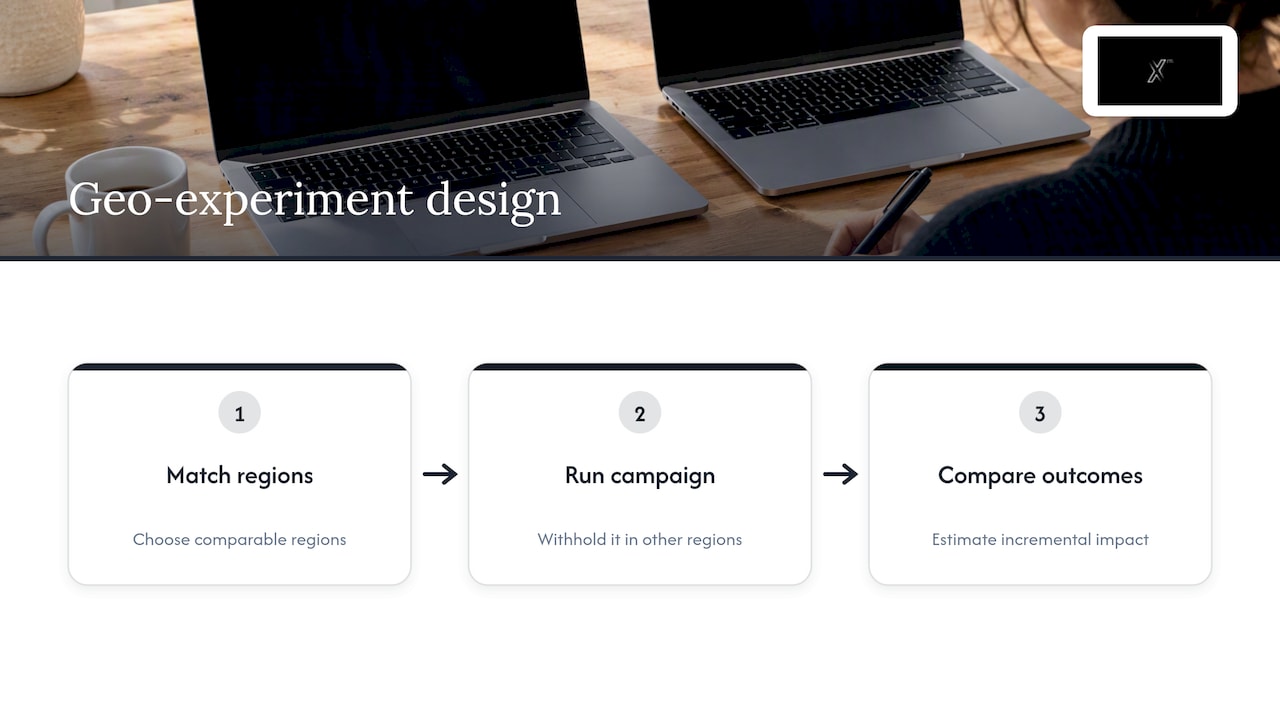
Geo-experiments are one way to check. Swarovski used them to test the incremental value of generic search campaigns, which tend to matter early in the customer journey. The idea is simple: run a campaign in some regions and not in comparable others, then compare outcomes. You do not need Swarovski’s budget to use the logic. A smaller business can pause a channel in one region or time window, or hold back a share of an audience, and see what actually changes.
When you cannot run a clean experiment, be honest about what the data can and cannot say. Report ranges and caveats instead of a single confident number.
Metrics worth tracking, and what they tell you
Keep the dashboard short. Most businesses can steer well with these:
| Metric | What it answers | Watch out for |
|---|---|---|
| Customer acquisition cost (CAC) | What does a new customer cost across all channels? | Excluding salaries, tools or agency fees makes it look better than it is |
| Cost per qualified lead | Are campaigns attracting the right people? | Cheap leads that sales never accepts |
| Lead-to-customer rate | Is the handoff to sales working? | Slow follow-up hides here |
| Customer lifetime value | How much is a customer worth over time? | Use real retention data, not hopes |
| Payback period | How long until a customer covers their acquisition cost? | Matters most if cash is tight |
| Share of branded search | Is awareness growing? | Seasonality and PR spikes |
The relationship between CAC and lifetime value tells you whether you can afford to scale. If CAC is climbing while conversion rates sag, more spend will not fix it. The problem is upstream: audience, message, offer or site.

Mistakes that stall a digital growth strategy
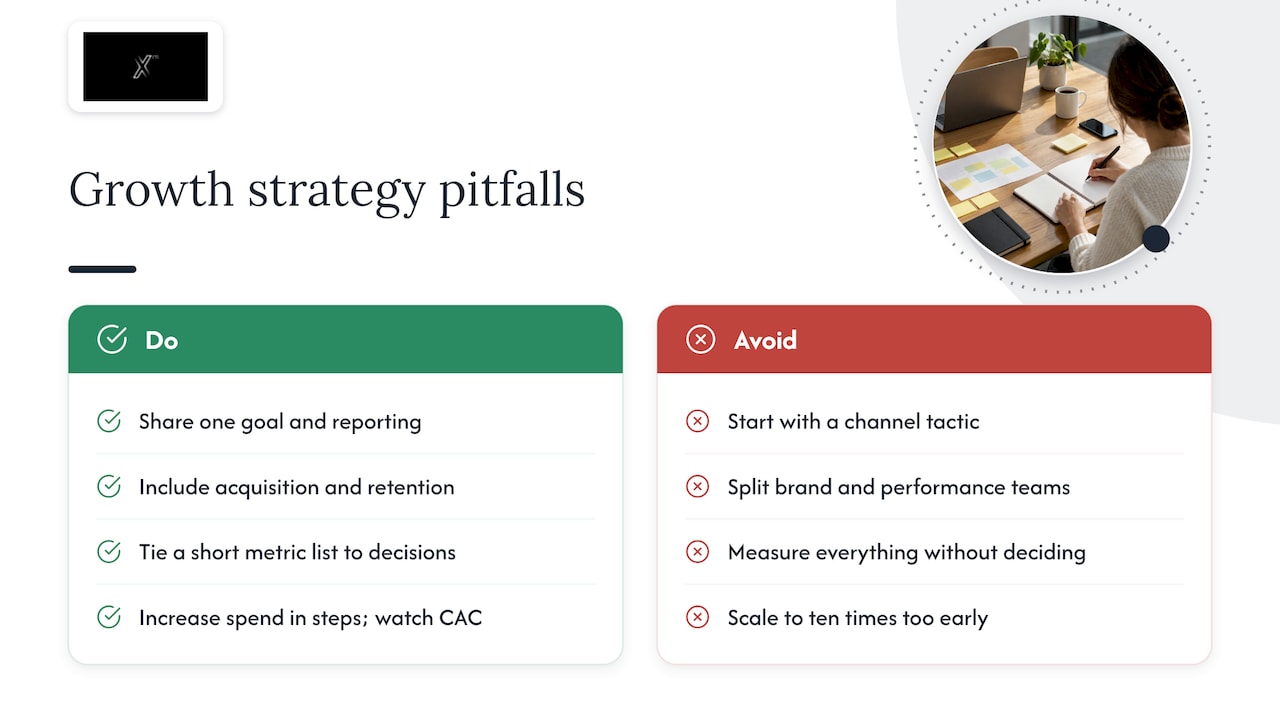
Starting with tactics. “We need TikTok” is a tactic. “We need to reach operations managers at mid-size logistics firms” is the start of a strategy.
Splitting brand and performance into rival teams. When the brand team and the performance team report separately and fight for budget, neither sees the full journey. One shared goal and shared reporting fixes most of this.
Ignoring retention. Growth marketing, as Amazon Ads frames it, covers both acquisition and retention. Existing customers are your cheapest source of referrals, upsells and case studies.
Measuring everything, deciding nothing. More dashboards do not create insight. A short list tied to decisions does.
Never closing the loop with sales. The strategy ages the day sales learns something marketing does not hear.
Scaling too early. A channel that works at a small budget may not hold up at ten times the spend. Increase in steps and watch CAC at each step.
Doing it in-house, with a freelancer, or with an agency
There is no single right answer. It depends on what you have and what you lack.
- In-house team: best when you have a marketing lead with authority, enough volume to keep specialists busy, and time to hire. Slowest to start.
- Freelancers or single-channel specialists: good for a defined task, such as a site rebuild or a video series. The risk is that nobody owns the whole picture.
- Full-service agency: useful when you need strategy, creative, media, web and analytics to work together and you want an external team that can act as your marketing department. The risk is choosing one that executes without a plan, so ask to see the strategy before the proposal.
Whichever route you take, insist on three things: a written goal, a measurement plan agreed before launch, and a regular review where results are discussed plainly.
Our perspective: growth is a connected system
At Xpert Marketing, we work as a full-service agency that combines strategy, creativity and execution, and we see the same pattern in the businesses that come to us. They rarely lack activity. They lack connection. The brand work lives in one folder, the ads in another, the website was built by someone else, and the numbers sit in a report nobody acts on.
So we start by treating marketing as a system, which is also how we explain it in Marketing 360 is a system, not just ads and social media. Research and analytics come first, then identity and messaging, then content, media and web, then measurement that feeds the next round of decisions. When it fits, we act as an external marketing department, so your team has one group accountable for the whole chain rather than five suppliers pointing at each other.
We also believe a plan should leave you stronger. That is why we pair execution with training in digital marketing, so your people can run more of it over time. If you are weighing a bigger program, our overview of how an agency builds brands that scale shows how we think about the brand side of growth.
— Xpert
Where Xpert Marketing can help
If you want a partner to build and run the plan, we cover the pieces described above: strategy and consulting, branding, content production, digital marketing, media planning and buying, web and tech, data and analytics, and training. Most engagements start with an audit and a strategy session, then move into a scoped project or an ongoing retainer. Pricing is not published, because it depends on scope, so get in touch through our site and tell us your goal.
If measurement is your weak point, start with our data and analytics service. If you already have a strategy and need channels managed, see digital marketing.
Connecting awareness to performance campaigns
Once your foundations are in place, the practical question is how to connect awareness with paid conversion. Three habits help:
- Share audiences. Build retargeting and lookalike audiences from the people your awareness content reaches, so paid campaigns start warm.
- Use the same message. The promise in the ad, the landing page headline and the sales call should match. Mismatch is one of the quietest conversion killers.
- Judge awareness on its own terms. Track reach, branded search and direct traffic over quarters, not days.
If you are new to paid channels, a primer such as performance marketing explained covers the vocabulary before you commit budget. Whatever you buy, verify traffic quality and tracking before you scale.
Pyetje të Shpeshta
What is a digital growth strategy?
It is a plan for using digital channels, your website, brand and data to win and keep more customers, with clear goals and a way to measure progress. It decides which activities deserve budget and in what order. It differs from a content calendar because it states the reasons and the results that would make you change direction.
What is the difference between a digital growth strategy and growth marketing?
Growth marketing is a method centered on frequent testing and on both acquisition and retention. A digital growth strategy is the wider plan that sets goals, audience, brand, channels and measurement. Growth marketing usually sits inside it as the way you run experiments and improve results.
How long does it take to see results?
It depends on your channels and sales cycle. Paid campaigns can show early signals within weeks, while SEO, brand and content usually take longer to build. That is why we suggest working in 90-day cycles with set thresholds, so you learn something concrete at the end of each one.
Do small businesses need a full strategy?
Yes, but a lean one. A single page covering your best customer, your main offer, the one or two channels you will focus on, and the two numbers you will watch is enough to begin. Add depth as results and budget grow.
When should I hire an agency?
Consider one when you need several disciplines working together, such as strategy, creative, web and media, and you do not have the in-house team to coordinate them. Ask for a written plan, agreed metrics and regular reviews before you sign.
Burimet
- Insights to impact: Creating and sustaining data-driven commercial growth, McKinsey
- Brand and Demand Marketing: Marketing’s Powerful New Duo, AMA
- Build a Digital Marketing Strategy That Delivers Results, Gartner
- What is growth marketing?, Amazon Ads
- Swarovski examined the relevance of generic search campaigns through geo-experiments, Think with Google
- Measure What Matters, Think with Google


