If you need faster, reliable marketing outcomes and lack the in-house capacity, hire an agency. Before you contact anyone, define the one business outcome you want, whether that is leads, qualified pipeline, or revenue, and set a realistic monthly budget range. Expect a 90-day onboarding and test period before results become measurable.
TL;DR:
- Choose a specialist for one defined gap; use an integrated agency when needs span three or more disciplines or you cannot coordinate vendors internally.
- First time agency buyers should prioritize strategy and proof, while businesses replacing an agency should emphasize the account team and communication.
- Percentage of ad spend fees reward higher budgets even when performance does not improve, so negotiate a fixed management fee tied to clear scope.
- Use a trial lasting 60 to 90 days with quick wins and test KPIs, and put account, tracking, creative ownership, and exit terms in writing.
Hiring an agency makes sense when a specific business goal outpaces what your team can execute alone. A product launch that needs paid media, SEO, and creative running at once, a sales team asking for more qualified leads than your in-house marketer can generate, or a brand that has outgrown its original identity are all situations where outside capacity and specialized skill close the gap faster than hiring and training internally.
The trade-off is real. An agency gives you speed and access to people who already know the channels, tools, and benchmarks for your category. What it costs you is a recurring fee and some integration work: briefing, access to your accounts, and a few weeks of ramp-up before the team understands your business the way an employee would.
Budget expectations matter here. Marketing budgets in 2025 held flat at about 7.7% of overall company revenue, consistent with the year before, according to the Gartner 2025 CMO Spend Survey. The implication for you: agencies that earn their fee today do so on clearly defined, measurable work, not on vague retainers for “marketing support.”
Before you start outreach, you should be able to say:
Matching your need to the right agency type saves months of mismatched expectations. Specialist agencies go deep on one discipline; integrated or full-service agencies coordinate several disciplines under one roof.
Hire a specialist when you have one well-defined gap, like a site rebuild or an SEO problem, and your other marketing functions are already working. Hire an integrated agency when your needs touch three or more disciplines, or when you do not have the internal capacity to manage several specialist vendors at once.
Once you know what type of partner you need, the harder question is picking the right one among several that look similar on paper. A simple weighted framework keeps that decision from coming down to who gave the best pitch deck.
Score each finalist on five criteria:
How you weight these five depend on your situation. If this is your first agency hire, weight strategy and proof most heavily: you have no track record with any vendor yet, so past performance and a credible plan matter more than personal rapport. If you are switching agencies after a bad experience, weight team and communication instead. Most failed agency relationships break down over who is doing the work and how often you hear from them, not over strategy quality.
A workable scoring method: rate each finalist 1 to 5 on each criterion, multiply by a weight (3 for high priority, 2 for medium, 1 for low), and total the scores. This turns a subjective “which pitch did I like” decision into something you can compare side-by-side on a single page, which matters when a decision involves more than one stakeholder.
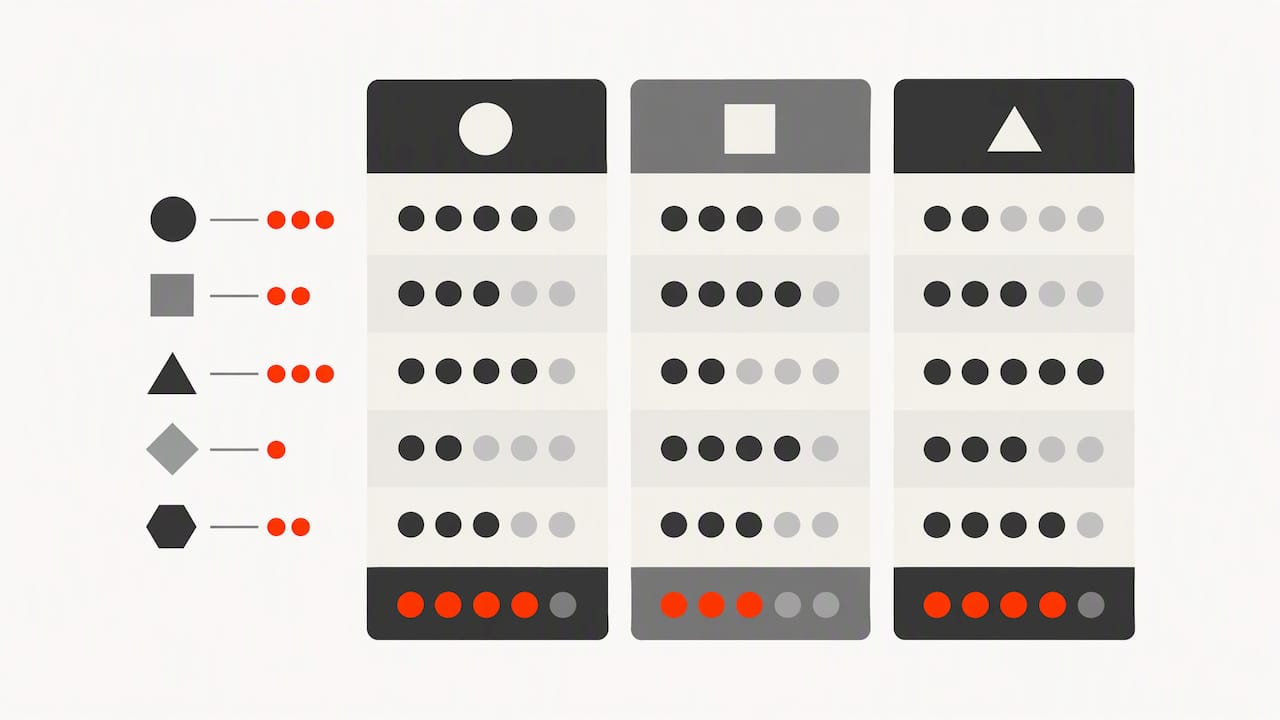
Compare finalists using the same written questions and the same scoring sheet, rather than judging each one in isolation right after their pitch. A platform like Agency Review Guide can help you benchmark finalists against a wider shortlist filtered by specialty and budget before you commit to a shortlist of your own.
Consiglio: Score agencies within 48 hours of each pitch, while details are fresh, and before the next pitch resets your impressions.
A short screening call filters out mismatched agencies before you invest real time. Start with five quick questions on your first call:
A thorough vetting process expands to 13 questions across the five categories from the scoring framework above: strategy and fit, proof and results, team and process, pricing and contracts, and communication and reporting, a structure recommended by Do Good Design’s agency vetting guide. That same guide suggests a 60 to 90 day trial window before committing to a longer term, with defined quick wins and test KPIs built into that trial so you are not waiting a full year to know whether the fit works.
Document every answer in the same format for every finalist: strategy fit in one column, proof in another, and so on. Comparing agencies side-by-side on identical written answers surfaces inconsistencies that a verbal pitch tends to smooth over, and it gives you something concrete to revisit if a decision gets contested internally.
Agency pricing comes in four common forms, and each shifts risk differently between you and the agency. Retainers are a fixed monthly fee for ongoing work, giving you predictable costs but requiring clear scope so the relationship does not quietly expand. One-off projects suit a defined deliverable like a website or a brand refresh, with a fixed price and end date. Hourly billing works for smaller or undefined scopes but makes monthly costs harder to predict. Percentage-of-spend fees, common in paid media, tie the agency’s fee to how much you spend on ads.
That last model deserves a caution. Percentage-of-spend pricing creates a structural conflict of interest, since the agency earns more by increasing your ad budget regardless of whether that spend performs better, a dynamic documented in this review of agency pricing models. A transparent fixed management fee aligns the agency’s incentive with your actual results instead of your spend level, and it is worth asking for directly during negotiation.
Four items to lock down in any agency contract:
A reasonable trial window before a longer commitment runs 60 to 90 days, according to agency vetting guidance from Do Good Design, giving both sides a defined period to validate quick wins and test KPIs before signing a longer term.
A credible agency can sketch a specific first 90 days for your business rather than a generic template. Expect it to look roughly like this:
During this period, your responsibility is fast access and feedback: approvals, brand guidelines, and answers to questions within a day or two. The agency’s responsibility is visible progress against the one core business metric you agreed on at the start, reviewed on a weekly call during onboarding and shifting to biweekly or monthly once the baseline is set.
We built our service mix, strategy and consulting, branding, creative content, digital marketing, media planning, web and tech, and Dati & Analisi, to match the exact gaps most business owners describe when they first call us: too many disconnected vendors, no clear measurement plan, or a brand that has not kept pace with growth.
When you work with us as a full-service partner, you should expect clear account management, a defined discovery and audit phase, and deliverables tied to the one outcome you set at the start, not a vague monthly report. Our full-service approach is built to replace the coordination work of managing several specialist vendors with a single accountable team.
Startups usually benefit most from agency speed and breadth: you get several disciplines running at once without hiring five specialists before you know which channels work. Scale-ups often shift toward consistency and cost control, which is where a hybrid model, a lean in-house team paired with an agency for specialized or overflow work, tends to perform best.
Time the hire to a specific inflection point, a launch, a funding round, a stalled growth number, rather than a calendar date, and revisit scope every two quarters as your needs change.
— Xpert
If you have a clear outcome and budget in mind but not the internal team to execute across channels, we built our agency to be that execution layer. A typical engagement starts with an audit of your current marketing, a roadmap tied to your priority outcome, and a proposal scoped to the budget you set before reaching out.
What that first conversation covers:
Explore our full range of services or get in touch to schedule an initial discovery call.
Costs vary widely by agency type, scope, and pricing model, from hourly rates for narrow projects to monthly retainers for ongoing full-service work. Our own service pricing is available on request based on the specific mix of services your engagement requires.
It is worth it when you have a defined outcome and a gap in speed or specialized skill that an internal team cannot close fast enough on its own. Marketing budgets held at about 7.7% of company revenue in 2025, which means the return has to be measurable to justify the spend.
Definitions of this rule vary across sources and it is not tied to a single authoritative framework, so treat any specific version with caution. Ask a prospective agency to explain which version they mean and how it applies to your specific goals before relying on it as a planning tool.
This is commonly described as a rough split of campaign success between audience targeting, the offer, and creative execution, though the exact framing varies by source. Use it as a general prioritization heuristic rather than a precise formula, and confirm with any agency how they apply it to your specific campaign.
Ciao! Raccontaci della tua attività e di cosa hai bisogno: ti risponderemo su WhatsApp.
Compila il modulo e il nostro team ti ricontatterà a breve.