

Lead Scoring Models: How to Choose and Build One
A lead scoring model ranks your leads by how likely they are to buy, so sales spends time on the right people first. The best model for most B2B teams is simple: one score for fit, one for engagement, clear thresholds, automatic decay and a quarterly check against closed deals. Predictive scoring comes later, once your data can support it.
This guide compares the main models, shows how to build one step by step, and covers the mistakes that make sales ignore a score.
TL;DR
- Score two things separately: fit (does this company and role match your ideal customer?) and engagement (what are they doing right now?). Combine them only for routing.
- Start with a rules-based model built from your closed-won deals. Move to predictive scoring only when you have enough data and the discipline to maintain it.
- Add negative scoring and score decay from day one, or old activity will keep cold leads looking hot.
- Treat the model as a hypothesis. Recalibrate it every quarter against real outcomes.
- Show sales why a lead scored the way it did. A score nobody can explain does not get used.
Indice
- What a lead scoring model actually does
- The main lead scoring models compared
- Which model fits your data
- How to build a lead scoring model, step by step
- Lead scoring best practices that keep a model alive
- Common mistakes to avoid
- Our perspective: scoring is a system, not a setting
- Need help turning scoring into pipeline?
- FAQ
- Fonti
What a lead scoring model actually does
Lead scoring assigns points to each contact or account based on who they are and what they do. The output is a priority order: who sales should call today, who should stay in nurture, and who should be left alone.
A good model does more than label leads. Academic research on lead scoring frames it as a way to measure lead quality and manage leads efficiently. In practice, its biggest benefit is often organizational: marketing and sales get a shared definition of a good lead, which shifts the conversation from how many leads arrived to how many are converting. A review of the lead scoring literature in Springer makes the same point about alignment between the two teams.
The same review reports that companies using lead scoring see qualified-lead conversion rise to 15 to 20% and up to a 70% gain in lead generation ROI compared with companies without formal scoring. Treat those as directional, not a promise: your result depends on your data, your sales cycle and how well the model is maintained.
The main lead scoring models compared
Most models you will see fall into four types. They are not mutually exclusive, and many teams run two of them together.
| Modello | How it works | Best for | Main risk |
|---|---|---|---|
| Single-score, rules-based | One point total from demographic and behavioral rules | Small teams starting out | Hides why a lead scored high |
| Two-axis (fit + engagement) | Separate fit and engagement scores, shown as a matrix | Most B2B teams | Needs a clear ideal customer profile |
| Account-based | Scores roll up across all contacts at a company | Long cycles, buying committees | Needs clean account data |
| Predictive (machine learning) | Algorithm learns patterns from past conversions | Large, clean CRM history | Black box, drift, maintenance |
Single-score, rules-based models
This is the classic approach: 10 points for a director title, 5 for an email click, 20 for a demo request. It is easy to set up in any CRM, and it is where most teams begin.
The weakness is that one number blends two different questions. A score of 75 could be an ideal prospect who has barely engaged, or a poor-fit contact who opens every email. GTMStack’s write-up on B2B scoring calls this the most critical structural failure, because sales cannot tell which one they are looking at.
Two-axis models: fit and engagement
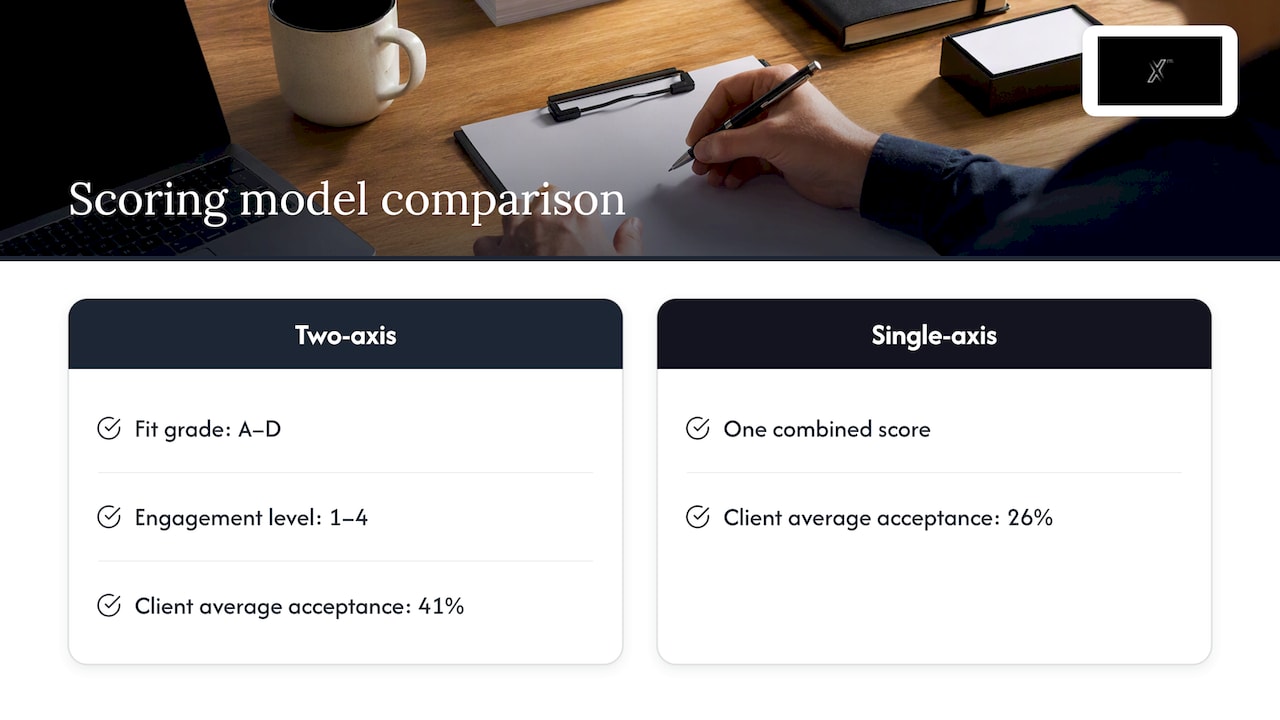
The fix is to keep the dimensions apart. Fit covers firmographics and role: industry, company size, revenue, job title, region. Engagement covers behavior: site visits, pricing page views, webinar attendance, email replies, demo requests.
A common way to display this is a matrix: fit graded A to D, engagement graded 1 to 4. An A1 lead is a perfect-fit company that is actively researching. A D1 is neither a fit nor interested. A lead scoring matrix like this gives a rep instant context. In GTMStack’s testing across its clients, two-axis models raised sales acceptance to an average of 41%, against 26% for single-axis models. That is one vendor’s client data, so use it as a signal, not a benchmark.
Un’ B2B scoring template from SoftwareInspect recommends the same structure: keep fit and intent visible as separate scores, use the combined total for routing, and show sales why each lead earned its score.
Account-based scoring
B2B deals rarely hinge on one person. If a VP of Finance reads your pricing page on Monday and an engineer downloads a guide on Wednesday, each contact alone may look lukewarm while the account is clearly in motion. Account-based models aggregate signals across contacts at the same company. They suit longer sales cycles and larger deal sizes, and they depend on reliable account matching in your CRM.
Predictive scoring
Predictive models use machine learning to find patterns in historical conversions. The research literature points to classification methods, decision trees and logistic regression as the most applied, with ensemble methods such as gradient boosting and random forests often favored for messy CRM data. A 2025 review of machine learning in CRM covers these techniques and their use in lead scoring.
Predictive scoring is not automatically better. It needs enough closed deals, clean data and someone who can monitor it. For teams weighing rules against algorithms, this overview of predictive and rules-based personalization approaches is a useful companion read on how AI-driven logic differs from fixed rules. Without explanations attached, predictive scores often face the same adoption problem as bad rules-based ones.
Which model fits your data
Use these questions to choose.
- How many closed-won deals do you have? Under a few dozen, a predictive model has little to learn from. Start with rules built from your best customers.
- Is your CRM data consistent? Missing job titles, duplicate accounts and untracked sources break every model, but predictive ones fail silently.
- How long is your sales cycle? Long cycles with several stakeholders point toward account-based scoring.
- Who will maintain it? A model needs an owner. If nobody will review it quarterly, choose the simplest version.
For a deeper walk through matching a model to your data, see our guide to lead scoring models for B2B and which one fits your data.

How to build a lead scoring model, step by step
1. Agree on definitions with sales
Before assigning a single point, marketing and sales need to agree in writing on what a Marketing Qualified Lead (MQL) and a Sales Qualified Lead (SQL) are. An MQL has shown enough fit and interest to deserve sales attention. An SQL has been accepted by sales after a real conversation. This definition is the backbone of your MQL to SQL process, and it should be reviewed on a regular schedule. If you want a framework for the qualification conversation itself, this guide to lead qualification frameworks, CRM and AI walks through common approaches.
2. Define your ideal customer from closed-won data
Pull your best customers from the last 12 to 24 months. Look at industry, size, role of the buyer, source and the pages or content they touched before buying. Do not score what you assume matters. Experts consistently advise calibrating against actual closed-won data, because assumptions erode credibility with reps quickly.
3. Build the fit score
Fit points should reflect how closely a lead matches that profile. A simple structure:
- Industry in your core segments: highest weight
- Company size in your target range: high weight
- Decision-maker or influencer title: high weight
- Region you serve: medium weight
- Technology or budget indicators you can verify: medium weight
4. Build the engagement score
Weight behavior by how close it is to a purchase decision. A demo request or pricing page visit signals far more than a blog read. Behavioral lead scoring works best when it reflects intent, not just activity: a contact who downloads five pieces of content may be a researcher with no budget, while one pricing visit from a senior buyer can matter more.
| Signal | Typical weight |
|---|---|
| Demo or contact request | Very high |
| Pricing or case study page visits | High |
| Webinar attendance | Medium |
| Multiple sessions in a week | Medium |
| Email opens | Low |
| Single blog visit | Low |
These weights are a starting hypothesis, not a standard. Your own conversion data should replace them.
5. Add negative scoring and decay
Subtract points for signals that lower the odds: personal email domains in a B2B context, competitor employees, unsubscribes, bounced emails, and a student or job-seeker profile. Then add decay. Models without it are effectively broken: a high score earned months ago keeps signaling a hot lead who has gone silent. SoftwareInspect describes high-maturity teams running daily automated decay through CRM-native automation or scheduled flows, so only current behavior influences priority.
6. Set thresholds and routing rules
Decide what happens at each level. For example:
- A or B fit with high engagement: route to sales within a set response time
- High fit, low engagement: enroll in a nurture track and watch for a trigger
- Low fit, high engagement: low-touch content, no sales time
- Low fit, low engagement: keep in the database, no active effort
This is also where your lead nurturing strategy plugs in. Leads that are not ready are not rejected: they get relevant content until their behavior changes. Salesforce’s overview of lead nurturing describes automated scoring as a way to see which prospects, for example those visiting a pricing page or requesting a demo, are showing interest.
7. Make every score explainable
Sales reps act on scores they understand. Practitioners recommend giving each score a plain-English reason, such as an account moving up because of a new executive hire (a fit change) versus repeated pricing page visits (an engagement spike). SoftwareInspect’s guidance treats this transparency as essential for internal adoption. Put the top two or three reasons right on the lead record.
Lead scoring best practices that keep a model alive
Treat the first version as wrong. Initial models are hypotheses. The teams that succeed run a quarterly calibration, comparing score tiers with actual closed-won outcomes. That reveals model drift, where high scores no longer predict conversion, and tells you which signals to downweight. GTMStack describes this continuous calibration approach in detail.
Wait for enough data before retuning. Adjusting weights on a handful of deals fits noise rather than signal. One often-cited guideline is at least 50 closed-won deals per scoring tier per quarter before recalibrating, as noted in research on probability-calibrated ensemble methods for CRM lead scoring. If you do not reach that volume, review less often and change fewer weights at a time.
Keep the model small. Ten to fifteen well-chosen criteria beat sixty. Every extra rule is another thing to explain and maintain.
Give sales a seat. Ask reps to flag leads the model misjudged, and use those cases in your review. A model the sales team helped shape is a model the sales team uses.
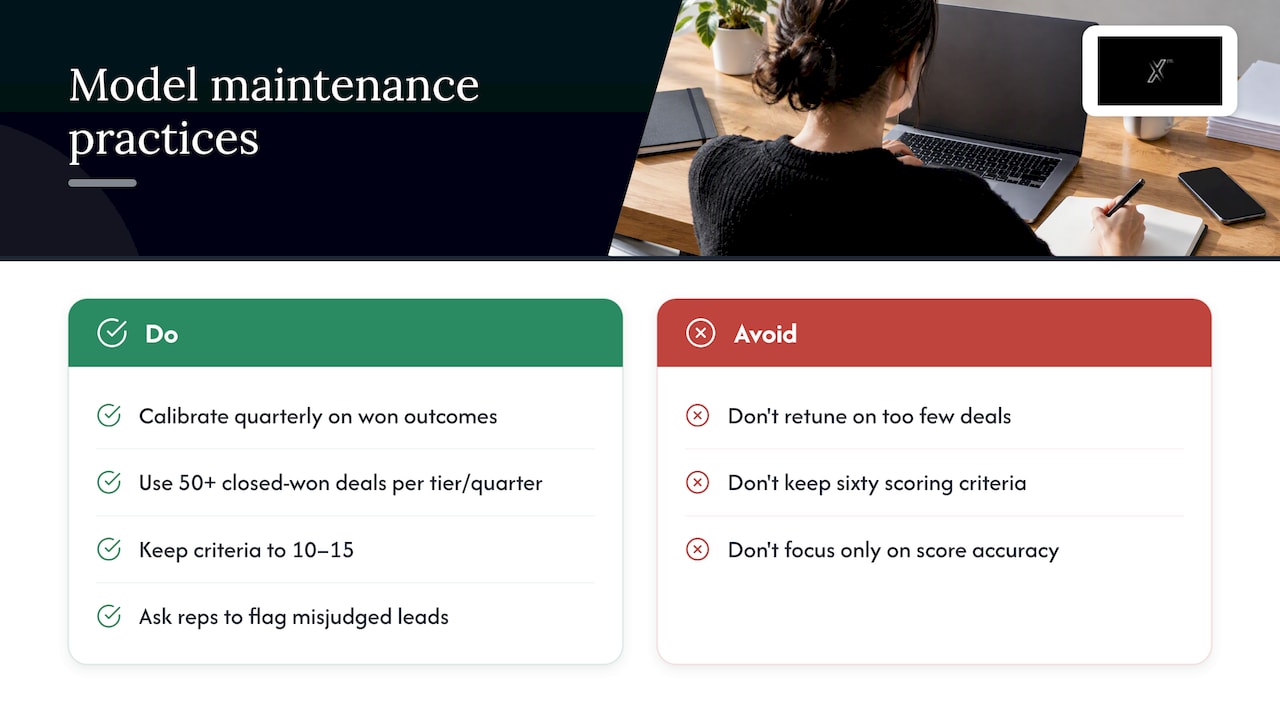
Track the right outcomes. Score accuracy matters less than what happens downstream: MQL to SQL rate, SQL to won rate, time to first contact and sales acceptance. Our piece on B2B marketing KPIs that matter covers how to choose them, and our guide to marketing attribution models helps you decide which touchpoints deserve credit in the engagement score.
Common mistakes to avoid
- Collapsing fit and engagement into one number. It hides the reason behind the score.
- Rewarding volume of activity. Email opens and page views are easy to inflate and weakly tied to buying.
- No decay. Old activity keeps dead leads at the top of the list.
- Scoring on gut feel and never checking. Without a closed-won comparison, the model slowly drifts.
- Deploying a predictive model on thin data. It looks sophisticated and performs worse than a clear rules-based model.
- Ignoring the data foundation. Scoring is only as good as the tracking and CRM hygiene beneath it.
Our perspective: scoring is a system, not a setting
We see lead scoring as one part of a connected marketing system rather than a CRM feature you switch on. A model is only as useful as the traffic, content and follow-up around it. If your campaigns bring in the wrong audience, no scoring formula will fix that. If your nurture content is thin, a well-scored warm lead has nowhere to go.
That is why we start with the commercial question before the configuration: who actually buys from you, and what did the journey look like? Then we connect strategy, content, paid and organic channels, web tracking and CRM so the signals feeding the score are trustworthy. We also push for simplicity. A two-axis model that every rep understands will outperform a clever model that nobody trusts, and it can be upgraded later as your data grows.
To see how scoring fits into pipeline building more broadly, read our guide to B2B lead generation and qualified pipeline. If you need to get the measurement layer right first, our walkthrough of paths to a working marketing analytics dashboard is the place to start.
— Xpert
Need help turning scoring into pipeline?
Xpert Marketing is a 360° agency covering strategy, digital marketing, web and tech, CRM and sales automation, and data and analytics. If you want a scoring model built on your own closed-won data and connected to the campaigns that feed it, explore our Data & Analytics service or see everything we do on our services page.
FAQ
What is the difference between lead scoring and lead qualification?
Lead scoring is a numeric or graded ranking based on fit and behavior, usually automated in your CRM. Lead qualification is the judgment, often by a person, about whether a lead has the need, budget, authority and timing to buy. Scoring tells you who to talk to first, and qualification confirms whether the conversation is worth continuing.
How many points should a lead need to become an MQL?
There is no universal number. Set the threshold by looking at which score ranges converted to sales opportunities in your own data, and require a minimum for both fit and engagement. Many teams use a 0 to 100 scale, but the scale matters less than whether sales accepts the leads that cross it.
Is predictive lead scoring better than rules-based scoring?
Only when you have enough clean historical data and someone to monitor it. Research shows machine learning methods are increasingly replacing traditional rules, but a simple, explainable two-axis model often wins for smaller datasets because sales trusts it and you can fix it quickly.
How often should I update my lead scoring model?
Review it quarterly against closed-won outcomes, and only change weights when you have enough deals to make the comparison meaningful. Between reviews, fix obvious problems such as broken tracking or a new product line, and keep a log of every change.
Fonti
- The state of lead scoring models and their impact on sales performance (Springer)
- The state of lead scoring models and their impact on sales performance (PMC)
- Building Lead Scoring Models That Sales Actually Trusts (GTMStack)
- B2B Lead Scoring Model: 100-Point Template (SoftwareInspect)
- Machine Learning Applications in Customer Relationship Management: A Comprehensive Review
- Probability-Calibrated Ensemble Methods for Automotive CRM Lead Scoring
- What is Lead Nurturing? (Salesforce)


