

Crisis Communication Plan: How to Build One That Works
A crisis communication plan is a short document that settles, before anything goes wrong, who decides, who speaks, whom you tell first and what you say while the facts are still coming in. The plan matters most in the first hour, when nobody has time to invent a process. Below is the structure public agencies and professional bodies recommend, adapted for a business owner, with templates, examples and the points where plans usually break. Our PR & Communication team builds these plans for companies, and the steps below follow how we would approach it.
TL;DR
- A crisis communication plan covers the information side of a crisis: roles, audiences, channels, approved messages and update rhythm. It sits inside your wider crisis management plan.
- Build it in six parts: risk scenarios, a small team, one spokesperson, an audience list with contacts, pre-cleared messages, and a practice schedule.
- Draft holding statements for the three to five crises you consider most likely, and keep every message to three or four key points.
- State what you know, what you don’t, what you are doing and when the next update comes.
- Test the plan with a scenario drill and review it at least once a year.
Indice
- What a crisis communication plan is, and what it is not
- Step 1: Map the risks you could face
- Step 2: Build the crisis team and name a spokesperson
- Step 3: List your audiences and their contacts
- Step 4: Write the messages before you need them
- Step 5: Set the first-hour, first-day and first-week rhythm
- Crisis communication templates: what to include
- Crisis communication examples worth studying
- Practice it and keep it current
- How Xpert can help
- Our perspective
- FAQ
- Fonti
What a crisis communication plan is, and what it is not
A crisis communication plan governs how information moves during an emergency: who approves it, who delivers it and to whom. A crisis management plan is wider. It covers the operational response, such as shutting down a system, recalling a product or evacuating a site. The communication plan is one part of that larger effort, and the two should be written to fit each other.
The U.S. CDC makes a related point in its crisis communication guidance: communicators should take part in key crisis decisions rather than just relay them once they are made. If your marketing or PR lead only hears about an incident when it is on social media, the plan has a gap before it starts.
Crises worth planning for are the ones that put your reputation or operations in public view: a data breach, a product defect, a service outage, a workplace accident, a viral complaint, an executive scandal or a natural disaster that shuts you down.
Step 1: Map the risks you could face
Start with the crises that are actually plausible for your business. The UK Government Communication Service’s STOP planning guide tells communicators to work from the organization’s risk register, set communication objectives and spell out what is known and unknown about each scenario. It also asks you to research who would be affected, including vulnerable groups and your own staff.
The University at Albany frames risk assessment as weighing likelihood and impact, then ranking scenarios so that your time and budget go to the ones that matter most.
A practical way to do this in an hour:
- List ten things that could go wrong, from a late shipment that becomes a social media pile-on to a ransomware attack.
- Score each from 1 to 5 for likelihood and for impact on customers and revenue.
- Keep the top three to five. These get full message drafts.
That number is not arbitrary. The Chartered Institute of Public Relations advises preparing draft messages for at least the three to five crises considered most likely, and testing them through scenario-based training.
Step 2: Build the crisis team and name a spokesperson
The CDC’s planning chapter lists what the plan should contain: senior endorsement, assigned public-information responsibilities, verification and fast clearance, who has release authority, spokespersons, partner contacts, channels and audience lists.
For a company of 10 to 200 people, that translates into a team of four or five:
- Incident lead: declares the crisis and owns the decisions. Usually the CEO or a COO.
- Communications lead: drafts and clears messages, runs the update schedule.
- Subject-matter expert: IT, operations, legal or HR, depending on the incident. Facts come from this person.
- Spokesperson: the single public voice.
- Monitoring and response owner: watches social channels, reviews, press and the inbox.
Name a backup for every role. Crises do not wait for holidays.
On the spokesperson, Adelphi University’s plan puts a senior leader in the public-facing role while communications staff handle briefings and media inquiries, and it allows the lead spokesperson to change as the crisis develops. That is a useful model: the face of the response can shift from a general manager to a technical expert as the story moves from apology to explanation.
The most common failure here is the approval chain. Write down who can approve a statement, and give that person a deputy. The European Stability Mechanism’s 2025 crisis handbook stresses pre-agreed internal clearance alongside preparedness, early warning and stakeholder relationships. If every post needs five signatures, you will publish after the story has already formed without you.
Step 3: List your audiences and their contacts
Ready.gov, the U.S. government’s preparedness site, says a plan should identify audiences, what each needs to know and who is best placed to tell them. Its examples include employees, customers, suppliers, management, officials and regulators.
Build a simple table and keep it with the plan:
| Audience | What they need | Best messenger | Channel |
|---|---|---|---|
| Employees | What happened, what to say, what to do | CEO or team lead | Text, email, internal chat |
| Customers | Impact on them, next steps, where to get help | Spokesperson or support lead | Email, website banner, social |
| Partners and suppliers | Operational impact, timing | Account owner | Phone, email |
| Regulators and insurers | Required notices and facts | Legal or incident lead | Formal notice |
| Media | Verified facts, a named contact | Spokesperson | Statement, briefing |
Ready.gov also recommends compiling contact information in advance, keeping it accessible during an incident, updating the lists regularly and securing them. If your only copy of the phone tree lives on the server that just went down, it is not a plan.
Tufts University’s plan adds two details worth copying: choose channels for the incident and the audience, including accessibility needs, and give a stated time for the next update even when there is little news.
Step 4: Write the messages before you need them
The principles
The STOP guide’s messaging principles, which draw on the Krebs approach, boil down to a few habits: say what is known and unknown, say what is being done, tell people what action to take, tell them where and when updates will appear, use trusted messengers and warn that information may change.
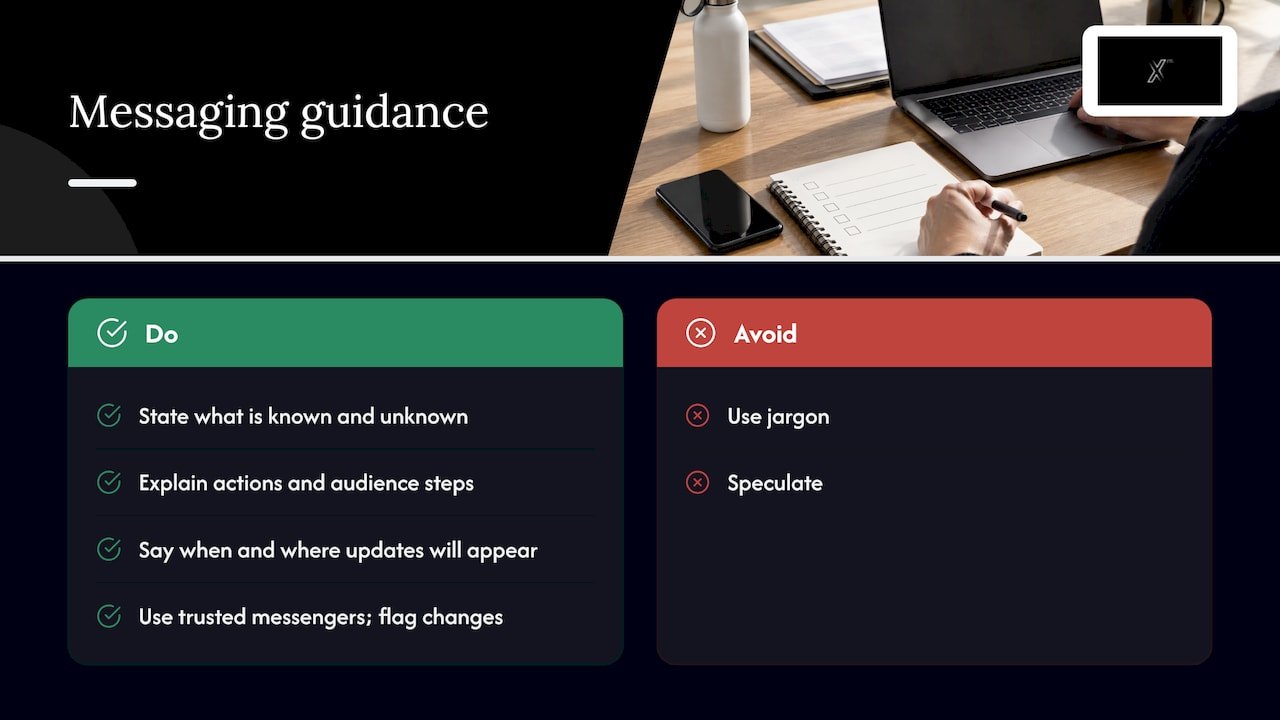
The European Food Safety Authority recommends three or four clear key messages, no jargon, no speculation, honest acknowledgment of unknowns and messages tailored to each audience and reviewed as the situation changes.
Tufts uses a memorable shorthand, AIR: Alert, Inform, Reassure. Give people safety guidance first, then facts, then something that supports trust while things remain uncertain.
The holding statement
A holding statement is the first public message, issued before you have the full story. EFSA says an early holding statement should cover what happened, how, and what the organization is doing, express concern and avoid unsupported blame. Its target is to publish within 50 minutes of crisis activation. Adelphi’s plan accepts that rapid communication may be incomplete at first and warns against speculating about details you do not have.
A fill-in version for a business might read:
We are aware of [incident]. Our team is [action being taken]. If you are affected, please [specific action]. We will post our next update at [time] on [channel]. Contact [name and channel] with questions.
The New York City Emergency Management template offers a similar customizable holding message that names the incident, response partners, recommended actions and where to find updates. Pre-approved templates like this save the hardest minutes of the response.

Step 5: Set the first-hour, first-day and first-week rhythm
The STOP guide recommends readying actions for the first hour, first day and first week, along with pre-cleared holding lines, contact lists, approval paths and channel plans. A workable version for a business:
- First hour: confirm the facts you can, alert the team, publish the holding statement, pause scheduled promotional posts.
- First day: brief employees before they read about it elsewhere, update customers on a fixed schedule, log every decision and inquiry.
- First week: publish what happened and what changes, support affected customers, brief partners, begin the review.
The North Carolina Association of County Commissioners’ plan recommends suspending unrelated scheduled posts, qualifying information that is not fully verified, and giving social updates every 15 to 30 minutes where practicable during fast-moving events. For most companies, a clear promise such as “next update at 3 p.m.” matters more than a fixed interval, as long as you keep it.
Crisis communication templates: what to include
Ready.gov says messages can be pre-scripted as fill-in templates, approved in advance and stored on a remotely accessible server, and that recovery communication deserves preparation too. The New Jersey Department of Health’s toolkit gives a customizable sample plan covering goals, situation analysis, team roles, press releases, talking points, spokesperson preparation and stakeholder engagement.
A complete template pack for a business includes:
- Crisis definition and activation levels (who declares, and at what threshold).
- Team roster with backups and after-hours numbers.
- Audience and contact list.
- Holding statements for your top three to five scenarios.
- Key messages and approved facts, with a Q&A for staff who answer calls and messages.
- Channel plan, including what you use if your website or email is down.
- A decision and inquiry log.
- A post-crisis review form.
Keep it short. The CIPR recommends a concise playbook with defined roles, rapid activation and verified-fact procedures, and the ESM handbook advises plans flexible enough for chaotic events. The CDC describes its plan as a flexible reference rather than a rigid manual. A 40-page binder nobody opens will lose to a six-page plan everyone has read.
Crisis communication examples worth studying
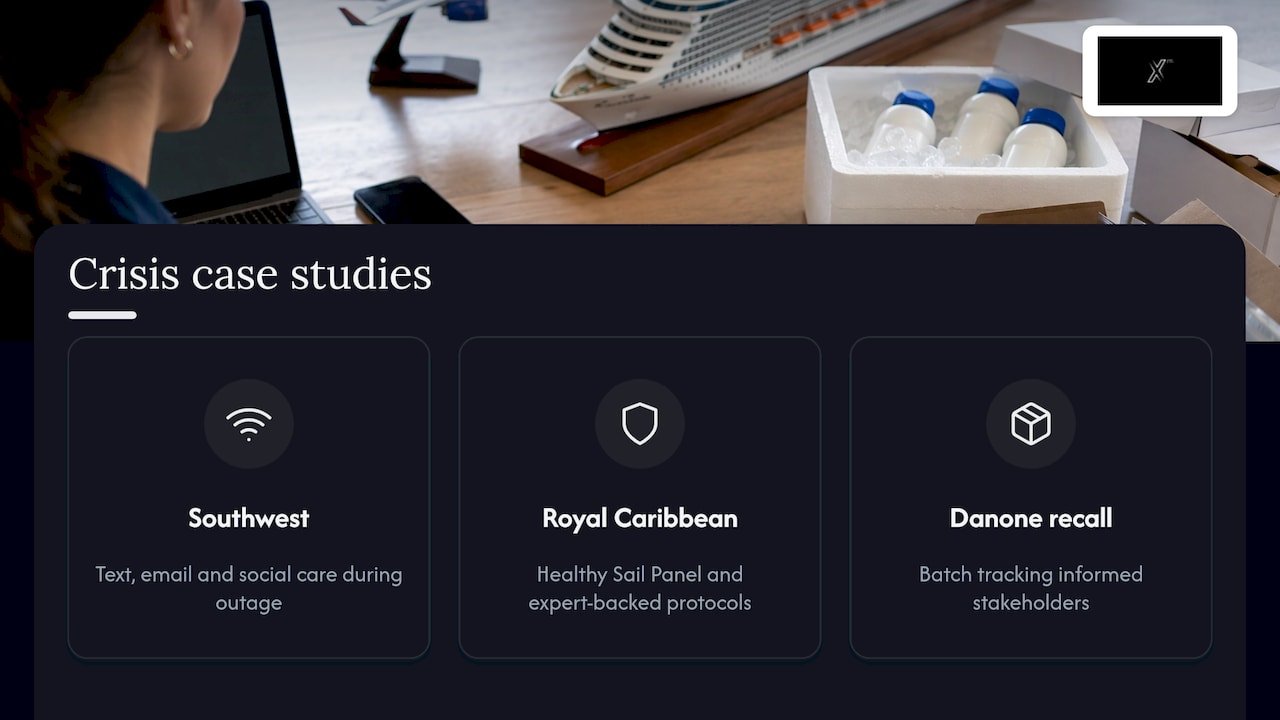
Southwest Airlines, 2016 technology outage. According to PR News’ case study, Southwest used alternate employee and customer channels, frequent factual updates, apologies, employee recognition and social video when regular systems were unavailable. Internally it used text messages, email, digital signs, employee social groups and intranet posts, while its social care team answered customers. The lesson: plan a channel for when your primary channel fails.
Royal Caribbean, pandemic-era trust rebuilding. The Public Relations Society of America’s award case study describes a response built on stakeholder research, an independent Healthy Sail Panel, expert-backed safety protocols, media preparation and frequent communication with customers, employees, regulators, investors and partners. The lesson: credibility comes from outside validation and a message that reaches every audience, not only customers.
Danone Nutricia, infant-formula recall. PR Week’s case study describes a precautionary recall handled with media training, digital and social channels, direct engagement, factory tours and batch tracking to inform and reassure stakeholders. The lesson: give people a way to check for themselves whether they are affected.
In each case the response was organized around known audiences, repeatable updates and tools prepared in advance.
Practice it and keep it current
The NYC template recommends testing the plan and preparing an after-action report. The CDC says plans should be reviewed regularly, usually annually, and the New Jersey toolkit also says yearly updates. The North Carolina plan adds a post-crisis review and revision based on lessons learned.
A simple annual routine:
- Run a 90-minute tabletop drill on one of your top scenarios, with a surprise detail halfway through.
- Time how long it takes to approve and publish the holding statement.
- Update contacts, backups and templates.
- Brief new hires and refresh spokesperson preparation.
We also run digital marketing trainings for teams that want their staff ready to handle these moments themselves.
How Xpert can help
A crisis plan touches branding, social media, press relations, your website and your internal messaging at once. Our team covers strategy and consulting, PR and communication, digital marketing and web, so the plan is written by people who also run those channels. You can see how we work in PR & Comunicazione, and our operational guide to crisis communication goes deeper on acting within the hour.

If you want a plan drafted, a drill facilitated or an external marketing department on call, start from our services page.
Our perspective
A crisis plan is a marketing asset as much as a safety document. The messages, channels and audiences it relies on are the same ones you build every day, and they only work in a crisis if they were already working before it.
At Xpert we integrate strategy, creativity and execution in one agency, and we act as a dedicated external marketing department when a client needs it. That integration is what a crisis demands: one team that knows the brand voice, the social accounts, the website and the press contacts, rather than five vendors waiting for each other.
Our advice is to write the plan before you need it, name a spokesperson, pre-approve your holding statements and practice once a year. Then the first hour is a routine you have already rehearsed.
Xpert
FAQ
What are the main elements of a crisis communication plan?
A solid plan has a risk assessment, a crisis team with a named spokesperson, audience and contact lists, a channel plan, pre-approved holding statements and key messages, and a schedule for practice and review. Public guidance from Ready.gov and the CDC includes each of these.
What are the steps of a crisis communication plan?
Assess risks, assemble the team, designate a spokesperson, map audiences and contacts, draft messages for likely scenarios, then test and update the plan yearly. During an incident, the sequence is confirm facts, activate the team, issue a holding statement, update on a stated schedule, and review afterward.
How long should a crisis communication plan be?
As short as it can be while still naming roles, audiences, channels and messages. Professional guidance from the CIPR and the ESM recommends concise, flexible plans, because people have to be able to use them under pressure.
What should I say first in a crisis?
Issue a holding statement that says what happened, what you are doing, what people should do and when the next update comes. Avoid blame and speculation. EFSA’s guidance sets a target of publishing within 50 minutes of activating the response.
How often should I update the plan?
Review it at least once a year, and after any real incident or major change in your team, systems or operations. Both the CDC and the New Jersey Department of Health point to yearly updates.
Fonti
- Ready.gov: Crisis Communications Plans
- UK Government Communication Service: STOP crisis communications planning guide
- CDC: Crisis and Emergency Risk Communication, communication plans chapter
- University at Albany: crisis communication strategies
- European Stability Mechanism: Handbook on Crisis Communication for Public Institutions
- EFSA: Best practice for crisis communicators
- Adelphi University: Crisis Communications Plan
- Tufts University: Crisis Communication Plan
- CIPR: Crisis Communication for Boards
- NYC Emergency Management: Crisis Communications Plan Template
- North Carolina county government crisis communications plan
- New Jersey Department of Health: Risk Communication Toolkit
- PRSA: Royal Caribbean crisis communications case study
- PR News: How Southwest responded to a crisis
- PR Week: Danone Nutricia recall communications


