

LinkedIn Ads Strategy: A B2B Playbook That Builds Pipeline
A good LinkedIn ads strategy comes down to five decisions: who you target, what you offer each audience, which format carries the offer, how you bid and budget, and how often you test. Get those right and LinkedIn becomes a predictable pipeline channel. Get them wrong and you pay premium prices to show a demo request to people who have never heard of you.
This guide walks through those decisions in the order you should make them, with the numbers we think matter and the mistakes we see most often.
TL;DR
- Build two layers: a cold layer of useful content, then a warm retargeting layer with bottom-funnel offers such as a consultation or demo.
- Size audiences on purpose: roughly 50,000 to 100,000 members for prospecting, and at least a few hundred for retargeting.
- Test Document Ads with lead gen forms. In one 2025 US dataset they converted far better than video or single image.
- Do not set a low bid to save money. Under-delivery costs more than a higher bid.
- Refresh creative at least monthly, and judge success by qualified pipeline, not form fills.
Përmbajtja
- Why LinkedIn needs its own strategy
- Step 1: Set one objective per campaign
- Step 2: Build a two-layer funnel
- Step 3: Size and structure your audiences
- Step 4: Choose formats that fit the offer
- Step 5: Use lead gen forms well
- Step 6: Set bids and budgets that give the algorithm room
- Step 7: Test monthly, because creative fatigue is fast
- Step 8: Measure pipeline, not just leads
- Our perspective: strategy before spend
- Work with a team that runs the whole system
- A 30-day launch checklist
- Pyetje të Shpeshta
- Burimet
Why LinkedIn needs its own strategy
LinkedIn is not Meta with a suit on. People arrive with a work mindset, and you target them by job function, seniority, industry and company rather than by interests. That precision is the reason it costs more per click than most other paid channels. It also means waste is expensive: a sloppy audience or a weak offer burns budget quickly.
So the strategy has to do three things that a generic “boost the post” approach does not:
- Define the buying committee you want, not just one job title.
- Match the offer to how warm each person is.
- Connect leads to sales follow-up fast enough to matter.
If you want the wider picture of how this channel fits into B2B marketing, our overview of LinkedIn marketing for B2B covers organic, ads and lead capture together. For a campaign-level overview of goals, one useful angle is how teams recover wasted LinkedIn ad spend by tightening targeting and offers.
Step 1: Set one objective per campaign
LinkedIn’s campaign setup starts with an objective: awareness, consideration or conversion, as HubSpot’s walkthrough of the process describes. Treat that choice seriously. Each campaign should have one job.
A simple mapping works well:
| Funnel stage | Campaign goal | Typical offer | Success metric |
|---|---|---|---|
| Cold | Awareness or engagement | Guide, podcast episode, short video | Engagement rate, cost per engaged visitor |
| Warm | Gjenerim klientësh | Checklist, webinar, document with lead gen form | Cost per lead, work-email rate |
| Hot | Conversion | Consultation, demo, audit | Cost per meeting, pipeline created |
Mixing these in one campaign makes results unreadable. You cannot tell whether a high cost per lead is a targeting problem or an offer problem.
Step 2: Build a two-layer funnel
The most common mistake we see is the cold intro: sending cold traffic straight to a demo request. B2B strategists describe this trap and its fix in this guide to LinkedIn ads for B2B: a cold layer built on high-value educational content, followed by a warm retargeting layer that uses Matched Audiences to reach people who have already engaged.

Here is how that looks in practice.
The cold layer
The goal is to earn attention and trust, not leads. Use assets a buyer would actually value:
- A practical guide or benchmark report
- A short video that answers one specific question
- A podcast episode featuring a real practitioner
Target by job function, seniority and industry. Measure engagement and the size of the retargeting pool you are building, not demo bookings.
The warm layer
Now you retarget people who watched your video, opened your document, visited key pages or engaged with your company page. This is where the consultation, audit or demo offer belongs. Because the audience already knows you, conversion rates rise and cost per qualified lead tends to fall.
The warm layer only works if the cold layer feeds it. Plan budget accordingly: many teams start by putting 60 to 70 percent into the cold layer, then rebalance once the retargeting pool is large enough. Treat that split as a starting hypothesis, not a rule.
For the organic and paid sequencing around this, see our 90-day B2B social media roadmap.
Step 3: Size and structure your audiences
Audience size is where many accounts quietly fail. LinkedIn’s own success guide advises a prospecting audience of 50,000 to 100,000 members, and notes that audiences under 10,000 often lead to higher CPCs and limited scale. For retargeting, the same guide recommends a minimum in the range of 300 to 10,000 users so the campaign has enough data to deliver.
That creates a tension with account-based marketing, where you may only want 200 target companies. Resolve it this way:
- Broaden the people, not the companies. Include every relevant function and seniority level inside the target accounts rather than one title.
- Combine criteria carefully. Each added filter shrinks the pool. Stack job function plus seniority plus industry before adding company size or skills.
- Use exclusions. Remove existing customers, competitors’ staff, your own employees and job seekers where relevant.
- Turn off audience expansion if you need strict control, and test it separately if you need scale.
We go deeper on facets, minimums and why a 300+ audience matters in our guide to LinkedIn ads targeting.
Step 4: Choose formats that fit the offer
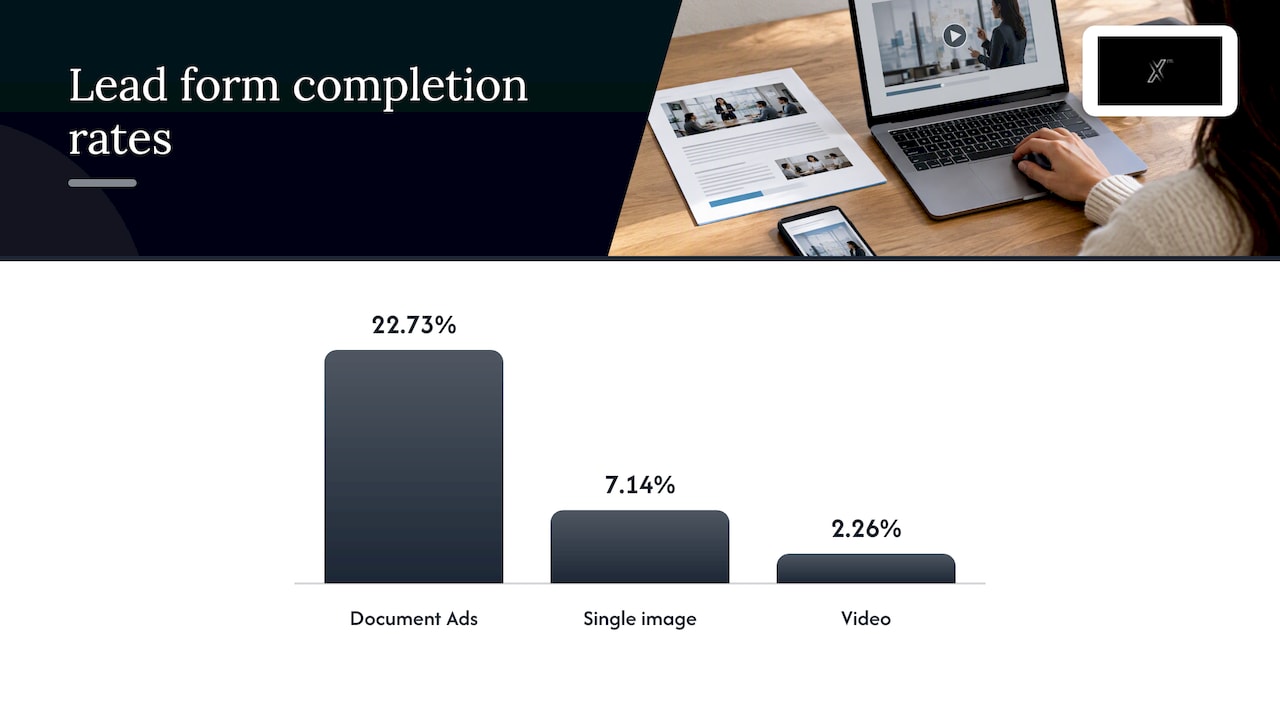
There is no single best format, but the data on lead capture is worth knowing. A 2025 newsletter summarizing US results reported that Document Ads reached a 22.73% lead gen form completion rate, against 7.14% for single image and 2.26% for video. The same piece reported the lowest cost per lead for Document Ads at $255.81, despite premium costs elsewhere.
Treat those as one dataset, not a law of nature. Completion rate measures what happens after someone opens the form, and it says nothing about lead quality. Still, they justify a test.
| Format | Best used for | Watch out for |
|---|---|---|
| Document Ads | Gated guides, checklists, reports | A document that is too thin to justify the form |
| Single image | Simple offers, retargeting, event promotion | Generic visuals that blend into the feed |
| Video | Cold-layer trust building, product explanations | Weak form completion if used for hard conversion |
| Message and conversation ads | Warm audiences, event invites, consultation offers | Over-frequency, which feels intrusive |
| Text and dynamic ads | Low-cost brand reinforcement | Limited impact on their own |
A reasonable first test is one Document Ad, one single image ad and one video, all aimed at the same audience, with the same offer where possible. Let the results tell you which format carries your message.
Step 5: Use lead gen forms well
Lead gen forms keep people inside LinkedIn and prefill their profile data, which usually raises completion. They also create two risks: low-intent leads and slow follow-up.
To reduce both:
- Match the offer to the form length. A short form suits a checklist. A consultation request can carry more fields, which filters out casual clicks.
- Ask for a work email so you can separate real prospects from personal addresses.
- Add one qualifying question, such as company size or timeline.
- Connect the form to your CRM so leads route to a person within minutes, not days.
- Write a thank-you step that tells people what happens next and links to a useful page.
Speed to follow-up is where many campaigns lose the value they paid for. If your team struggles to qualify and route leads, a clear qualification framework helps; this overview of lead qualification frameworks is a good place to compare approaches. Our own approach to turning form fills into sales conversations is in our guide to B2B lead generation.
Step 6: Set bids and budgets that give the algorithm room
A frequent beginner move is to set a low bid to protect budget. LinkedIn’s success guide warns that low bids frequently lead to under-delivery and stalled growth, and suggests bidding at or above the recommended amount so the system can collect data and optimize.
Practical guidance:
- Start with the recommended bid shown in Campaign Manager, then adjust once you have data.
- Fund each campaign enough to learn. A campaign that gets a handful of clicks a week teaches you nothing.
- Run fewer campaigns with more budget each. Splitting a small budget across ten audiences starves all of them.
- Set a decision rule in advance, for example: after a fixed spend and a fixed number of leads, pause the weakest creative and keep the strongest.
Because LinkedIn click costs are high compared with other channels, your offer and landing experience carry more weight here. A 20 percent lift in conversion rate is worth more on a $10 click than on a $1 click.
Step 7: Test monthly, because creative fatigue is fast
The same newsletter data recommends a testing cadence of at least once per month, since creative fatigue sets in faster on LinkedIn than on many other platforms. Your audiences are narrow, so the same people see the same ad again and again.
A simple monthly rhythm:
- Week 1: Launch two new creative variants against your current best.
- Weeks 2 and 3: Let them run without edits. Watch click-through rate and cost per lead.
- Week 4: Retire the loser, promote the winner, and write next month’s challenger.
Change one variable at a time: the headline, the visual, the offer or the audience. If you change all four, you will not know what worked.
Step 8: Measure pipeline, not just leads
Cost per lead is the number everyone sees first, and it can mislead. A $255 lead who books a sales call is worth more than a $60 lead who never answers. Track these in order:
- Cost per lead and the share with a work email
- Lead-to-meeting rate
- Meeting-to-opportunity rate
- Cost per opportunity and pipeline value
This needs CRM data connected to your ad platform. Without it, you are optimizing for the metric that is easiest to see. Our digital marketing team sets up this reporting as part of campaign work so that decisions are made on opportunities.
Our perspective: strategy before spend
At Xpert Marketing we treat LinkedIn as one part of a connected system, not a stand-alone channel. The accounts that struggle usually have a good ad platform and a weak foundation: unclear positioning, a thin offer, a landing page that does not match the ad, or no process for following up leads.
So we start with research and positioning, then decide which audiences and offers deserve paid support. We build the content for the cold layer, set up the retargeting and the CRM connection, and review the numbers with the client against pipeline goals. Where it makes sense, we also train in-house teams so they can run the channel themselves.
If your LinkedIn results are flat, resist the urge to change the bid first. Check, in this order: audience size, offer, format, follow-up speed. The fix is usually earlier in that list than you think.
— Xpert
Work with a team that runs the whole system
If you would rather have LinkedIn campaigns planned, built and measured by one team, see our full list of services. We can act as your external marketing department, from strategy and creative production to media buying, web and analytics. If your team wants to run ads itself, our marketing trainings are built for that.
A 30-day launch checklist
Use this before you spend the first dollar:
- One written objective per campaign and a named metric
- A defined buying committee: functions, seniority levels, industries
- Prospecting audience of roughly 50,000 to 100,000 members, with exclusions applied
- A cold-layer asset and a warm-layer offer ready
- Lead gen form connected to your CRM, with a named owner for follow-up
- Conversion tracking in place on your site
- Three creative variants queued, with the first monthly test scheduled
If you cannot tick every line, fix that first. The ad spend will still be there next week.
Pyetje të Shpeshta
What is a good LinkedIn ads strategy for B2B?
Start with a two-layer funnel. Use educational content to reach a well-sized cold audience, then retarget engaged people with a consultation, demo or audit offer. Measure qualified pipeline rather than raw leads, and test new creative every month.
How big should my LinkedIn audience be?
LinkedIn’s own guidance points to about 50,000 to 100,000 members for prospecting, with audiences under 10,000 often seeing higher CPCs and limited scale. For retargeting, a few hundred to several thousand users is the minimum range it recommends. If your account list is smaller, broaden the roles inside those companies.
Are LinkedIn lead gen ads worth it?
They can be, because the in-platform form lowers friction and usually lifts completion. The risk is lead quality, so ask for a work email, add a qualifying question and follow up quickly. Judge them by meetings and opportunities, not by form fills alone.
Should I set a low bid to control cost?
Usually not. Low bids tend to cause under-delivery, which leaves you with too little data to optimize. Start at the recommended bid, fund campaigns enough to learn, and cut spend by removing weak creative or audiences instead.
Burimet
- LinkedIn Ads for B2B: How to Run Successful LinkedIn Ads Campaigns
- The Revenue Engine Newsletter
- LinkedIn Ads Success Guide
- How to Advertise on LinkedIn (+ Research, Expert Tips)


