

Market Research Strategy: A Practical Guide for Business Owners
A market research strategy is the plan for how you will collect, analyze and report information about a specific market, and it starts with the decision you need to make, not with a survey. Rev defines it as deciding what you are trying to learn first, then choosing the research tactics that answer it. Done well, it keeps you from paying for data nobody uses. Done by a team that also runs strategy, creative and media, it flows straight into the campaigns, website and brand work that follow, which is how we approach it at Xpert Marketing.
TL;DR
- Start with the business decision (enter a market, reposition, price, launch a campaign), then write the questions the research must answer.
- Limit each study to a few focused questions, define the audience precisely, and pick methods that fit those questions.
- Layer your evidence: secondary research to map the landscape, qualitative to understand why, quantitative to confirm at scale.
- Write down a plan with objective, audience, methods, timeline and budget before any data is collected.
- Report findings separately from interpretation, and give every recommendation an owner and a measure.
Përmbajtja
- Market research strategy, plan and framework: what each one is
- Why a business needs one
- Build your strategy in seven steps
- Choosing the right research methods
- A worked example: repositioning a B2B service
- Analyzing and presenting findings
- Common mistakes to avoid
- How an integrated agency turns research into growth
- Our perspective
- Pyetje të Shpeshta
- Burimet
Market research strategy, plan and framework: what each one is
The three terms are used loosely, and mixing them up is how projects drift. Here is a clean way to separate them.
- Strategji is the overall logic: which decisions the research will support, which questions matter, and which mix of methods will answer them.
- Plan is the written document that carries out the strategy. According to QuestionPro, it outlines a project’s objective, audience, methods, timeline and budget before data collection starts. It is narrower than a marketing plan, which covers how you reach, price and sell to customers.
- Framework is a structure that organizes the thinking. Common examples named in Rev’s guide include segmentation, targeting and positioning (STP), SWOT and Porter’s Five Forces.
In practice you pick a framework to structure the analysis, write a strategy so the research serves a decision, and then produce a plan so someone can execute it on a schedule and a budget. If you are searching for any of the three, you are really asking one question: how do I get reliable evidence before I commit money?
Why a business needs one
Research without a decision attached is a report that sits in a folder. The Government of Canada’s introduction to market research says research can help you complete your business plan, reduce risk, monitor competition, find ways to increase sales and understand customer characteristics and preferences. It lists the kinds of decisions it supports: expansion, new product or service lines, increased production or stock, and advertising campaigns.
The Indian School of Business names seven uses that map well onto what business owners actually ask us: identifying target audiences, understanding customer needs, spotting trends, gaining a competitive edge, strengthening brand perception, reducing risk and boosting marketing impact.
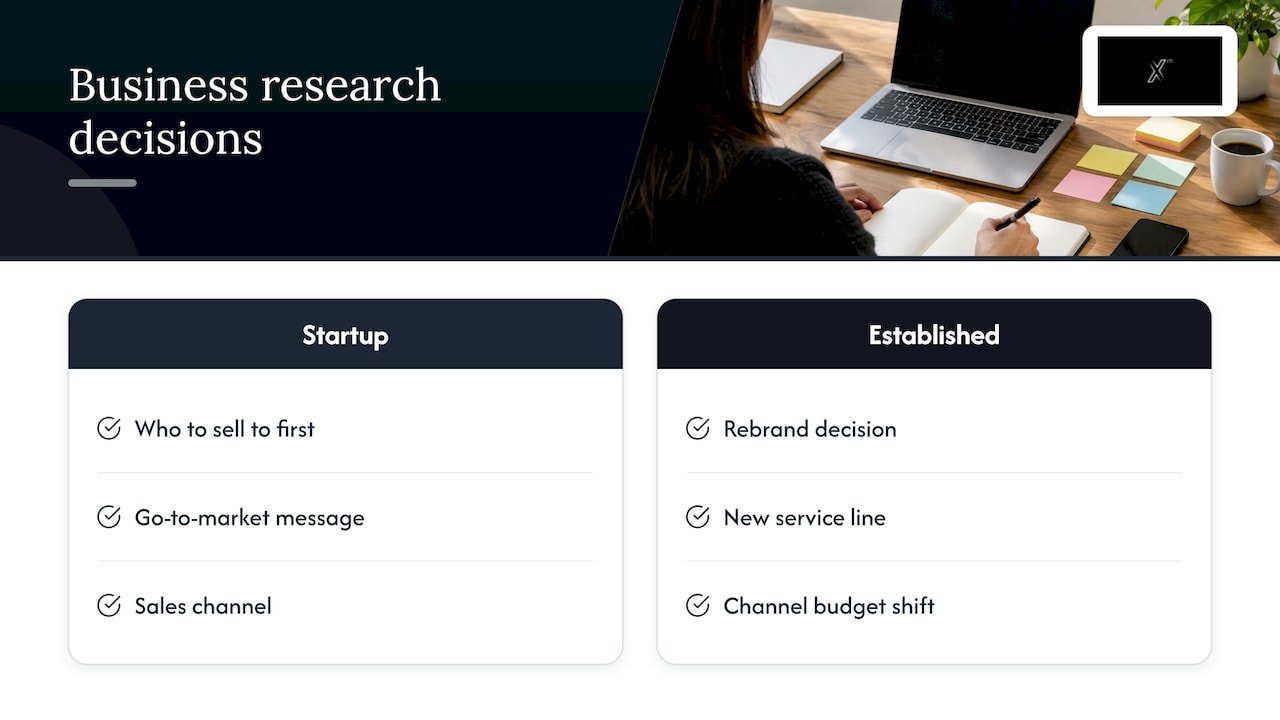
For a startup, the decision is usually go-to-market: who to sell to first, with what message, through which channel. For an established company, it is often a rebrand, a new service line or a shift in budget between channels. In both cases the strategy should name the decision in one sentence before anything else. For example: “Should we reposition our software for mid-sized logistics firms, and what message would make them switch?”
Build your strategy in seven steps
1. Define the decision and the problem
Write the decision, the options on the table and what you would do differently depending on the answer. OpenStax’s Principles of Marketing begins its research process the same way: define the problem, then develop the plan, collect data, analyze and interpret, and report, with the last step initiating action and evaluating the process.
Where it goes wrong: a vague goal such as “learn about our customers.” If no answer could change your next move, the study is not ready.
2. Turn the decision into research questions
Objectives work best as questions the study must answer, not topics to explore. A good set has three to five questions per study, which keeps the work focused and affordable. Academic guidance from Kumar’s research methods text describes objectives as action-oriented statements, using phrases such as “to find out,” “to determine” and “to examine.”
Example questions for a B2B company weighing a new segment:
- Which problems do buyers in this segment say they cannot solve today?
- What do they currently use, and what do they pay?
- Which message makes them most likely to book a conversation?
Where it goes wrong: ten questions in one survey. Respondents tire, the analysis blurs and nobody acts on the result.
3. Define the audience and the sample
Describe who you need to hear from in three layers: demographics or firmographics, behaviors and attitudes. It should be specific enough to guide recruitment and flexible enough that you can actually assemble the sample. For business-to-business work, that means company size, industry, role and buying authority. If paid social is part of your plan, the same discipline applies to targeting; our note on LinkedIn Ads targeting with facets shows how audience definition affects reach.
Where it goes wrong: researching the people who are easiest to reach (your current fans, your email list) rather than those you need to win.
4. Choose methods that fit the questions
This is the core of the strategy, covered in detail in the next section. Match each question to the cheapest method that can answer it credibly.
5. Write the plan: timeline, budget and quality checks
Put the objective, audience, method, collection channels, draft questions, timeline, budget and success measure in one document, and review it before launch. QuestionPro’s eight-step plan outline follows exactly this order. Add a pilot: test your survey or interview guide on a handful of people before the full field period.
Where it goes wrong: no owner. Name one person who approves the plan and one who signs off on the findings.
6. Collect and analyze
Keep raw data, notes and recordings organized so the work can be revisited. Rev’s guide recommends the FAIR principles (findable, accessible, interoperable, reusable) for exactly this reason. Analyze against your questions, not against whatever pattern looks interesting.
7. Report, decide and measure
Set a threshold in advance: what result would make you proceed, change course or stop? Then give each recommendation an owner, a deadline and a metric. Research that does not end in a decision with an owner has not finished its job.
Choosing the right research methods
Two distinctions drive almost every choice. Primary research is gathered firsthand from your own audience; secondary research uses existing reports and data. Qualitative research explains motivations and perceptions; quantitative research measures how widespread they are.
Një University of Vermont market research workbook by Rosalie J. Wilson calls first-hand research the most powerful and accurate form because it comes directly from prospective customers, and treats third-party research as a broad overview to use as supporting evidence.
GWI’s guidance describes a layered approach: begin with secondary research to map the landscape, use qualitative work to explore nuances and test assumptions, then validate at scale with quantitative research. Each stage informs the next, so the final decision rests on more than a single study.
| Question you need answered | Best-fit method | What it gives you | Watch out for |
|---|---|---|---|
| What is the market landscape? | Secondary research, competitor review | Context, benchmarks, hypotheses | Dated or generic data |
| Why do customers choose or leave? | Interviews, focus groups | Motivations, language, objections | Small samples, group influence |
| How many people feel this way? | Surveys | Measurable patterns across a segment | Leading questions, weak sample |
| What are people saying unprompted? | Social listening | Real vocabulary, emerging topics | Loud voices are not the whole market |
| Which message or offer performs? | Tests and experiments | Direct behavioral evidence | Needs enough traffic or volume |
The five common methods and the five Ps
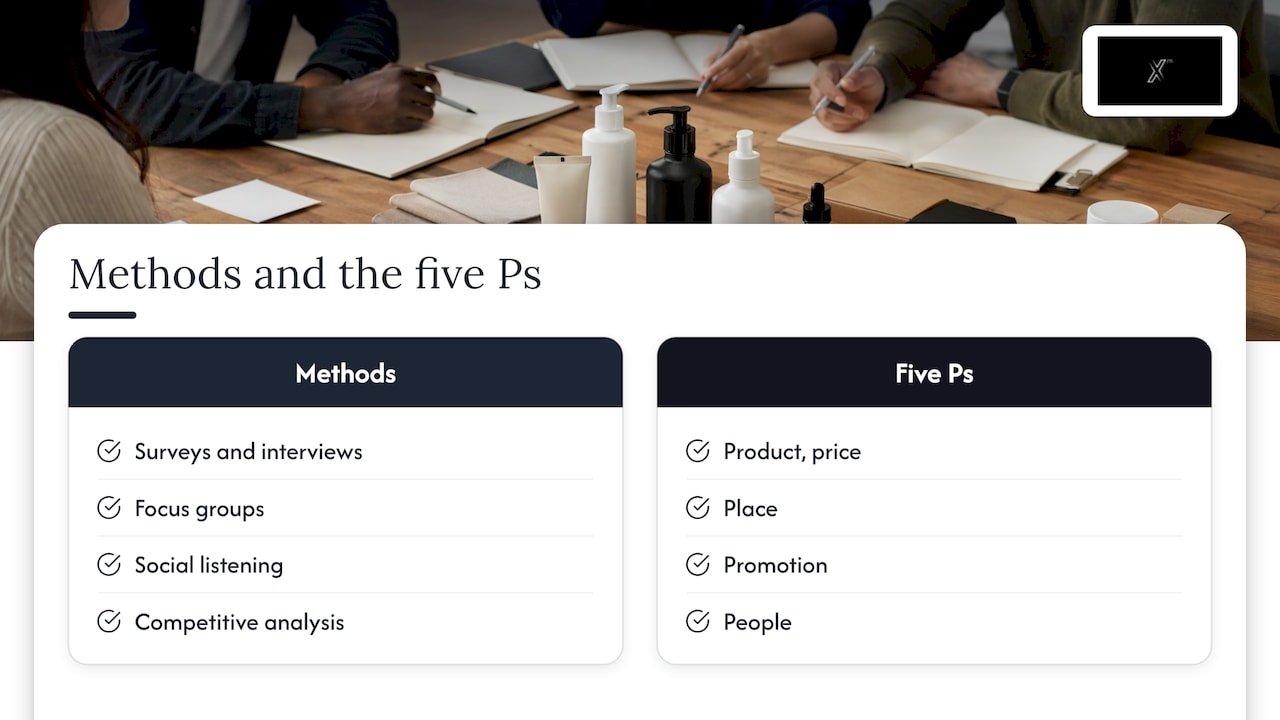
People also ask about “the five methods” and “the five Ps.” The five most widely used methods in marketing teams are surveys, interviews, focus groups, social listening and competitive analysis, and HubSpot notes that most teams combine several to cross-check findings.
The five Ps (product, price, place, promotion, people) are not methods at all. They are the marketing mix used as a checklist of topics a research program should cover. Use them when scoping the study: for each P, ask which decision is open and which question would settle it. The “people” lens is the one most often skipped, and it is where interviews and behavioral data earn their keep.
A worked example: repositioning a B2B service
Imagine a 40-person IT services firm that wants to move from “general support” to compliance-focused services for healthcare clinics.
- Decision: invest in a new positioning and website, or stay general.
- Questions: What do clinic managers find hardest about compliance? Who do they trust to solve it? Which headline makes them request a call?
- Audience: clinic managers and practice owners at clinics with 10 to 100 staff.
- Methods: a week of secondary research and competitor review, eight to twelve interviews, then a short survey and a landing page message test.
- Threshold: proceed if at least one problem statement is named unprompted by most interviewees and the tested message beats the current one on enquiries.
- Output: a positioning brief, message hierarchy and a media and content plan.
The example shows the real value of a strategy: every activity exists to answer a question, and every answer feeds a build. The research becomes the brief for content, media and web work, rather than a separate document.

Analyzing and presenting findings
Most damage happens after fieldwork. Four habits prevent it:
- Write the objectives brief first and open the report with it, so readers see which questions the data answers.
- Separate findings from interpretation. State the data point and the base size (how many people answered), then give your reading in its own section.
- Show base sizes honestly. A percentage from 12 respondents is a direction, not a measurement.
- Attach an owner and a metric to each recommendation, and check the age of any data you reuse.
For teams that want the numbers to keep working after the study, a data strategy connects research, analytics and campaign reporting so the same questions can be tracked over time.
Common mistakes to avoid
- Starting with a method (“let’s run a survey”) instead of a decision.
- Asking leading or double-barreled questions.
- Recruiting a convenient sample rather than the right one.
- Treating the five Ps as a research method.
- Collecting more data than the decision needs.
- Ending with a deck and no owner for the next step.
- Never re-checking: markets move, so set a date to revisit the findings.
How an integrated agency turns research into growth
Research earns its cost when it changes what you build and buy. At Xpert Marketing we operate as a 360° agency that joins strategy, creativity and execution, and our approach draws on market research and analytics to shape omnichannel strategies. That means the people who read your research are the same people who plan media, write content, design the identity and build the site.
If you want research that ends in a launch plan, our Strategy & Consulting, Data & Analytics, Digital Marketing and other services cover the full path, and we can act as your external marketing department when you need one. You can see how this plays out in our Portofoli ynë.
If your team wants to build research skills in-house, we also run digital marketing trainings.
Our perspective
We see market research as the first brick of a connected system, not a standalone report. A study that stops at insight leaves the hardest part, turning it into a brand, a message, a channel mix and a measurable plan, to someone else.
That is why we start with the decision. What will you do differently on Monday if the answer is yes, and if it is no? Once that is written down, the methods, the sample and the budget almost choose themselves.
We also believe in layering evidence. Existing data tells you where to look, conversations tell you why, and larger-scale measurement tells you how much. Strategy, creative and execution under one roof mean the findings reach the people who build your campaigns and your website without losing detail on the way.
Our aim is for every business we work with, from startups to established companies, to leave a research effort with a plan, owners and metrics, and with the confidence to scale what works.
Xpert
Pyetje të Shpeshta
What is a market research strategy?
It is the plan for how you will collect, analyze and report data about a specific market. It starts with what you need to learn and the decision it supports, then selects the methods that will answer those questions. The written plan, with timeline and budget, is how you carry it out.
What are the five methods of market research?
The five most commonly used are surveys, interviews, focus groups, social listening and competitive analysis. Most teams combine several so each result can be checked against another. Which mix fits depends on whether you need to explain behavior or measure it.
What are the five Ps of market research?
They are product, price, place, promotion and people, borrowed from the marketing mix. They work as a checklist of topics your research should cover, not as a research method. Use them when scoping a study to confirm that no major area is left out.
How many questions should a study answer?
Three to five focused research questions is a practical limit for one study. Fewer questions keep surveys and interviews short, make analysis cleaner and make it easier to tie results to a decision. If you have more, split them into phases.
Should I start with primary or secondary research?
Start with secondary research to map what is already known, then use primary research to fill the gaps with feedback directly from your prospects. Firsthand research is usually the most accurate for your own audience, while existing reports give context and benchmarks.
Burimet
- 12 Key Market Research Strategies, Rev
- How to Write a Market Research Plan, QuestionPro
- Introduction to market research, Government of Canada
- Market Research: How Businesses Use It to Win, ISB
- Steps in a Successful Marketing Research Plan, OpenStax
- Research objectives chapter, Kumar, SAGE
- Market Research Workbook, University of Vermont
- Types of Market Research, GWI
- Marketing Research Methods, HubSpot


