

Podcast Marketing Strategy: A Practical Plan for Business Shows
A podcast marketing strategy is a written plan that connects a show to a business outcome, names the listener it is for, and sets out how episodes are planned, promoted, repurposed and measured. Without it, a company podcast becomes a publishing habit that nobody can justify in a budget review. With it, every episode has a job. At Xpert Marketing, we treat podcasting as one part of a connected marketing system, and our podcast service covers the planning, production and measurement this article describes.
This guide is written for business owners and marketing leads in the US, Australia and elsewhere who want a show to build brand, pipeline or customer engagement, not just downloads.
TL;DR
- Start with the business outcome (awareness, thought leadership, leads or hiring), then design the show backward from it.
- Write one listener profile, and give that person a reason to come back to every episode.
- Promote where discovery really happens: friends, social clips, search and app suggestions, with paid ads as a smaller lever.
- Record once, then turn each episode into clips, a written post, a newsletter and search-friendly show notes.
- Measure downloads, listener retention and business results separately, and review them monthly.
Përmbajtja
- Why a podcast needs a strategy first
- Step 1: Choose the business outcome
- Step 2: Define the listener, not the topic
- Step 3: Build a podcast content plan
- Step 4: Promote the show where listeners discover it
- Step 5: Repurpose every episode
- Step 6: Measure what matters
- A realistic weekly routine
- Perspective: why integration decides whether the show pays off
- Where Xpert Marketing fits
- Pyetje të Shpeshta
- Burimet
Why a podcast needs a strategy first
The audience is there. Edison Research’s Infinite Dial 2025 found that 55% of Americans aged 12 and over listen to podcasts monthly, and 51% have watched a podcast. That is a large audience, but it is also a crowded field. Competing for attention means the show needs a defined purpose, not simply a microphone and a schedule.
The Reuters Institute for the Study of Journalism makes a point that applies equally to brands: in its content model for successful podcasting, author Kirsi-Marja Takala argues the most common mistake is ignoring the listener’s reason for listening, and that expensive marketing will not hold an audience if the content strategy is weak. Promotion amplifies a show. It cannot fix one that has no clear promise.
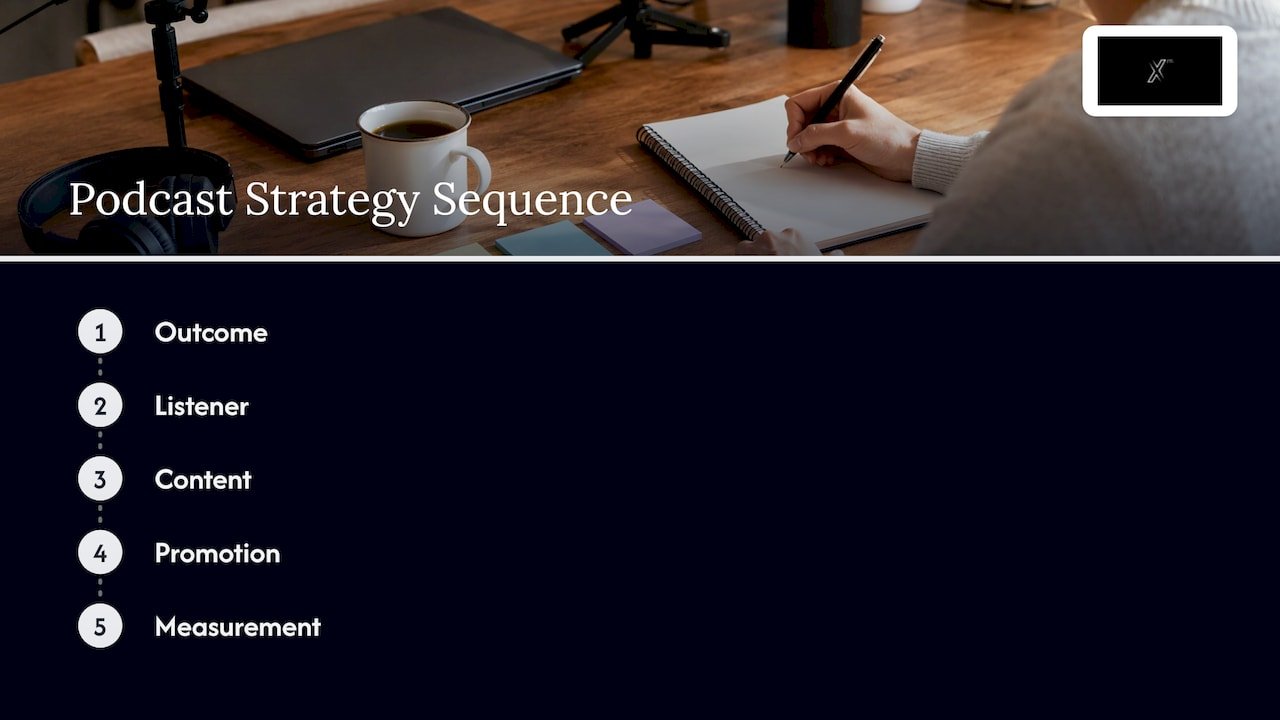
So the order matters: outcome, listener, content, then promotion, then measurement.
Step 1: Choose the business outcome
Pick one primary outcome. Most company podcasts fit one of four types:
| Outcome | What the show does | Typical call to action |
|---|---|---|
| Brand awareness | Positions the company as a recognizable voice in its industry | Follow the show, visit the site |
| Thought leadership | Experts share insights and interview industry figures | Subscribe, connect on LinkedIn |
| Gjenerim klientësh | Episodes lead to a landing page, offer or consultation | Book a call, download a guide |
| Employer branding | Shows the culture and career paths inside the company | View open roles |
A startup entering a market usually starts with awareness and thought leadership. A company with an established sales process may lean toward lead generation. A business going through a rebrand can use the show to demonstrate its new positioning in the company’s own voice, week after week.
Write the goal as a measurable target, for example a number of qualified inquiries per month or a subscriber count by a set date. If you cannot say how you will recognize success, you cannot plan the show around it.
Step 2: Define the listener, not the topic
A podcast “for everyone” reaches no one clearly. Write a one-paragraph profile of your ideal listener: their role, the goal they are working toward, their biggest frustration, the words they use for it, and the reason they would press play on a Tuesday morning.
Two practical ways to build that profile:
- Talk to five customers or prospects and note the exact phrases they use to describe their problem.
- Look at which shows your customers already follow, and what their reviews praise or complain about.
Then test every episode idea against it. If the listener would not recognize their own problem in the title, the episode belongs somewhere else, or nowhere.

Step 3: Build a podcast content plan
A content plan is a repeatable format plus a list of episodes tied to the listener’s questions. Format matters more than most teams expect, because consistency is what lets a listener know what they are getting.
A workable structure for an interview or insight show:
- A short opening hook, ideally under 15 seconds, that states what the listener will get.
- A brief intro of 30 to 60 seconds.
- A first segment of roughly 8 to 15 minutes that leads with the strongest content.
- A second segment that goes deeper.
- A close with one clear call to action and a tease for the next episode.
This outline follows the planning guidance in Hilite’s podcast planning guide. Treat it as a starting point and adjust it once you see where listeners drop off.
On topics, build around three or four recurring themes that map to the listener’s problems and to what your business can credibly speak about. Plan a quarter at a time: 12 to 13 weekly episodes, each with a working title, a guest or speaker, one takeaway and one call to action. Add a trailer and a strong starting episode so a new listener has an obvious place to begin.
Guests as marketing partners
Every guest has an audience. Agree before recording how the episode will be shared, send them ready-made clips and graphics, and tag them in posts. Consistent, good-looking images of hosts and guests also help each episode look credible in a feed, and a team photography refresh is one way companies keep that visual side current.
Step 4: Promote the show where listeners discover it
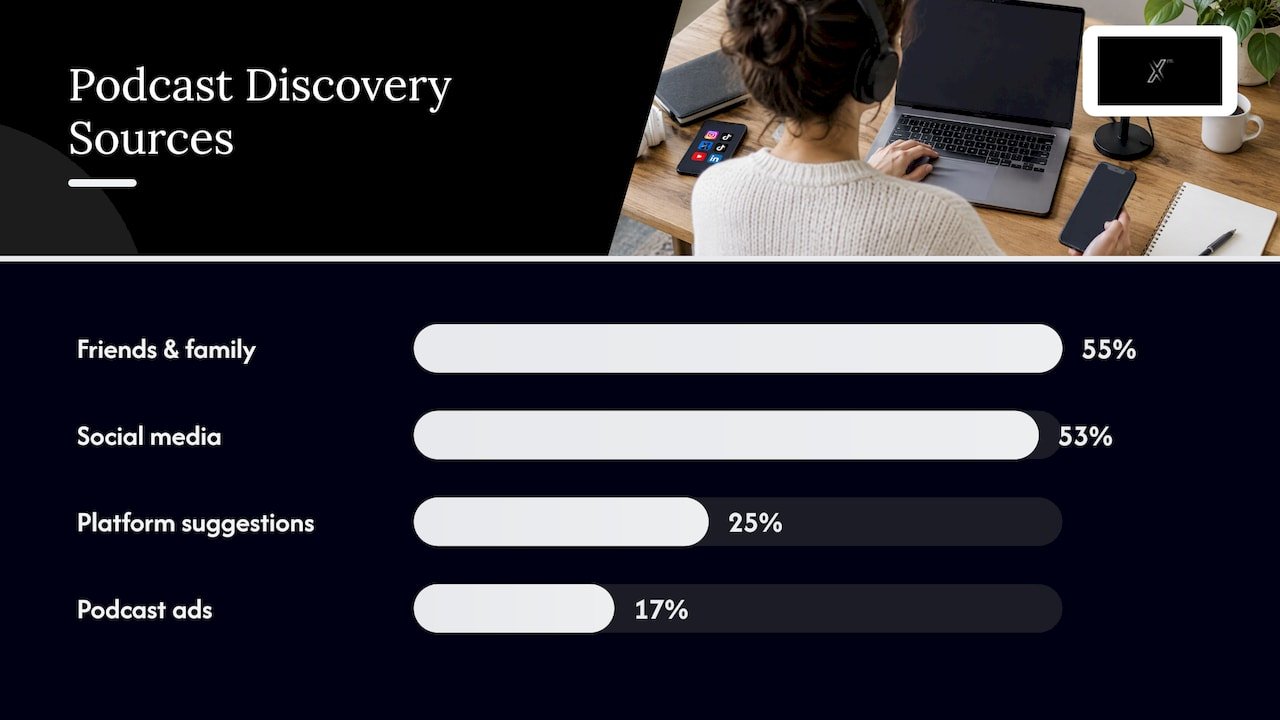
Podcast promotion strategy comes down to matching effort to how people actually find shows. The Podcast Study 2026, a survey of 1,205 US respondents, found that 55% discovered new podcasts through friends and family, 53% through social media, 25% through platform suggestions and 17% through podcast ads. Social media was about three times as effective as podcast ads for discovery.
That shapes where a business should spend its time:
- Word of mouth and relationships. Ask guests, customers and employees to share episodes. Make sharing easy with a pre-written post and a clip.
- Social clips. Short vertical video clips with captions work as trailers for the full episode. Our video marketing strategy guide covers how to plan video for B2B audiences, and our B2B social media roadmap shows how to structure the posting around pipeline.
- Search. Search engines cannot index audio, so a transcript and well-written show notes with the keywords your customers use are what make an episode findable.
- App listings. Titles and descriptions should say plainly what the episode is about, in the words a listener would type into a podcast app.
- Cross-promotion. Appear as a guest on shows with a similar but non-competing audience, or invite their hosts onto yours.
- Paid promotion. Paid placement can add reach once organic habits are working. Treat it as a test with a defined budget, and see our guidance on testing incremental lift before scaling media spend.
Video matters more every year. Edison’s research shows the habit is already mixed: 48% of Americans 12 and over have both listened to and watched a podcast. Recording video with the audio gives you more formats from the same session.
Email as your owned channel
A newsletter gives you a direct line to listeners that no platform algorithm controls. Send a short note per episode with one takeaway, the guest and a single link. Because a newsletter only works if it reaches the inbox, it is worth reading an email deliverability fix for small businesses before you build the list.
Step 5: Repurpose every episode
Repurposing means reshaping an episode into formats that suit each platform, not posting the same file everywhere. One 45 to 60 minute recording can feed a week of content.
A simple weekly workflow for one interview episode:
- Day 0: correct the transcript and write the show notes. This transcript is your single source, so fixes happen once.
- Day 1: publish a short captioned vertical clip.
- Day 2: turn the strongest idea into a blog post that links back to the episode.
- Day 3: post a second clip and one or two quote graphics.
- Day 4: share a LinkedIn post or thread built on a single insight.
- Day 5: send the newsletter.
- Day 6: release a third clip.
That pattern is adapted from BlaBlaScribe’s seven-day calendar. Your cadence can be lighter. The principle is that one recording earns attention in several places, and each piece points back to the show.
A useful filter: for each clip, ask whether it makes sense to someone who has never heard the show. If it needs context, cut it differently.
Step 6: Measure what matters
Podcast data comes from several systems and does not always agree, so decide in advance what you will track and how you will define it. Keep three groups separate:
- Delivery: downloads per episode, tracked as a trend over time rather than a single number.
- Angazhimi: how much of each episode people actually hear, and which topics and formats hold them.
- Business results: qualified inquiries, demo requests, newsletter sign-ups, hires or customer conversations that mention the show.
Record the definition, the period and the source of each metric, and add direct listener feedback to explain what numbers cannot. Review monthly, change one variable at a time, and give a new format enough episodes to show a pattern. Podcast growth tends to build slowly, so judging after three episodes usually means judging too early.
Tie the results back to the goal from Step 1. A show with modest downloads but a steady stream of qualified inquiries may be doing exactly what it was built to do. Our data and analytics service is built for connecting this kind of reporting to marketing decisions.
A realistic weekly routine
After launch, promotion is a habit rather than a project. A manageable week for a small team:
| Task | Time |
|---|---|
| Promote the new episode to existing listeners, clips and newsletter | About 30 minutes |
| Personal pitches to two or three newsletters, shows or publications | About 20 minutes |
| Networking with guests and adjacent hosts | About 10 minutes |
The split follows the weekly hour suggested in RSS.com’s growth playbook. Add a monthly check of listings, chart positions, episode packaging and analytics, and adjust the plan from what you see.
Perspective: why integration decides whether the show pays off
We see podcasting as one channel inside a connected marketing system, not a standalone project. A show works hardest when strategy, creative and execution come from the same team: the positioning that defines the listener, the production that makes the episodes sound and look right, the clips and web pages that carry them into search and social, and the analytics that show what the audience did next.
That is how we approach it at Xpert Marketing. We work as an external marketing department when a business needs one, and we also offer digital marketing training for teams that want to run parts of the plan in-house. For a startup, that can mean a show that supports go-to-market. For a company in the middle of a rebrand, it can mean a consistent voice across every channel. In both cases the aim is the same: measurable growth from content people choose to spend time with.
Xpert
Where Xpert Marketing fits
If you would rather not coordinate strategists, producers, designers, editors and analysts yourself, our Podcast service shapes an idea into a full series with consistent themes, messaging and audience value. It sits alongside our digital marketing work, so episode promotion, clips, email and paid media are planned together. You can see the full range on our services page.
Tell us the outcome you want from the show, and we will help you plan the format, the calendar and the measurement around it.
Pyetje të Shpeshta
How long should a podcast marketing strategy take to show results?
Expect a pattern, not a spike. Podcast audiences tend to compound slowly, so judge a format over a full quarter of episodes rather than a few releases. Track the trend in downloads and listener retention each month, and connect it to your business metric.
What is the best way to promote a new business podcast?
Start with people already close to you: guests, customers and employees. Social clips and shareable posts are the most productive next step, since social media is a leading discovery route for new shows. Add search-friendly show notes and transcripts, then test paid promotion with a small defined budget.
How often should we publish?
Choose a cadence you can sustain for at least a year, usually weekly or every two weeks. Consistency matters more than volume, because listeners return for a predictable format and a clear promise.
Is the podcast market too crowded for a new show?
A broad show will struggle, but a focused one can find its listeners. With 55% of Americans 12 and over listening monthly, according to Edison Research, there is a large audience. A specific listener profile, a distinct angle and a promotion routine are what help a show stand out.
Burimet
- The Infinite Dial 2025, Edison Research
- Focus on your listeners: how to build a content model for successful podcasting, Reuters Institute
- The Podcast Study 2026
- How to Plan a Podcast: Free Planning Template and Guide, Hilite
- Repurpose Podcast Content: A 7-Day Calendar, BlaBlaScribe
- The Podcast Growth Playbook, RSS.com


