

Brand Storytelling: Build a Story Customers Remember
Brand storytelling is the practice of turning what your company believes, who it serves and what it changes into one clear narrative, then telling that narrative the same way in everything you publish. It works when the story is true, specific to your customer and carried by a real system, not by a single campaign. Below you will find what a brand story contains, a simple four-part framework, how to adapt it across channels, examples worth learning from and how to tell whether it is working.
TL;DR
- A brand story is a strategic narrative about why you exist, who you help and what changes for them. It is not your company history.
- Build it from four parts: a hero (your customer), a tension, a resolution and proof you can back up.
- Keep the message constant and let the format change per channel. Research suggests that holding your logo steady matters most for ad preference.
- Measure it with leading signals (engagement, branded search, customer language) and lagging ones (conversion, repeat purchase).
- Stories scale when a strategy, creative and execution team work from one narrative document.
Table of Contents
- What brand storytelling actually is
- Why it matters for customer connection and growth
- A four-part brand narrative framework
- How to tell your brand story, step by step
- Keeping the story consistent across channels
- Brand storytelling examples and what they teach
- How to tell whether your story is working
- Our perspective: a story is an operating system, not a campaign
- Turn your story into a working marketing system
- FAQ
- Sources
What brand storytelling actually is
Brand storytelling is a strategy in which a company uses narrative to communicate its identity, values and message to customers, as Harvard Business School Online describes it. The story is the foundation. Ads, blog posts, videos, social posts and sales decks are how you tell it.
That difference matters if you are a business owner deciding where to start. Three things are often confused with a brand story:
- Company history. A timeline of founding dates and milestones is a record. A story picks the parts of your history that explain why you do the work and leaves out the rest.
- A slogan or tagline. A tagline is one line the story can produce. It is not the story.
- Product advertising. Feature-led ads tell people what you sell. A story explains why it matters to them.
If you are early in your thinking, it helps to see why service business branding matters, because a story only holds together when the brand underneath it is clear about who it serves and what it promises.
Why it matters for customer connection and growth
Stories do three jobs that facts alone do not. According to the Harvard Business School professor Jill Avery, a story can capture attention, evoke strong emotion and build empathy, which leads to engagement and action. People remember narratives more easily than lists of benefits, and they repeat them.
The academic evidence points the same way:
- A 2023 literature review of 78 papers found that marketing storytelling elicits brand identification, awareness and customer engagement, and supports self-expression and a sense of belonging.
- A 2025 experimental study of Instagram users found that the perceived value of storytelling pieces generated high engagement with the advertised service, across functional, emotional and social value.
- A 2020 study of 254 US consumers on Nike’s Kaepernick campaign showed that the values a story expresses shape purchase intention. Viewers who identified with themes of dominance and egalitarianism were more likely to buy. Those who held uncritical patriotism were less likely.
The last finding is useful for any owner: a story that takes a clear position attracts the customers who share it. It does not have to please everyone.
Storytelling also supports lower-cost growth. McKinsey’s work on the community flywheel argues that when customers tell the brand’s story for it through user-generated content, marketing spend can stay relatively low as a share of sales, while engagement metrics matter more.

A four-part brand narrative framework
You do not need a complicated model. Most strong brand stories can be written as four parts. Write each in one or two sentences, then combine them into a single page.
1. The hero: your customer
The hero of your brand story is the person or business you serve, not your company. Describe them precisely: a first-time founder launching in a crowded market, a regional retailer that has outgrown its website, a family business that wants to look as established as it is. The brand plays the guide.
2. The tension: what is wrong with the status quo
Name the gap between where the customer is and where they want to be. Jill Avery frames this as the gap between ‘what is’ and ‘what could be’. The sharper you make this tension, the more recognizable your story feels to the reader.
3. The resolution: the change you make possible
Describe the transformation, not the service list. “We build websites” is a description. “A buyer who used to bounce now books a call” is a resolution. Keep it to one outcome your customer would recognize.
4. The proof: why anyone should believe it
A story without proof reads like an ad. Proof can be a customer result, a process, a number you can verify or a founder’s real reason for starting. The Philips case below shows why this part cannot be skipped: emotional storytelling holds up when it rests on a functional truth.
The 2023 literature review noted above identifies content, classification and character as the elements that recur when stories are built. Your four parts cover the same ground: the hero is the character, the tension and resolution are the content, and the proof gives the story its category and credibility. If you want to connect this to your wider positioning, our guide to a brand strategy framework shows where the narrative sits next to purpose, audience and brand promise.
How to tell your brand story, step by step
Here is the process in the order that works for most small and mid-sized businesses.
- Interview your customers and your team. Ask why customers chose you, what they were struggling with before and what they now do differently. Their words become your raw material. The mistake here is relying on what the leadership team assumes. Customer language is almost always plainer and more specific.
- Define purpose and audience in writing. Write who you serve, what you believe and what you promise. Include a boundary: something you will not do. Boundaries make a story credible.
- Draft the one-page narrative. Combine hero, tension, resolution and proof. Add the three to five themes you will return to. Each theme should be something you can show with evidence.
- Choose the true parts of your history. Canto’s guide to brand stories makes the useful point that a brand story is a marketing tool, not a full account of company history. Highlight the moments that explain why you do this work. Never invent a founding myth. Customers check, and a single exposed exaggeration costs more than the story earned.
- Assign each channel a job. Your website converts, email nurtures, social builds recognition, video carries emotion and sales conversations handle objections. The story is the same. The treatment differs.
- Produce a first set of assets. Start small: a brand story page, a short video, three social posts and one customer story. Test them before you scale.
- Review quarterly. Read a month of your published work as a stranger would and ask whether the story is still recognizable.
The heavy lifting in steps 3 to 6 is where many owners stall, because it needs strategy, writing, design and distribution to work together. Our creative and content production team covers copywriting, graphic design, video, photography and podcast, so the narrative you define becomes finished assets without being passed between separate vendors.
Keeping the story consistent across channels
Most advice says to be consistent everywhere. The research suggests being precise about what to keep consistent.
A 2025 conjoint study from HEC Montréal tested what consumers actually prefer in ads. Only logo consistency, especially logo spacing, significantly affected ad preference. Consistency of key message, tone of voice and visuals did not show a significant effect in that experiment. The authors note that much of the earlier support for cross-platform consistency rests on business cases and intuition.
What does that mean for your business?
- Fix your visual anchors. Logo, colors and typography should stay stable everywhere. A visual identity system with clear guidelines makes this easy for every designer and agency you work with.
- Keep the core narrative stable, adapt the format. Do not paste the same post on every platform. A fifteen-second video can carry only the tension. A longer video or article can show the full transformation. An email can serialize the proof over several messages.
- Write it down once. A single one-page narrative that every brief links to prevents drift when more people create content.
If you want the bigger picture of how story, identity and channels connect, our article on Marketing 360 as a system explains why isolated tactics rarely add up to a brand.
Brand storytelling examples and what they teach
Examples are most useful when you extract the principle, not the production budget.
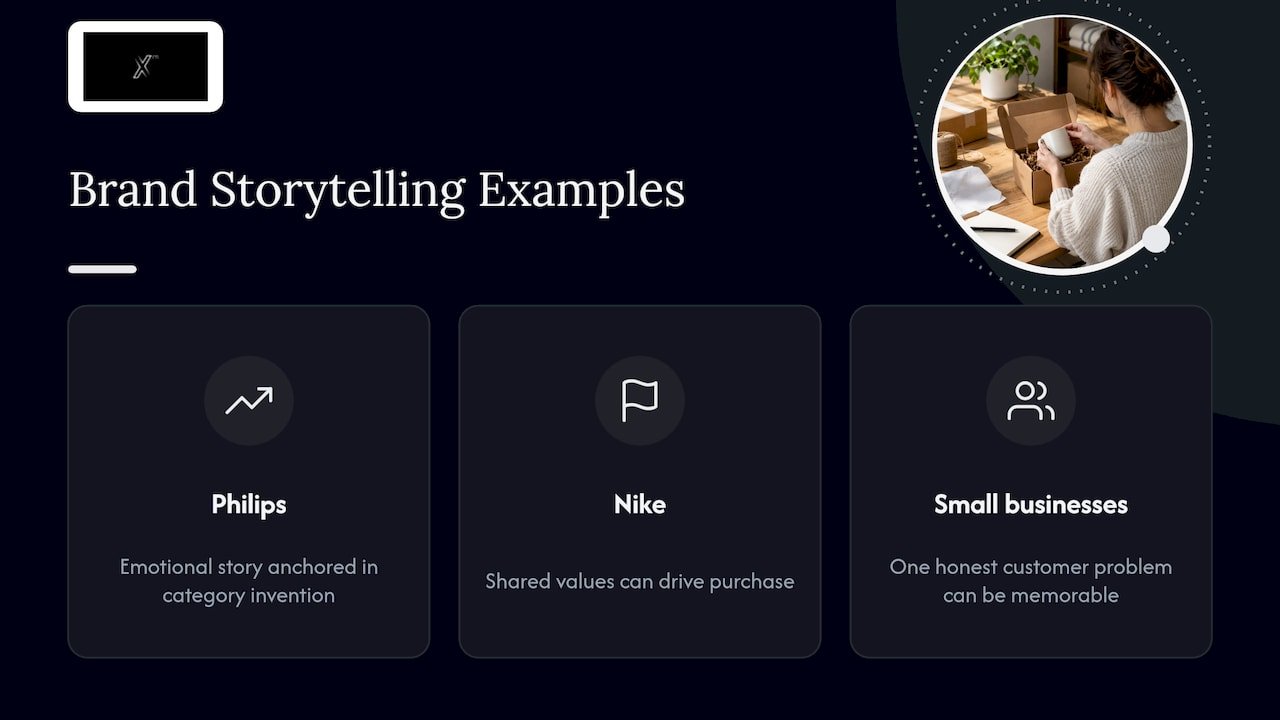
Philips airfryer. An award-winning case study reported that the “Loves the Food You Love” campaign grew market share 900% year over year within 12 months, and lifted brand preference from 10% to 23%. The lesson: the emotional story worked because it sat on a functional truth, the brand’s status as the inventor of the category. Your story needs the same anchor, something real you can claim.
Nike. The Kaepernick campaign shows that a story with a clear value position polarizes, and that polarization can still drive purchase among the audience who shares the value. It also shows the risk: taking a stand only works when the stand is genuinely yours.
Smaller businesses. You do not need a global budget. The AMEC case study also illustrates that ideas which earn attention can outperform simply outspending competitors. A startup can tell the story of one customer problem in a specific, honest way and be remembered for it.
For a deeper B2B angle, see our page on storytelling in marketing, which covers method and business-to-business practice.
How to tell whether your story is working
Results from storytelling are rarely instant, so track two groups of signals.
Leading signals (weeks):
- Time on page and scroll depth on story pages
- Video completion and saves or shares, which are strong signs a story resonates
- Customers and reviewers repeating your phrases back to you
- Growth in branded search
Lagging signals (months):
- Conversion rate from story-engaged visitors compared with other visitors
- Repeat purchase or renewal rates
- A falling blended customer acquisition cost
- Shorter sales cycles in B2B
Set a baseline before you launch, then compare after each quarter. Without a baseline, any improvement is a guess. This is where analytics work pays off: our data and analytics service is built around tying marketing activity to measurable outcomes, so story performance is read from your own numbers.
Our perspective: a story is an operating system, not a campaign
We often meet businesses that have a good story and no way to carry it. The founder can tell it in a meeting, but the website says something else, the social posts say a third thing and the sales deck a fourth.
Our view is that brand storytelling only pays when strategy, creativity and execution sit together. The strategy decides what the story is. The creative work makes it feel true. The execution makes sure it shows up everywhere your customer looks, in the right format, with results you can measure.
That is why we work as one team across branding, content, digital marketing, media and analytics, and can act as an external marketing department when a company needs one. A narrative written once and applied everywhere is easier to keep honest, and easier to improve as the data comes in.
If your business is rebranding, launching or scaling, start with the story. Everything else gets cheaper and clearer once it is settled.
Xpert
Turn your story into a working marketing system
If you want a narrative that is defined, produced and measured by one team, our services cover strategy and consulting, branding and visual identity, creative and content production, digital marketing, PR and communication, web and tech and data and analytics. You can also read how we build brands that scale, or contact us through the Xpert Marketing site to talk about your story.
Business owners in the US and Australia, including Sydney, can work with us on a project or retainer basis, from a single brand story to a full go-to-market plan.
FAQ
What is the difference between a brand story and brand storytelling?
The brand story is the narrative itself: why you exist, who you help and what changes for them. Brand storytelling is the ongoing practice of telling it through content, design, PR and customer experience. You write the story once and tell it for years.
How long should a brand story be?
The core version should fit on one page, and its essence in one or two sentences. Longer versions, such as an about page or a video, are expansions of that core. A short core is easier for every team member and partner to repeat accurately.
Should every channel say exactly the same thing?
No. Keep the core message and your visual anchors, especially the logo, stable. Adapt the length, format and emphasis to each channel. Research from HEC Montréal found logo consistency to be the factor that most affected ad preference.
How do I know if my brand story is resonating?
Watch engagement (shares, saves, completion), branded search and the words customers use about you. Then check conversion, repeat purchase and acquisition cost over a quarter or more against a baseline you set before launch.
Can a small business or startup use brand storytelling?
Yes. A startup often has an advantage because its founding reason is recent and real. Focus on one customer problem, one clear resolution and proof you can show, and apply it consistently across your website, content and outreach.
Sources
- What Is a Brand Story? | HBS Online
- What Do #Storytelling and #Marketing Have in Common? Literature review, Springer
- Supporting sacrifice or condemning belief, Inderscience
- Engagement and Purchase Intention in Storydoing and Storytelling, index.comunicación
- A better way to build a brand: The community flywheel, McKinsey
- Cross-platform consistency study, HEC Montréal
- Most Effective Planning Research for Consumers, AMEC
- Why you need an impactful brand story, Canto
- Why Your Service Business Brand Matters, GURU Business


