

Content Marketing Strategy: How to Build One That Pays
A content marketing strategy is a documented plan that says why your business creates content, who it is for, what you will publish, where it will be distributed and how it will move a business result such as revenue, lower costs or better customers. It is not a posting schedule. The schedule comes later. This guide walks through the steps, a working framework, examples of what good looks like and the measurement that keeps the whole thing honest.
TL;DR
- A strategy answers why, for whom and how you will win. A content plan or calendar only schedules topics, dates and owners.
- Follow seven steps: know the audience, set measurable goals, audit what you have, plan topics and formats, create, distribute, then measure and adjust.
- Distribution and measurement beat volume: recent B2B research finds high performers publish about the same amount as everyone else but amplify more.
- Start with one cornerstone asset and repurpose it across channels instead of inventing fresh content for each one.
- Name an owner, an approval path and a metric tied to pipeline before you publish anything.
Table of Contents
- What a content marketing strategy is, and what it is not
- The decision filter: your content mission
- How to build a content marketing strategy in seven steps
- A simple framework you can fill in on one page
- Build once, repurpose often
- Content marketing examples: what good looks like
- Measure what the business cares about
- Our perspective: a strategy is a connected system
- Where we can help
- Common mistakes to avoid
- A 30-day start plan
- FAQ
- Sources
What a content marketing strategy is, and what it is not
The terms get mixed up constantly. The Content Marketing Institute separates content marketing strategy, content strategy and content plan, noting that people use them interchangeably even though each is a little different. In practice, the useful split is this:
| Layer | The question it answers | Typical output |
|---|---|---|
| Content marketing strategy | Why do we create content, for whom, and what business result should it drive? | A written mission, audience definition, goals, channel choices, operating model |
| Content plan | What do we publish, when, and who owns it? | Topics, formats, dates, owners, calls to action |
| Content calendar | What goes live this week? | A schedule of individual assets |
A useful way to see the gap is to read a practitioner explanation of how strategic direction differs from a content plan. The short version: without the top layer, every request from sales, leadership or a product team looks equally urgent, and the calendar fills with whatever shouted loudest.
The Content Marketing Institute lists five components that a documented strategy usually contains: a business case, an operations plan, audience personas and journey maps, a brand story and a channel plan. You do not need a 40-page deck. You need those five answers written down where the team can find them.
The decision filter: your content mission
The central question is not what you can publish. It is why you are creating content, whom it helps and how it can help that audience in a way competitors do not, as the Content Marketing Institute frames it. A documented mission gives you a filter for topics, formats and channels.
Write it in one or two sentences:
We help [specific audience] do [specific job] by publishing [specific kind of content], so that [business outcome].
A B2B software company might write: we help finance managers at mid-sized companies close the books faster by publishing practical guides and templates, so that they trust us when they evaluate tools. Now a topic about office culture trends gets a quick no, and a template for month-end reconciliation gets a yes. That is the mission doing its job.
How to build a content marketing strategy in seven steps
The commonly taught process has seven steps. Salesforce’s content strategy guide follows the same arc: understand the audience, set goals, audit, plan, create, distribute, measure. Here is how we would apply each one.
1. Understand the audience
Start with the people who actually buy, not a generic persona. Interview five to ten customers and two or three salespeople. Ask what they searched for before they contacted you, what almost stopped them from buying and which questions come up on every call. Those answers are your first topic list, and they are better than any keyword tool at telling you what matters.
Map the answers to the buying journey: awareness, consideration, decision and post-purchase. Most teams skew to the top. Contentful’s 2026 benchmark write-up reports that on average 31% of content targets the top of the funnel, 25% consideration and 18% decision-stage content. If your own mix looks like that, the decision stage is where easy gains usually hide.
2. Set measurable goals
Pick one primary goal and no more than two supporting ones. Salesforce recommends SMART goals: specific, measurable, achievable, relevant and time-bound. Compare:
- Weak: get more traffic.
- Better: generate 40 sales-qualified leads per quarter from content by the end of Q2.
If you cannot connect the goal to revenue, cost or customer quality, it is a vanity goal and you should say so in the document.
3. Audit what you already have
List every asset: blog posts, case studies, decks, webinars, videos, email sequences. For each, record the topic, funnel stage, last update, traffic or engagement, and whether sales actually uses it. Then sort into four piles: keep, update, merge, retire. Salesforce also suggests a SWOT-style look at your position during this stage, which helps you see where you are credible and where a competitor owns the conversation.
Most audits reveal the same thing: three or four assets do most of the work, and a long tail has not been touched in two years. Refreshing the winners usually beats creating new pieces.
4. Plan topics and formats
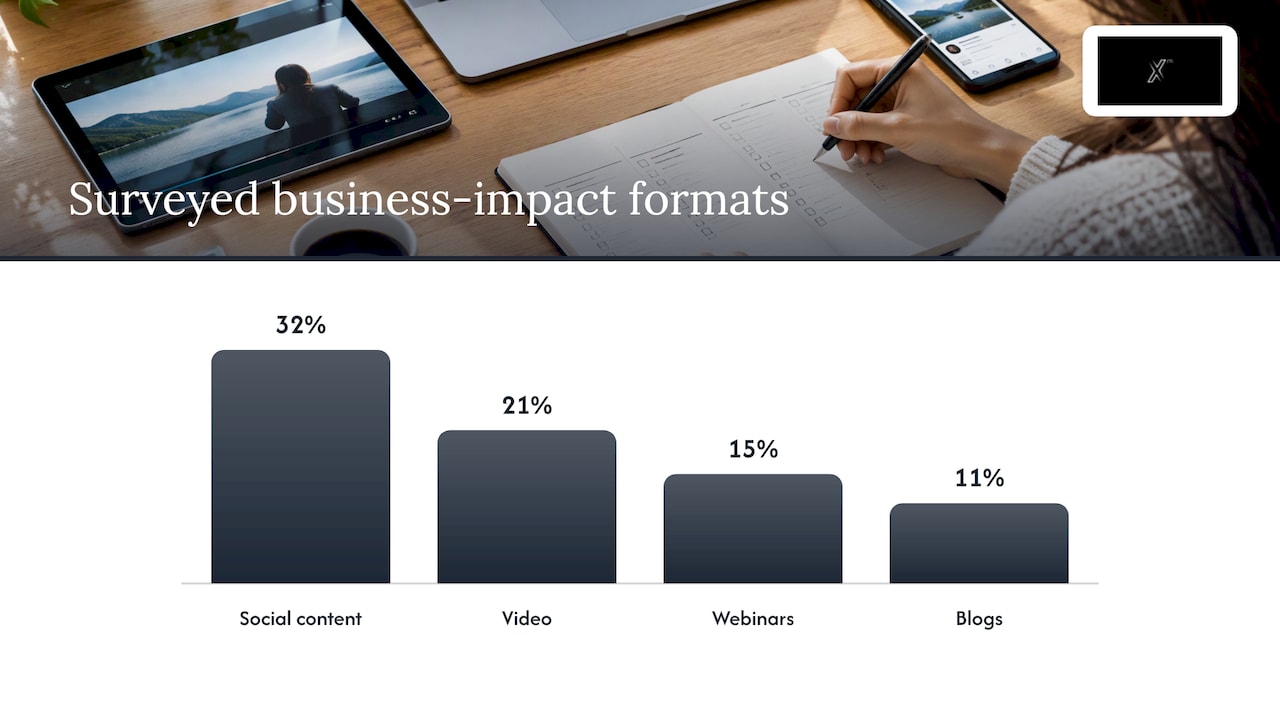
Choose formats by what your audience consumes and what your team can sustain, not by trend. The same B2B benchmark research reports which formats executives credit for business impact. In the 2025 survey of 321 North American B2B SaaS respondents, social content was named the top business-impact format by 32%, video by 21%, webinars by 15% and blogs by 11%. That is one sector and one survey, so treat it as a prompt to test, not a rule. A services firm with a long sales cycle may find written case studies and email do more than short video.
Group topics into three or four pillars that tie back to the mission. Each pillar gets a cornerstone asset (more on that below) and a set of supporting pieces.
5. Create and optimize
Brief every piece with the same short template: audience, funnel stage, the one question it answers, the call to action, the metric. Add search and AI-answer optimization at the brief stage rather than as a final pass. If you want to see how that planning feeds team targets, our piece on AI search optimization and GEO KPIs covers it.
6. Distribute and promote
This is the step teams underfund. The Contentful benchmark report finds that high performers publish similar volumes to their peers, but invest more consistently in amplification and spread content more evenly across the funnel stages. In other words, the winner is rarely the team that writes the most.
Build a distribution checklist for each asset: owned channels (site, email, social profiles), earned (partners, press, communities) and paid. Email deserves a real place in it. If you are choosing tools to send and segment, a guide to email marketing automation and CRM workflows shows what that setup involves. For paid amplification, test before you scale: our article on media planning and incremental lift explains how. If LinkedIn is your main B2B channel, the 90-day B2B social media roadmap gives a pipeline-oriented plan.
7. Measure and adjust
Review monthly for leading indicators and quarterly for pipeline. Decide in advance what would make you stop, change or double down on a pillar. We cover the measurement detail in its own section below.
A simple framework you can fill in on one page
If you searched for a content strategy framework, this is the one-page version we recommend. It follows the CMI components, trimmed to what a small team can actually maintain.
- Business case. The goal, the metric, the target and the date.
- Audience. One primary segment, the job they are trying to do, their top five questions.
- Mission. The one-sentence filter described above.
- Pillars. Three or four themes, each with a cornerstone asset.
- Channels. Two or three where the audience already is, with a distribution checklist.
- Operating model. Owner, contributors, approval steps, publishing cadence, tools.
- Measurement. Leading and lagging metrics, review rhythm, decision rules.
The operating model is where good strategies quietly die. A content strategy toolkit from a national marketing team describes content strategy as something that needs clear ownership, approval rules, resources, governance, promotion and measurement. At enterprise scale, marketing, sales, SEO, analytics, legal, regional and technology teams may all affect execution. For a smaller company the list is shorter, but the principle holds: decide who can say yes, who must review and how long review may take. Our own view of this is in the Marketing 360 system overview.
Build once, repurpose often
The fastest way to escape the content treadmill is a cornerstone model. The Content Marketing Institute describes starting with a distinctive asset, such as original research, a guide, an event or a course, and then repurposing it into core articles, podcast or webinar content and finally short social, email or video cuts.
Here is what that looks like for a hypothetical logistics software company:
- Cornerstone: an annual survey of 200 warehouse managers on labor planning.
- Core pieces: a report landing page, three articles on the strongest findings, a webinar with two customers.
- Short cuts: a dozen charts for social posts, a four-email nurture sequence, short clips from the webinar for sales to send prospects.
One research effort feeds a quarter of content across channels, and every piece points back to the same message. That is also much easier to brief, approve and measure than twenty unrelated topics.
Content marketing examples: what good looks like
Readers often ask for named brand examples. Rather than hold up a big-brand campaign nobody can copy, here are three patterns that work at almost any size, each reduced to the decisions behind it.
The problem-first guide. A company in a complicated category publishes the definitive plain-language guide to a buying decision. It ranks for early research, then links to a comparison page and a consultation. The strategy decision: own the questions buyers ask before they know vendors exist.
The proof library. Case studies built around one number and one quote each, organized by industry and company size, used by sales in follow-up emails. The strategy decision: treat decision-stage content as a sales tool, not a blog afterthought.
The expert series. A podcast or interview series with customers and industry practitioners, cut into short clips and quotes. The strategy decision: borrow credibility and reach from guests, and give the team a repeatable format.
Notice what none of these rely on: volume. Each starts with a clear audience and a place in the buying journey.

Measure what the business cares about
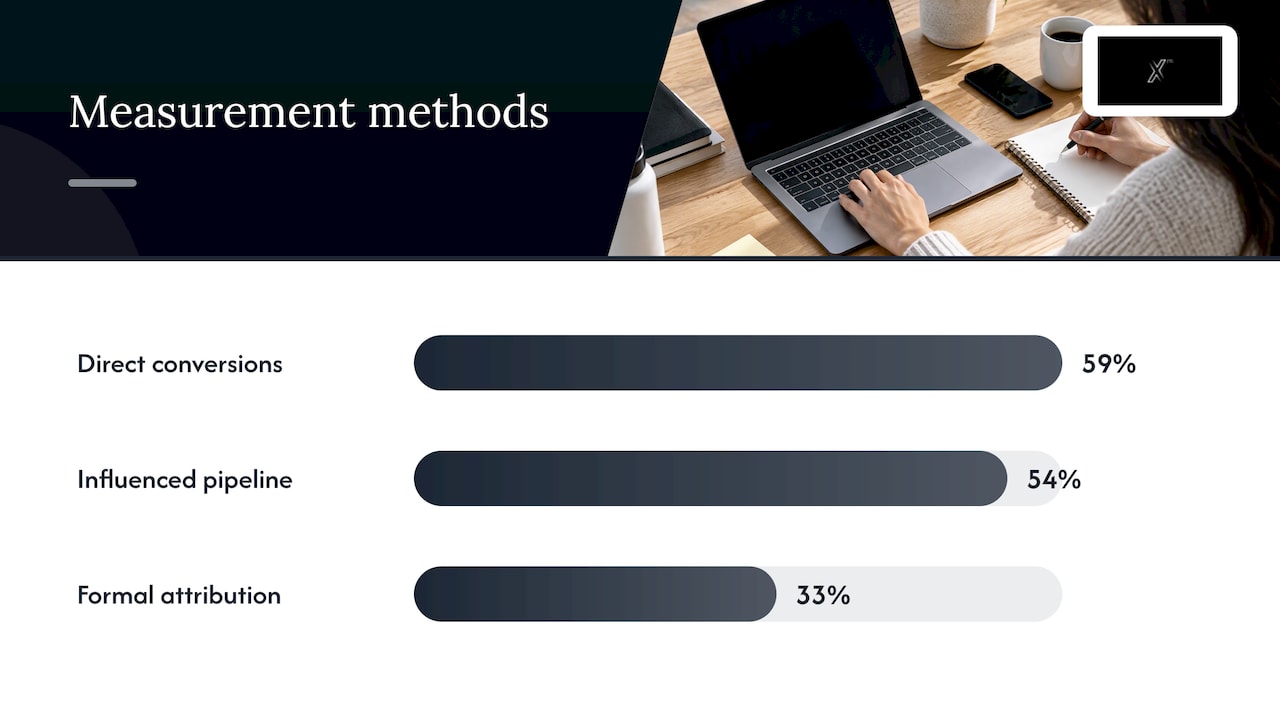
Most teams can count views. Fewer can say what content did for revenue. The benchmark survey cited above found that 59% of respondents measured direct conversions and 54% measured influenced pipeline, while only 33% used formal attribution models. So attribution is a gap even among teams that track results.
A practical measurement stack has three tiers:
- Reach and engagement: organic visits, email click rates, video completion. These tell you whether the content is found and read.
- Conversion: form fills, demo requests, newsletter signups from specific assets.
- Commercial impact: influenced pipeline, sales-cycle length, win rate when content was consumed.
If your sales cycle is long, last-click reports will undersell content that works early. Our guide to marketing attribution models by sales cycle explains how to choose. For thinking about which indicators predict outcomes rather than just record them, this article on tracking a small set of leading KPIs is written for public affairs teams but the logic of choosing five to seven predictive indicators carries over to marketing.
Set a review rule you will actually follow. Example: if a pillar produces no qualified conversations after two quarters despite promotion, rework the angle or retire it.
Our perspective: a strategy is a connected system
At Xpert Marketing, the pattern we see most often is not a shortage of content. It is content disconnected from everything around it: a blog that does not match the brand voice, social posts that do not point to a landing page built to convert, and reports that stop at impressions.
We treat content as one part of a connected system of strategy, creative production, digital channels and analytics. That is why we start with research and measurement questions before we talk about formats, and why we are comfortable acting as an external marketing department when a team lacks capacity. Our view is that a strategy earns its keep when the person writing the post, the person running the distribution and the person reading the dashboard are working from the same page.
Two habits we would pass on. First, write the metric into the brief before the draft exists. Second, give every asset a distribution plan on the day you commission it, not the day it is published.
— Xpert
Where we can help
If you want a partner for the strategy and the execution, our Digital Marketing team handles content, social, SEO, paid and email, and our Data & Analytics team sets up the measurement behind it. If you want your own team to run the program, we also offer digital marketing trainings. You can see the full range on our services page. For a B2B-specific walk-through from audit to measurable pipeline, read our B2B content strategy guide.
Common mistakes to avoid
- Starting with the calendar. A full calendar with no mission produces consistent, forgettable content.
- Copying a competitor’s topics. You inherit their positioning and none of their authority. Look for the angle only you can credibly take.
- Publishing and moving on. If promotion is not budgeted in time or money, the asset will underperform.
- Ignoring existing assets. Refresh and repackage before creating from scratch.
- Measuring only activity. Posts published and followers gained are inputs, not outcomes.
For a wider set of habits that support all of this, see our marketing tips every business should follow to grow online.
A 30-day start plan
Week 1. Interview customers and sales, write the mission and pick the primary goal and metric.
Week 2. Run the content audit and mark keep, update, merge and retire.
Week 3. Choose pillars, pick the first cornerstone asset and write briefs. Name owners and approvers.
Week 4. Produce the cornerstone, set up the distribution checklist and dashboard, and schedule the first monthly review.
By day 30 you will not have results, but you will have a strategy a new team member could pick up and follow, which is the real test of whether it is a strategy at all.
FAQ
What is a content marketing strategy?
It is a documented plan for why you create content, who it serves, what you publish, where you distribute it and how it affects business results. It is broader than a content plan, which lists tactical topics, dates and owners.
What are the seven steps in creating a content strategy?
Understand your audience, set measurable goals, audit existing content, plan topics and formats, create and optimize content, distribute and promote it, then measure results and adjust. The order matters because goals and audience research decide every choice after them.
How is a content strategy different from a content calendar?
The strategy sets the business rationale, audience, mission, channels, operating model and measurement. The calendar only schedules individual assets. Without the strategy, a calendar tends to fill with whatever is requested most loudly.
How much content do we need to publish?
Less than most teams assume. Benchmark research on B2B SaaS companies reports that high performers publish at similar volumes to peers and differ mainly in how consistently they promote content. Choose a cadence you can sustain and promote well.
Sources
- Developing a Content Marketing Strategy, Content Marketing Institute
- Create a Content Marketing Strategy in 3 Steps, Content Marketing Institute
- Content Strategy: What is it, and how to create one, Salesforce
- Five hard truths about successful content marketing in 2026, Contentful
- B2B SaaS Content and Website Performance Benchmarks, Contentful
- Content Strategy Toolkit, best practices guide


