

Marketing Technology Integration: A Practical Guide for Business Owners
Marketing technology integration means connecting the tools you already pay for, such as your website, CRM, email platform, ad accounts and analytics, so they share data and work from one picture of the customer. Done well, it is a strategy first and a technical project second. That is why we build it at Xpert Marketing as part of a single plan that joins strategy, creative work and execution, rather than as a pile of connectors added after the fact.
This guide explains what integration involves, why most stacks underperform, and how to plan and measure it. It is written for owners and marketing leads in the US, Australia and beyond who want the tools to pay for themselves.
TL;DR
- Integration means two or more platforms that used to run separately now exchange data, so each campaign can be judged and personalized with the full customer picture.
- Most stacks waste money: Gartner reports that only 49% of martech tools are actively used, and Bain finds leaders are twice as likely to actively integrate and use their tools.
- Start with the customer journey and the business goal, not the tool list. Each tool must earn its place at a stage of the journey.
- Give every field and every tool one owner and one system of record, then measure against a baseline set before launch.
- Our team can run the strategy, the CRM and automation setup, and the analytics in one engagement.
Table of Contents
- What marketing technology integration actually means
- Why most stacks underdeliver
- The tools that usually get connected
- How to plan marketing technology integration, step by step
- Privacy and consent travel with the data
- Choosing and scaling your stack
- Measuring whether integration worked
- Where we come in
- Our perspective
- FAQ
- Sources
What marketing technology integration actually means
A marketing stack is the set of tools you use to attract, convert and keep customers. Northwestern’s Medill IMC program describes it as the combination of tools, platforms and software that work together to streamline marketing workflows.
Integration is what makes them work together. One Martech Series white paper defines it as connecting two or more platforms that previously operated in isolation so they can ingest each other’s data. The payoff it names is better insight, more relevant audiences and a clearer view of which marketing efforts succeed. It also describes a more precise message: the right person gets the right message at the right moment.
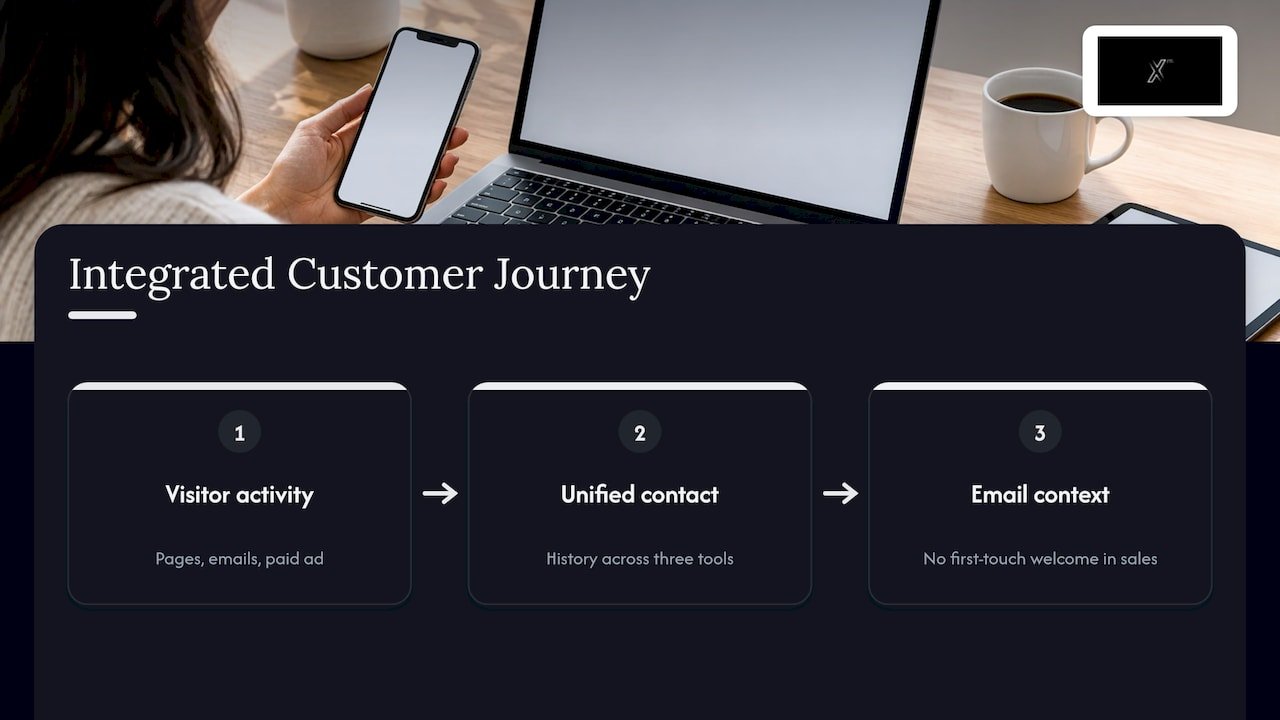
A simple example: a visitor reads three pages on your site, opens two emails and clicks a paid ad. Without integration, that is three unrelated records in three tools. With it, your sales team sees one contact with a history, and your email platform knows not to send a first-touch welcome to someone who is already in a sales conversation.
Integration versus an integrated campaign
The two ideas are related but different. An integrated campaign keeps one consistent message across channels. Technology integration is the plumbing that lets you deliver and measure that consistency. A recent academic literature review on omnichannel communications found that integrating touchpoints is the most important mechanism for customers, because it makes the experience more consistent and reduces the effort of deciding. If you are planning the campaign side as well, our guide to an integrated marketing campaign covers it.
Why most stacks underdeliver
Buying more software rarely fixes a marketing problem. Gartner’s marketing technology research reports that only 49% of martech tools are actively used, that just 15% of organizations qualify as high performers meeting strategic goals with positive ROI, and that martech takes nearly 22% of total marketing spend. In plain terms, half of what companies pay for sits idle.
Bain & Company’s December 2025 study points to the difference between leaders and laggards. Leaders are 1.2 times more likely to run on a primary platform with select best-of-breed tools layered in, customized only for the most valuable areas. They are also 2 times more likely to actively integrate and use their tools for measurable impact.
The pattern for a growing business is clear:
- Tools are added one at a time, each solving a single request.
- Nobody owns the data that moves between them.
- Reports from the ad platform, the email tool and the CRM disagree, so nobody trusts any of them.
- The team falls back on spreadsheets, and the integration never happens.
That is an operating problem as much as a software one, which is why it helps to have strategy, content and technology planned together.
The tools that usually get connected
Most small and mid-sized businesses connect the same core pieces. Shopify’s stack guide groups them usefully:
| Layer | Typical tools | What the connection gives you |
|---|---|---|
| Foundation | Website CMS (such as WordPress), CRM | One home for content and one record per customer |
| Channel tools | Web analytics, email platform, social tools, SEO tools, ad platforms | Activity from every channel tied back to the same contact |
| Advanced layer | Attribution, SMS and marketing automation, customer data platforms, BI dashboards, tag management | Cross-channel measurement and automated follow-up |
The CRM is usually the hub. If you are weighing that decision, our CRM implementation strategy guide walks through it, and CRM integration in marketing shows how CRM and automation fit together. If your data lives in an older system, the CRM data migration plan explains how to move it cleanly.
How to plan marketing technology integration, step by step
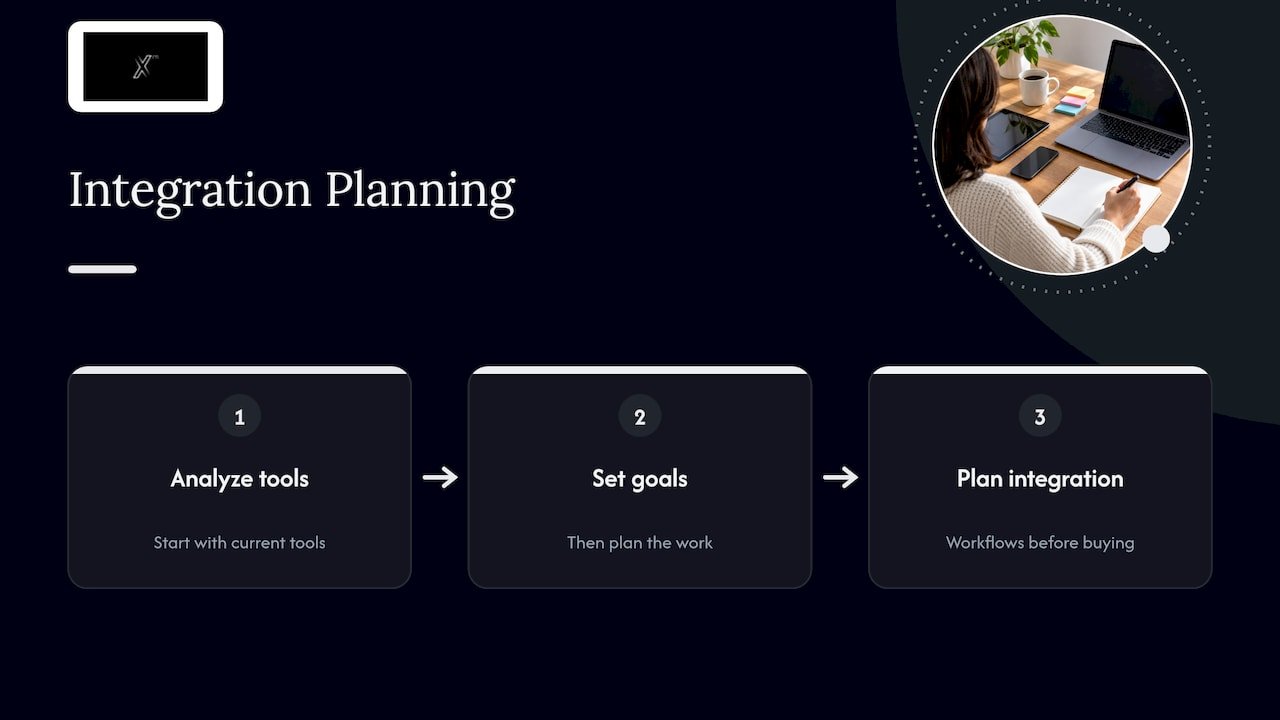
Medill IMC advises treating stack building like marketing strategy: analyze current tools, set goals, then plan workflows and integration before buying anything. That order is the whole method. Here it is in practical steps.
1. Map the customer journey first
Write down how a stranger becomes a customer and then a repeat customer: awareness, consideration, decision, retention. For each stage, list what the customer does and what you need to know. Then find where people drop off. If 8 in 100 demo requests convert but only 1 in 100 trial sign-ups does, that is where a workflow or a tool must do work. The mistake here is starting from the tools you already own, which locks in the gaps.
We do this step with the business before any software is discussed, because the answer shapes the strategy and the creative as much as the stack.
2. Audit what you have
List every tool, who uses it, what it costs, what data it holds and what it connects to. Mark overlaps (two tools doing one job), unused features and duplicate records. Given Gartner’s 49% utilization figure, expect to find shelfware. Cutting it frees budget for the integrations that matter.
3. Define goals and a baseline
Choose a few measurable goals, such as cost per lead, lead response time or revenue from email. Record today’s numbers before you change anything. A peer-reviewed Springer article on marketing automation integration recommends setting performance measurement metrics as a baseline before implementation, with return on marketing investment, incremental revenue, retention rate, cost per lead and campaign response rates among the primary measures. Without a baseline you cannot show the project worked.
4. Choose a system of record for each kind of data
Decide which tool is the source of truth for each type of information: contact details, deal stage, consent status, purchase history. When two tools can edit the same field, they will eventually overwrite each other. One owner per field, and a clear direction of sync, prevents most data disputes.
5. Connect in phases, starting with the highest-value flow
Begin with one flow that moves revenue, for example a web form that creates a CRM contact and triggers a welcome sequence. Test it with real records, then add the next. Phasing keeps errors small and lets your team learn each connection before the next arrives. Native integrations between popular platforms often cover the basics. Where they do not, a connector service or custom development bridges the gap.
6. Standardize your definitions
Integration exposes disagreements about what counts. A “lead” in marketing may be an “inquiry” in sales, and ad platforms use different attribution windows. Agree on a short glossary of metrics and lifecycle stages before building dashboards, or the numbers will look precise and mean nothing.
7. Assign owners and review on a schedule
Every tool and every integration should have a named owner, a purpose and a review date. Review at least quarterly: what is used, what broke, what can be retired. Integration is not a one-off project, because platforms change their interfaces and your business changes its offers.
8. Train the people who will use it
Adoption decides whether any of this pays off. A connected stack that the team does not understand drifts back to manual work. Our digital marketing trainings exist for this reason, so your staff can run the system after launch.

Privacy and consent travel with the data
When you connect systems, personal data moves with them. Businesses with customers in the US, and especially in California, need to handle consent and data requests under rules such as the CCPA; Australian businesses work under the Privacy Act; and any customers in Europe bring GDPR into play. Record where consent was given, store it with the contact, and make sure every connected tool respects it. Ask a qualified privacy lawyer to confirm the obligations that apply to your business and customers.
Choosing and scaling your stack
When you do need a new tool, judge it first on how well it connects. Evaluate on integrations, ease of use, scalability, reporting, support and total cost, and ask whether it will still fit when your contact list is ten times larger.
Gartner advises a composable, modular and API-friendly approach, so you can swap one piece without rebuilding everything. Bain’s guidance is similar in spirit: use a primary platform, and customize only where the value is highest. Bain also suggests asking how much shelfware you already have and piloting ready-made tools before building custom ones.
For a startup this means keeping the first stack small: a website you control, a CRM, an email platform and analytics, connected properly. For a rebranding business, it means making sure the new identity flows into every template, form and ad account at once, so the market sees one brand. For a company scaling web and tech, it means choosing the architecture before the volume arrives.
Measuring whether integration worked
Use two kinds of measures, reviewed monthly.
Operational measures tell you whether the connections are healthy:
- Do syncs run without errors?
- Is the data complete and correct in the CRM?
- Are the team actually using the features you pay for?
Business measures tell you whether it matters:
- Cost per lead and cost per customer against your baseline
- Time from form submission to first contact
- Revenue and retention from automated campaigns
- Hours saved on manual data entry and reporting
Compare each to the baseline from step 3. If the numbers do not move after a few cycles, revisit the journey map before adding more tools. A data and analytics setup that pulls the channels into one view makes this review fast.
Where we come in
Xpert Marketing is a 360° agency that works as a dedicated external marketing department when a business needs one. Integration touches strategy, branding, content, web development, CRM and sales automation, marketing automation, and data and analytics, and we offer each of them. Having them under one roof means the journey map, the site, the CRM setup, the automation and the reporting are planned together rather than handed between vendors.
If your tools do not talk to each other, or you are about to choose them, see our full list of services and tell us your goals. We will start from the customer journey, not from a software catalog.
For the automation layer specifically, our guides on marketing automation strategy and email marketing automation show how we approach it.
Our perspective
We believe integration fails when it is treated as an IT task that happens after the marketing plan is finished. The tools should follow the strategy, and the strategy should follow what customers actually do.
That is why our model joins strategy, creativity and execution in one agency. The message in your campaign, the page it lands on, the CRM record it creates and the report that judges it should be designed as a connected system, not four separate purchases.
We also think capability should be left behind. Marketing 360 is a system, and a system only works when your team can run it. So we pair execution with training, and we measure the work against the goals you set at the start.
Xpert
FAQ
What is marketing technology integration?
It is the practice of connecting your marketing platforms, such as CRM, email, analytics, ad accounts and website, so they exchange data automatically. The result is one view of each customer and reporting you can trust. It replaces manual exports and conflicting spreadsheets.
Which marketing tools should I integrate first?
Start with the CRM and your website forms, because that is where leads become records. Then connect your email or automation platform and your analytics. Add advertising and attribution once the core flow works.
How long does an integration project take?
It depends on how many tools, how clean your data is and how much custom work is needed. A sensible approach is phased: foundations and data definitions first, then source connections and automation triggers, then reviews. We scope it with you after reviewing your current stack and goals.
How do I know if my stack is underused?
Audit each tool for who uses it, which features are active and what it duplicates. Gartner reports that only 49% of martech capabilities are used on average, so low use is common. Tools with no owner and no clear purpose are the first to review.
Sources
- Martech Series: Integrated Marketing white paper
- Omnichannel Integration in Integrated Marketing Communications, SHS Conferences
- Medill IMC: How MarTech Stacks Power Integrated Marketing
- Gartner: Maximize ROI With Marketing Technology
- Bain & Company: Too Much Marketing Technology, Too Little Impact
- Shopify: Martech Stack guide
- Springer: Marketing automation systems integration


