
Persona Development: How to Build Personas That Drive Sales
Persona development is the process of turning customer research into a small set of realistic profiles that represent the people you sell to. Done well, it tells your team who to target, what to say and where to say it. Done badly, it produces a polished PDF of invented “Marketing Mary” details that nobody opens twice. This guide shows how to do it the first way: what to collect, how to write the profiles, how many you need, and how to keep them alive.
TL;DR
- A persona is a research-based, fictional representation of one type of customer. It is built from real data and interviews, not from guesses about demographics.
- Start with two or three personas for your highest-value segments, and expand to as many as seven only if the business needs it.
- In B2B, pair an ideal customer profile (which companies to target) with personas (which people inside them to persuade).
- Validate drafts with sales and customer success, then review the personas at least once a year.
- A persona earns its place only when it changes a decision: a message, a channel, a budget or a product priority.
Table of Contents
- What a persona is, and what goes into one
- Persona development step by step
- How many personas do you need?
- B2B personas: buyers, users and committees
- Ideal customer profile vs. persona
- The negative persona
- Putting personas to work
- Measuring whether your personas work
- Keeping personas current
- Common mistakes in persona development
- Our perspective: personas are a bridge between strategy and execution
- Need help turning personas into a growth plan?
- FAQ
- Sources
What a persona is, and what goes into one
A buyer or customer persona is a composite, fictional portrait of a specific type of customer in a market segment, based on research. It is not an average customer and it is not a real individual. It is a working summary of patterns you have seen repeatedly.
Most effective personas combine two kinds of information. Salesforce describes demographic details such as age, industry and role plus psychological and behavioral information that explains how customers decide to buy. In practice, that means these building blocks:
- Background: role or occupation, industry, company size (for B2B), location, education, income or budget authority.
- Goals and motivations: what success looks like for this person, and what they are measured on.
- Pain points and objections: what is going wrong today and what makes them hesitate to buy.
- Behavior: how they research, which sources they trust, which channels they use, how they prefer to be contacted.
- Decision role: whether they decide, influence, approve, or simply use the product.
You do not need every field. Shopify’s guidance on personas lists many possible details, from interests to purchasing power, and cautions that teams need not include all of them. Keep a field only if you can name a decision it will inform. If “favorite TV show” will never change an ad, a landing page or a sales call, leave it out.
Persona development step by step
The process below works for a startup with fifty customers and for an established company with thousands. The only difference is the volume of data.
1. Define what the personas are for
Before collecting anything, write down the decision the personas must support. Examples: “choose the right channels for our next campaign,” “rewrite the website for two audiences,” or “decide which features to prioritize.” A clear purpose tells you which details matter and stops the project from becoming an endless research exercise.
2. Mine the data you already have
The fastest research is the data sitting in your own systems. HubSpot’s guidance on building personas points to quantitative data from CRMs and analytics alongside qualitative input from interviews, surveys and sales team feedback. For B2B, ZoomInfo recommends starting by mining CRM, closed-won deal and customer success records to find patterns among your best customers.
Look for answers to questions like these:
- Which customers closed fastest, paid the most, stayed the longest or referred others?
- What job titles show up in those deals, and who signed?
- Which pages, content and channels did they touch before becoming a lead?
- What reasons for losing deals appear again and again in your notes?
If your CRM is messy, this step will show it. Missing job titles, duplicate companies and inconsistent deal stages make pattern-finding unreliable. Cleaning the data first is often the most valuable part of the project, and if you are changing systems anyway, a CRM data migration plan is a good moment to fix it.
3. Talk to real people
Data tells you what happened. Conversations tell you why. Common methods include customer and prospect interviews, surveys, focus groups, sales and support feedback, and social listening, all listed in HubSpot’s research guide. Lyssna’s persona research guide adds that strong research combines qualitative and quantitative methods: interviews for motivation and context, surveys to validate at scale, and analytics for behavior.
A practical minimum for a small company:
- Five to eight interviews with recent customers, including at least one who nearly did not buy.
- Two or three interviews with people who chose a competitor or did nothing.
- A conversation with the salespeople and support staff who hear objections every week.
- A short survey sent to your list to test what the interviews suggested.
Ask about the situation that triggered the search, what they tried first, who else was involved, what almost stopped them, and where they looked for answers. Record the exact words they use. Those phrases become headlines and email subject lines later.
4. Find the patterns and group them
Lay the notes side by side and look for clusters: people who share a goal, a trigger and a way of deciding. A group is a persona only if it behaves differently enough to need different messaging or a different channel. If two groups would receive identical campaigns, merge them.
For B2B, group by role and context rather than by demographics alone. Miro’s B2B persona guide recommends grouping buyers by role, such as economic buyer or end user, and by the job they are trying to get done. A 38-year-old operations director and a 52-year-old operations director may think alike. An operations director and an IT lead at the same company almost never do.
5. Write the profile
Keep each persona to one page. A useful structure:
- Name and role: a memorable label such as “Growth-stage founder” or “Operations lead at a mid-size distributor.”
- Goal in one sentence.
- Top three pains, in the customer’s own words.
- Triggers: the events that start a search.
- Objections: what they worry about before buying.
- Where they look: channels, communities, publications, search terms.
- What convinces them: proof, formats, who they trust.
- Message hook: one sentence you would say to them.
A stock photo and a first name help people remember the persona. Do not let them replace the substance. Add a source note under each claim (“from interviews 3, 5, 7” or “from CRM, 2025 closed-won deals”), so anyone can see what is evidence and what is assumption.
6. Validate before you publish
Test the draft with the people closest to customers. Miro’s guidance describes testing drafts with sales and customer success teams and checking them against real call recordings so the persona reflects how buyers actually talk. If your salespeople say “that’s not who I talk to,” believe them and revise.
Researchers Jain, Djamasbi and Wyatt add a useful point for small teams: a quick, low-cost persona process can help build internal consensus and test assumptions about customers. You do not need a six-month study to start. You need a first version that gets challenged by evidence.
How many personas do you need?
Fewer than most teams think. HubSpot suggests most businesses start with two or three core personas and expand to between three and seven as needed. Start with the segments that bring the most revenue. Every extra persona multiplies the content, ads and sales material you must produce, so add one only when you have the capacity to serve it differently.
| Business situation | Sensible starting point |
|---|---|
| Early-stage startup, one product | 1 to 2 personas |
| Single product, several buyer roles (B2B) | 2 to 3 personas, one per role in the buying group |
| Several product lines or markets | 3 to 5 personas, each tied to a revenue segment |
| Large organization, multiple regions | Up to 7 core personas, with regional variations noted |
B2B personas: buyers, users and committees
In B2B, one purchase involves several people who want different things. The person who uses your tool, the manager who must justify it, the finance lead who checks the budget and the executive who signs off all read your marketing with different questions. Acquia describes role-based personas as a way to understand how stakeholders, such as a C-suite executive versus an IT administrator, approach buying based on their responsibilities. Goal-based personas, which focus on objectives such as reducing cost or raising revenue, work especially well in B2B, according to the same source.
Examples of B2B buyer personas
Miro’s guide gives examples such as a Product Manager, a VP of Operations, an IT lead and a design team member, each with distinct goals, pain points and buying roles. Here is how that thinking might look for a company selling marketing services, written as illustrative examples rather than real customer data:
| Persona | Goal | Typical pain | Decision role | What convinces them |
|---|---|---|---|---|
| Founder of a growing company | Predictable leads without hiring a full team | Scattered freelancers, no shared strategy | Final decision | Clear plan, proof of measurable results |
| Head of marketing | Hit pipeline targets with a small team | Too many channels, weak reporting | Influencer and day-to-day owner | Channel-level numbers, a realistic workload |
| Finance or operations lead | Control spend and risk | Cannot see what marketing returns | Approver | Transparent budgets, KPIs tied to revenue |
| Sales manager | Better-qualified leads | Marketing leads that never convert | Influencer | Shared lead definitions, feedback loops |
Notice that each row suggests a different message. The founder wants a plan, the finance lead wants evidence of return, the sales manager wants lead quality. One generic brochure cannot do all three jobs.
Segmenting beyond job titles
Titles hide a lot. Two “heads of marketing” can have completely different budgets and authority. Enriching your account and contact data with firmographics and verified decision-maker information helps you see who actually sits in the buying group, and this guide to finding B2B decision makers and verifying them with a second source explains a practical way to check contacts before you build outreach around them.
Ideal customer profile vs. persona
The two terms are often mixed up, but they answer different questions. An ideal customer profile (ICP) is company-centric: industry, revenue, company size and other signs of organizational fit. A buyer persona is human-centric and focuses on an individual decision-maker’s motivations and challenges. HubSpot summarizes the relationship this way: in B2B, the ICP identifies the companies to target, while the persona explains how to reach the people within them. Miro makes the same distinction: the ICP names the target accounts, the persona guides how you speak to each stakeholder.
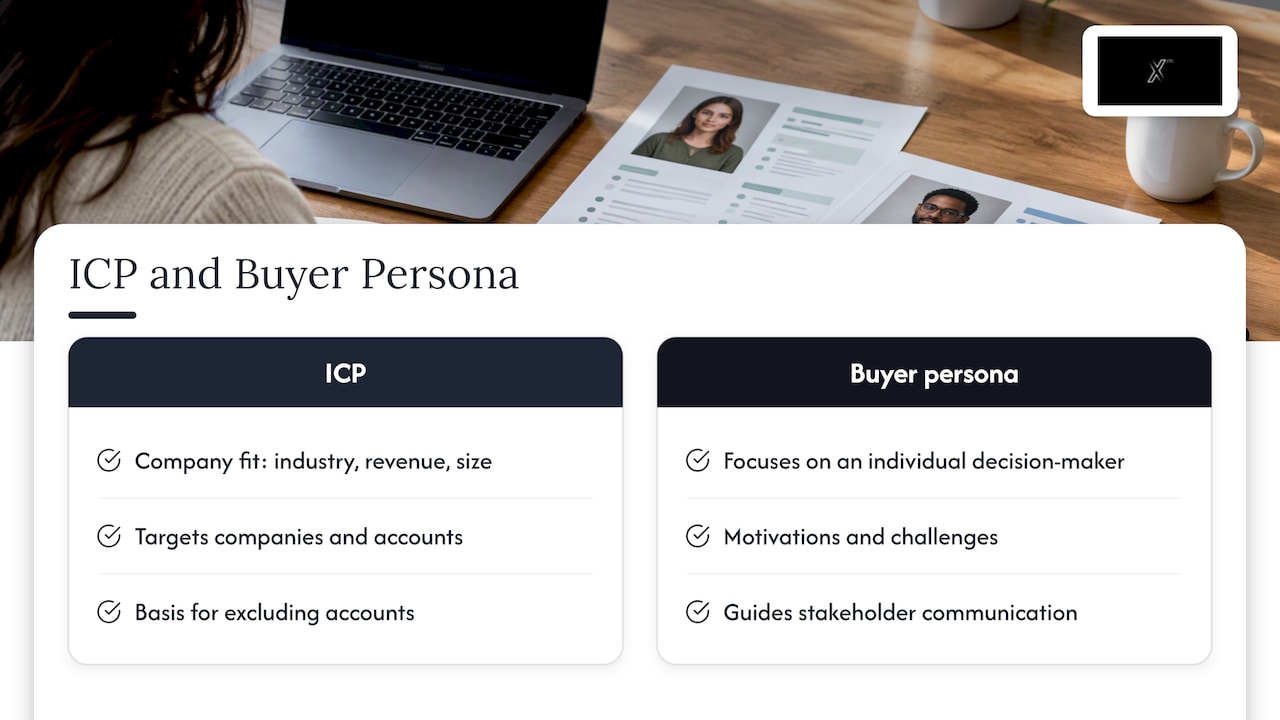
A simple order of work: define the ICP first, so you know which companies are worth pursuing, then build personas for the two or three roles that matter inside those companies. The ICP also gives you a basis for exclusion, which brings us to a persona many teams skip.
The negative persona
A negative persona describes the customer you do not want: the one who churns in two months, demands custom work at a standard price or never had the budget. Pipedrive describes these as personas of poor-fit customers that help teams avoid activities that attract them. ZoomInfo argues that excluding non-ICP accounts prevents wasted pipeline resources and raises win rates. Treat that as one vendor’s view, but the logic is sound: every hour spent on a poor-fit lead is an hour not spent on a good one. Your closed-lost and churned-customer records are the place to find this group.
Putting personas to work
A persona matters only if it changes what people do on Monday morning. Miro, Salesforce and Acquia all describe teams using personas to guide marketing, content, sales playbooks and product prioritization. Here is where to apply them first.
- Messaging and website: write the homepage and key landing pages around the persona’s trigger and main objection, using the customer’s words from interviews.
- Content planning: map one question per persona per buying stage, then decide the format and channel that persona actually uses.
- Paid targeting: translate role, seniority and industry into audience settings. If your buyers are on LinkedIn, our piece on LinkedIn Ads targeting explains how audience facets and minimum audience size shape what you can reach.
- Organic social: choose formats and posting themes per role. Our B2B social media strategy walks through a 90-day plan.
- Sales enablement: turn objections into talk tracks and case studies matched to each role.
- Lead generation: align qualification criteria with the ICP and personas so marketing and sales agree on what a good lead is. See our guide to B2B lead generation.
Acquia argues that picturing a specific person, such as a marketing manager with budget limits, leads to more relevant solutions than targeting abstract segments. That is a vendor’s argument, but it matches what we see in practice: a team that can describe one person in detail writes sharper copy than a team that can only describe “SMEs, 25 to 54.”
Measuring whether your personas work
A persona is a hypothesis, so test it. Pick two or three indicators and compare before and after:
- Conversion rate on pages rewritten for a persona.
- Lead-to-opportunity rate for campaigns aimed at that persona.
- Sales cycle length and win rate for the matching segment.
- Engagement by channel for each audience.
If nothing moves after a quarter, the persona is probably too generic, built on assumption, or not actually used. Our overview of B2B marketing KPIs helps you choose measures that tie to revenue, not vanity metrics.
Keeping personas current
Personas age. Markets shift, new competitors appear and your own product changes who buys it. Miro and Salesforce both describe personas as living documents stored centrally, linked to supporting research and reviewed periodically. HubSpot suggests a review quarterly, or at least annually.
A light routine that works:
- Keep every persona in one shared location, with links to the interviews and data behind it.
- After each quarter, ask sales and support what they heard that the persona does not say.
- Check whether your best customers still match. Behavior over time, such as which customer groups stay and which leave, shows when a persona has drifted, and a retention cohort analysis workflow is one way to see it.
- Date each version and note what changed.
Common mistakes in persona development
- Building from assumptions. If no interview or data point supports a detail, mark it as a guess or delete it.
- Too many personas. Seven profiles nobody remembers are worse than three that everyone uses.
- Demographics only. Age and gender rarely explain why someone buys. Goals, triggers and objections do.
- No owner. Assign one person to maintain the documents.
- Filing and forgetting. Present the personas in a working session and run one real campaign brief against them.
- Confusing the ICP with the persona. One is a company, the other is a person.
Our perspective: personas are a bridge between strategy and execution
We see the same pattern with many growing companies. The strategy deck describes one audience, the website speaks to another, the ads target a third and the sales team talks to a fourth. Personas fix that when they are treated as a shared reference, not a marketing deliverable.
Our approach at Xpert Marketing is to connect strategy, creativity and execution in one system, so a persona built in a research workshop shows up in the creative brief, the media plan, the landing page and the reporting dashboard. That is also why we insist on data: the profile should come from market research and analytics, and it should be judged by measurable results afterward. When a client needs it, we act as an external marketing department, which means the people who write the personas are the same ones who have to make them perform.
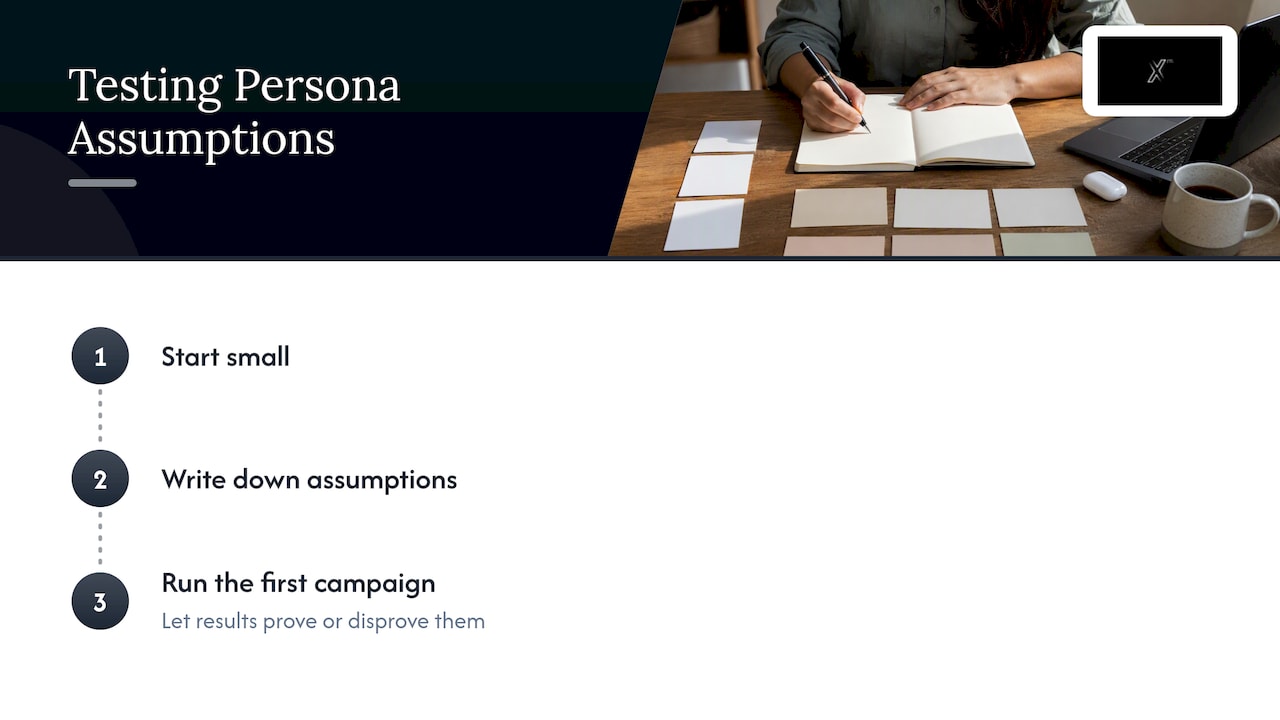
Our advice: start small, write down your assumptions, and let the first campaign prove or disprove them. A persona that survives contact with real customers is worth far more than one that looks complete.
— Xpert
Need help turning personas into a growth plan?
If you would rather not build this alone, our team can run the research, write the personas and carry them through into content, paid media, web and reporting. Explore our marketing services, see how our data and analytics work supports audience research, or look at our marketing trainings if you want your own team to learn the method. You can also start from our homepage and tell us what you are trying to achieve.
FAQ
What is the difference between a buyer persona and a target audience?
A target audience is a broad group defined mostly by shared characteristics, such as small retailers in a region. A persona is a more detailed portrait of one type of person within it, covering goals, pains, behavior and decision role. You use the audience definition to size the market and the persona to write for it.
How do I create personas if I have no customers yet?
Start with interviews with people who match the type of buyer you expect, plus conversations with experts, competitor and review research, and any search or social data you can find. Label the result as a hypothesis. Once you have your first customers, compare reality with the draft and revise it quickly.
How long does persona development take?
A lean version, using existing CRM data and five to eight interviews, can be done in a few weeks. A larger program with surveys across several markets takes longer. The research quality matters more than the timeline, and a quick first version can be improved later.
Do B2B companies need personas as well as an ideal customer profile?
Yes, because they solve different problems. The ICP tells you which companies to pursue, while personas tell you how to speak to the individual roles inside them, such as the user, the manager and the approver. Using both keeps targeting precise and messaging relevant.
How often should I update my personas?
Review them at least once a year, and quarterly if your market, product or channels change quickly. Update sooner when sales hears new objections or when your best customers start looking different from the profile.
Sources
- What Are Buyer Personas? (TechTarget)
- What Is a Buyer Persona? (Salesforce)
- What Is a Buyer Persona? (Shopify)
- How to create detailed buyer personas (HubSpot)
- How to Create Buyer Personas (ZoomInfo)
- Persona Research (Lyssna)
- A Guide to B2B Buyer Personas (Miro)
- What is a customer persona? (Acquia)
- A step-by-step guide to creating effective customer personas (Pipedrive)
- Creating Value with Proto-Research Persona Development (ACM)


