

The Rebranding Process: 8 Steps From Audit to Launch
A rebranding process runs in eight stages: set a measurable goal, audit the current brand, define your audience and positioning, build the new identity, clear it legally, prepare every asset, launch in one coordinated move, then measure and adjust. Most rebrands that stall do so because the work is run as a design project instead of a business project. Strategy, creative and execution have to move together, which is how we at Xpert Marketing approach every engagement: one team that connects strategy, creativity and execution.
This guide is written for owners and marketing leads in the US, Australia and beyond who are deciding whether to rebrand and how to run it without losing the customers they already have.
TL;DR
- Rebrand when the brand no longer reflects what the business is, who it serves or where it is going. Slow sales alone are not a reason.
- Write down the goal, what must change, what must stay, and how you will measure success before anyone opens a design file.
- Work in order: audit, audience and positioning, identity, legal clearance, assets, launch, measurement.
- Mature brands usually gain more from a partial rebrand that keeps recognition than from starting over.
- Treat the website move, redirects and every public profile as part of the rebrand, not an afterthought.
Table of Contents
- What a rebrand is, and what it is not
- When to rebrand
- Full or partial rebrand?
- The rebranding process, step by step
- How long does it take?
- A rebranding checklist you can copy
- Rebranding examples and what they teach
- Protecting existing customers and staff
- Why an integrated team makes the process easier
- Our perspective
- Start your rebrand with a plan
- FAQ
- Sources
What a rebrand is, and what it is not
Rebranding means changing how a business presents itself: its name, logo and visual identity, messaging, brand strategy, or all of them. Shopify describes two forms, a full rebrand across every touchpoint and a partial refresh.
It helps to separate a rebrand from a repositioning. A Forbes Agency Council member distinguishes the two: repositioning changes how you market an existing brand, while rebranding creates a new brand with a new name, promise, customer experience and look. If your product is fine and your story is stale, you may only need repositioning, which is faster and cheaper.
When to rebrand
Good reasons share one feature: the brand is now wrong about the business. Typical triggers:
- A strategic shift. You moved upmarket, added a new product line or changed your business model.
- A merger or acquisition. Two identities need to become one.
- A new market. You are entering or leaving a region or segment, for example a Sydney company selling into the US.
- An outdated or confusing image. Customers and competitors see a company you no longer are.
- A need to stand apart. Your visuals and message look like everyone else’s in the category.
There is a bad reason too. HubSpot cautions that slow sales or weak awareness on their own do not justify a rebrand, because content strategy or market research may fix them. A rebrand is warranted when your vision, mission, values and market are no longer reflected in the brand.
A quick test: write one sentence describing who you serve and why you are different today. If the current name, logo and website contradict that sentence, you have a rebrand. If they support it but nobody notices, you have a visibility problem.
Full or partial rebrand?
This decision shapes the budget and the risk. HubSpot’s Swetha Amaresan notes that the more established a business is, the more it has to lose, so mature brands should usually choose a partial rebrand that keeps built-up loyalty while refreshing the image. Total rebrands suit foundational shifts such as mergers or product overhauls, per the same HubSpot guide.
| Situation | Usually fits | What changes |
|---|---|---|
| Dated look, strong reputation | Partial refresh | Logo, palette, typography, tone |
| New positioning, same name | Repositioning plus refresh | Messaging, website, sales materials |
| Merger or new company structure | Full rebrand | Name, identity, strategy, every touchpoint |
| Startup with little equity yet | Full rebrand is low risk | Everything, ideally before scale |
Startups have the easiest case: there is little recognition to lose, so a decisive rebrand early costs less than one after years of growth.

The rebranding process, step by step
Step 1: Set the goal and the measures
Start with an opportunity statement. Adobe’s guide frames it as answering what problem the rebrand solves, what must and must not change, who the primary audience is and how you will measure success. The same guide advises pausing if the rebrand cannot be tied to a measurable outcome.
Use specific goals with a baseline. Shopify’s process calls for SMART goals with KPIs and baselines before anything changes. Capture today’s numbers now: organic traffic, branded search volume, demo or inquiry rate, win rate, email list growth. Without a baseline you cannot say a year later whether the rebrand worked.
Where it goes wrong: goals like “look more modern” cannot be measured, so every opinion in the room becomes equally valid.
Step 2: Audit the brand you have
An audit looks at consistency, visibility and reputation, as Frontify’s guide lays out. In practice, collect everything customers can see: website, social profiles, proposals, decks, packaging, signage, invoices, email signatures, directory listings. Then add what people say about you: reviews, sales call notes, employee interviews.
Two outputs matter. First, a list of what is worth keeping, such as a recognizable color, a name with equity or a phrase customers repeat. Second, a list of every place the brand appears, which becomes your rollout checklist later.
A structured marketing audit also shows which channels are performing before you change anything. Our digital marketing audit approach is built to evaluate and steer performance, which gives the rebrand a factual starting point.
Step 3: Define audience and positioning
Identify who you are really selling to: how and where they buy, what frustrates them, and how your value proposition compares with competitors. Then write a positioning statement covering who you serve, what you offer and your unique selling proposition. Shopify describes this statement as the guide for messaging, tone and visual decisions.
For startups, Forbes contributor Alison Coleman, citing an agency expert, advises treating a rebrand as a holistic process rather than a superficial makeover: clarify core values, value proposition and long-term vision, and involve stakeholders from employees to customers so you get insight and buy-in.
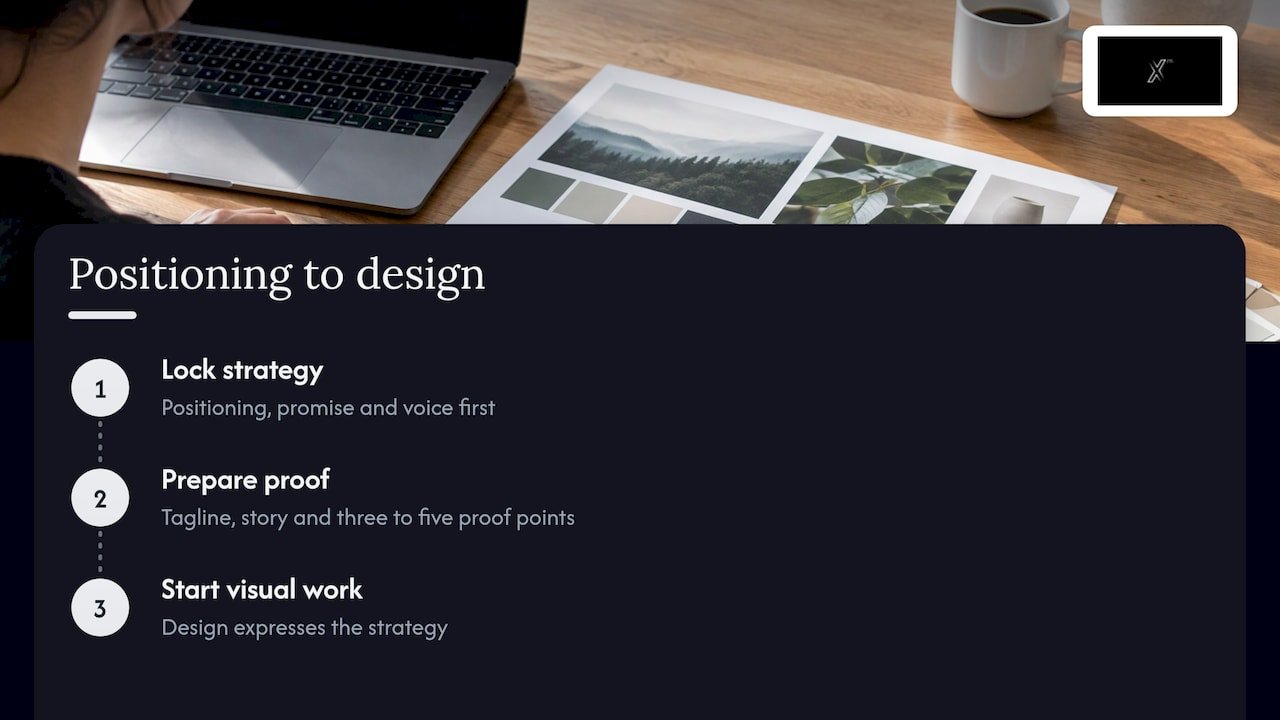
Lock the positioning, promise and voice first. Adobe’s guidance is that design should express strategy, not the other way around, and suggests having a tagline, a one-paragraph story and three to five proof points ready before visual work begins.
Where it goes wrong: skipping straight to logo options. You then judge designs by taste, because there is no strategy to judge them against.
Step 4: Build the identity
Core elements typically include the logo, color palette, fonts, tagline, brand voice, visual motifs and icons, according to Frontify. Its guide also recommends a cross-functional review with internal stakeholders and cultural consultants to make sure the new identity is inclusive, legally compliant and free of unintended negative connotations. This matters if you serve several markets, such as the US and Australia, where a name or color can read differently.
The deliverable that makes the identity usable is a set of brand guidelines: logo rules, color values, typography, tone of voice, examples of right and wrong use. Without it, every freelancer and department reinterprets the brand within months. Our visual identity design page covers the elements, process and guidelines, and if you are only updating your mark, our piece on when and how to modernize a logo is the shorter route.
Step 5: Clear the name and the assets legally
A new name needs a trademark search before you print anything. Search existing registrations and common-law use in your markets, check domain and social handle availability, and file for protection. In the US, a legal check is the point where you bring in a trademark attorney; it is a legal step, not a design one. If you operate in Australia too, the same clearance applies there.
Legal review is also where an otherwise finished rebrand can fall apart, which is why it belongs before asset production and not after.
Step 6: Produce the assets in the right order
Build templates first (slides, documents, email, social), then the website, then print, signage and packaging. The order matters because templates are what your team uses daily, and reprinting packaging is the costliest mistake to make twice.
A complete list of what to update, drawn from Frontify’s guide: website, apps, social profiles, marketing materials, packaging, sales collateral, email signatures, newsletter templates and business directory listings.
Step 7: Launch as one coordinated move
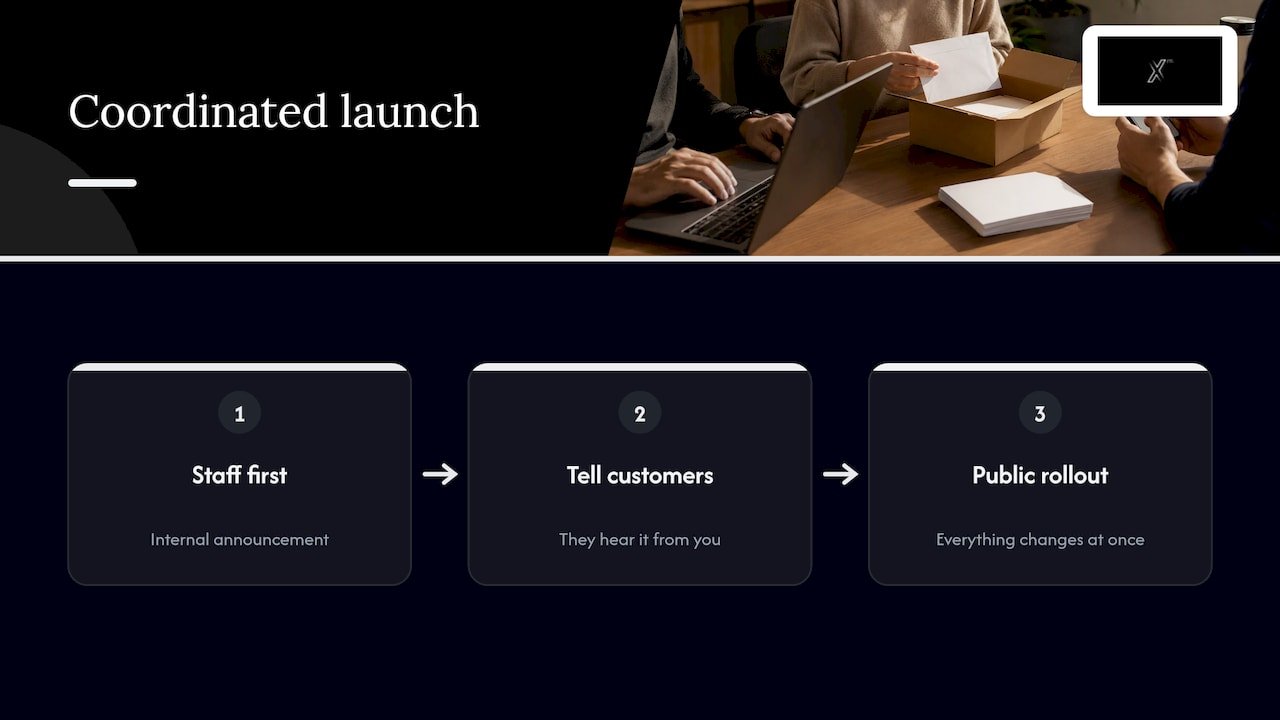
A rebrand lands best when staff learn first, customers hear it from you rather than discover it, and everything public changes at once. A rollout plan generally includes an internal announcement, an external announcement such as a blog post, press releases, social posts, a customer newsletter and a separate email to your list (Frontify).
If the domain or URLs change, plan the technical move carefully. Google’s documentation on site moves with URL changes explains how to redirect old pages to new ones so you keep as much of your search visibility as possible. Timing is a business choice too: one startup founder in the Forbes piece picked January, the quietest month, so any traffic dip after the website relaunch could be absorbed by extra ad spend.
Press and communication work belongs here, because the story of why you changed is part of the launch. See our PR and communication service.
Step 8: Measure and adjust
Return to the baselines from step 1. Track the metric closest to revenue first. In an in-house rebrand, Rippling used demo sign-ups as its top website metric and reported a 50% increase in organic leads for its sales team, with the external launch falling in weeks 13 to 15 of a four-month project.
Also review sentiment, missed touchpoints (the old logo you find on a vendor portal six months later) and sales feedback. Plan a review at 30, 90 and 180 days.
How long does it take?
There is no single answer, and it depends on scope. One agency-run naming and identity project reported by the American Marketing Association took three to seven months, moving through interviews, name selection, concept testing and finalization. Rippling’s in-house effort took four months. A partial refresh with an existing name is shorter; a merger or multi-market rollout is longer.
Cost varies just as widely. One startup in the Forbes article put its total rebrand at around £20,000, which is one data point, not a benchmark. Your scope, number of touchpoints and markets drive the figure.
A rebranding checklist you can copy
Strategy
- Written reason for the rebrand, with a baseline for each success metric
- What must stay and what must change
- Audience definition and positioning statement signed off
Audit
- Inventory of every asset, channel and document that shows the brand
- Customer and employee input collected
Identity and legal
- Name, logo, colors, typography, voice
- Trademark search and filings; domain and handles secured
- Brand guidelines published
Production
- Templates first, then website, print, signage, packaging
- Redirect map, page titles and metadata updated
- Social profiles, listings, email signatures, invoices updated
Launch and review
- Internal announcement before external
- Website, listings and announcements switched the same day
- Review at 30, 90 and 180 days against the baseline
A useful addition from Chief Marketer’s rebranding checklist: involve representatives from across departments and track timelines, budgets and milestones in one shared plan. Rebrands are rarely late because of design; they are late because three departments each waited on another.
Rebranding examples and what they teach
- Johnnie Walker. After Diageo reworked its “Keep Walking” messaging, sales passed 21 million nine-litre cases in 2022 for the first time, reversing eight years of decline, according to LBB. The creative team’s lesson: with a rich legacy you honor the past while reimagining it, and let local markets adapt the idea. It launched in Australia, Brazil, Chile and the US.
- Royal Challenge. Since its October 2022 redesign, the whisky’s volume growth rate rose from 11% to 21.8% and first-time buyer share from 24% to 42%, reported by Warc. A redesign aimed at a specific audience can pay back fast.
- Pond’s. The move to Pond’s Skin Institute, after testing more than 400 designs, rolled out to over 21 markets and beat business targets by 164% in the first half of 2024, per Transform magazine.
- Lloyds Banking Group. It kept the familiar black horse while refreshing logo, palette and style, one of the examples in Frontify’s guide, and a clean illustration of a partial rebrand.
The pattern: each rebrand had a clear audience and business problem, and each kept something recognizable or tied the change to a measurable result.
Protecting existing customers and staff
A rebrand fails quietly when loyal customers feel the company they chose is gone. Keep the thread: retain a recognizable color, a product name or a promise they already trust. Explain the reason for the change in terms of what they gain. Tell employees first and give them the new language, so every sales call and support reply says the same thing on day one.
When you cannot keep the name, run the old and new names together for a defined period with clear signage, a notice on the website and a redirect from old to new.
Why an integrated team makes the process easier
The eight steps above touch strategy, naming, design, copy, web development, PR and analytics. When each sits with a different vendor, the handoffs create the delays and inconsistencies that sink rebrands. Xpert Marketing’s offer spans strategy and consulting, branding and visual identity, creative and content production, digital marketing, web and tech, PR and communication, and data and analytics, so a rebrand can run as one connected system instead of a chain of separate briefs.
If you want a partner for the brand work itself, see our branding and visual identity services, or our broader piece on how an agency builds brands that scale.
Our perspective
We see a rebrand as a business decision first and a design exercise second. The identity is the visible part, but the value sits in the decisions behind it: who you serve, what you promise, and what you stop saying.
That is why we integrate strategy, creativity and execution in one agency. Research and analytics define the audience and the positioning. Creative work gives the strategy a face. Web, content and communication carry it into every channel, and measurement tells you whether it is working.
For ambitious brands, especially startups building go-to-market strategies and companies scaling their web and tech presence, this joined-up approach keeps the rebrand coherent from the first workshop to the last redirect. When needed, we act as a dedicated external marketing department, so your team keeps running the business while the rebrand moves forward.
Xpert
Start your rebrand with a plan
Our team covers the whole path in this guide, from strategy and visual identity to web, content, PR and analytics. Clients such as Market Nerd and Privè have worked with us on brand presence and operational processes. Explore the full list of services and tell us what you want the new brand to achieve.
See our portfolio for the kind of work we deliver, or go straight to the Xpert Marketing home page to get in touch.
FAQ
How do I know it is time to rebrand?
Rebrand when the name, look or message no longer match what the business is, who it serves or where it is heading, for example after a merger, a new product line or a market change. Slow sales alone are not enough, since HubSpot notes that content strategy or research may solve those. Compare your one-sentence positioning with how the brand appears today.
What is the difference between a rebrand and a refresh?
A full rebrand changes the name, identity, strategy and touchpoints. A refresh updates visuals or messaging while keeping the core brand. Established brands often choose the refresh to keep customer loyalty.
What should I do first?
Write the goal, what must change and what must stay, and capture baseline metrics such as organic traffic, inquiries and conversion rate. Then audit every place the brand appears. Design comes after both.
Will a rebrand hurt my search rankings?
It can if URLs or the domain change without a plan. Mapping old pages to new ones with redirects, as described in Google’s site move guidance, keeps the impact down. Launching in a quieter sales period also helps.
Sources
- Shopify: Rebranding, when to rebrand and how to do it
- Forbes Agency Council: Repositioning versus rebranding
- HubSpot: What is rebranding
- Adobe Express: How to rebrand your business
- Forbes: The how, when and why of a rebrand
- Frontify: Rebranding guide
- Google Search Central: Site moves and migrations
- Rippling: In-house rebrand in four months
- AMA: How a name change propelled an adoption agency
- Chief Marketer: The checklist for rebranding
- LBB: Johnnie Walker rebrand results
- Warc: Royal Challenge redesign
- Transform magazine: Pond’s Skin Institute


