A successful CDP implementation gives you unified, queryable customer profiles that drive reliable activation and measurement, not just another data silo. The immediate next step is to run a focused pilot alongside a targeted data audit, so you prove value on one use case before scaling, following practical implementation patterns described in the unified customer data playbook. Done right, this approach gets you faster personalization and cleaner attribution within months, not years.
TL;DR:
- Finish the source audit, data quality checks, and identity rules before activation; resolving records too early can create incomplete or duplicated customer profiles.
- Choose a warehouse centered architecture if your team has strong engineering; a dedicated platform suits teams seeking faster deployment with less internal capacity.
- Small projects typically take three to six months; enterprise rollouts can take nine to eighteen months or longer, with ongoing staffing and connector costs.
A customer data platform implementation moves through distinct stages, and skipping any of them is what turns a promising project into a stalled one. Forrester’s implementation checklist treats CDP work as a data-management and change program, not a plug-and-play install, which is exactly why a staged roadmap matters more here than with most martech purchases.
Each stage builds on the one before it. Rushing identity resolution before your data audit is finished is a common reason profiles come out duplicated or incomplete, which then undermines every downstream segment.
Conseil : Assign one named owner per stage, even if that person also owns three others. Shared ownership is how CDP timelines quietly slip by months.
Getting budget approved means translating technical capability into numbers a CFO will recognize. Gartner’s guidance on making the case for a CDP centers on tying platform capabilities directly to measurable business outcomes rather than describing features in isolation.
A five-slide framework works well for most approval meetings:
Typical cost line items include platform licensing, integration work, engineering time, ongoing data operations, and activation setup, all of which belong in the same business case rather than being discovered later. When you present this to finance, lead with the use case that has the clearest revenue tie, such as lifecycle email retargeting, and let the platform capabilities support that story instead of leading it.
Governance is not a compliance afterthought, it is the work that determines whether your profiles can be trusted once they reach a campaign. Forrester’s checklist specifically calls out governance and profile assembly as implementation stages in their own right, not optional add-ons.
Before any activation goes live, complete this checklist:
For identity resolution, pick a primary identifier that is stable and widely captured, often email or a loyalty ID, then layer in secondary signals for edge cases. Many implementations reserve a dedicated early phase just for auditing and governance before mass ingestion begins, which prevents the kind of late-stage rework that adds months to a timeline.
Conseil : Treat contract testing between data producers and consumers as a standing discipline, not a one-time check. It catches schema changes before they silently break a live audience.
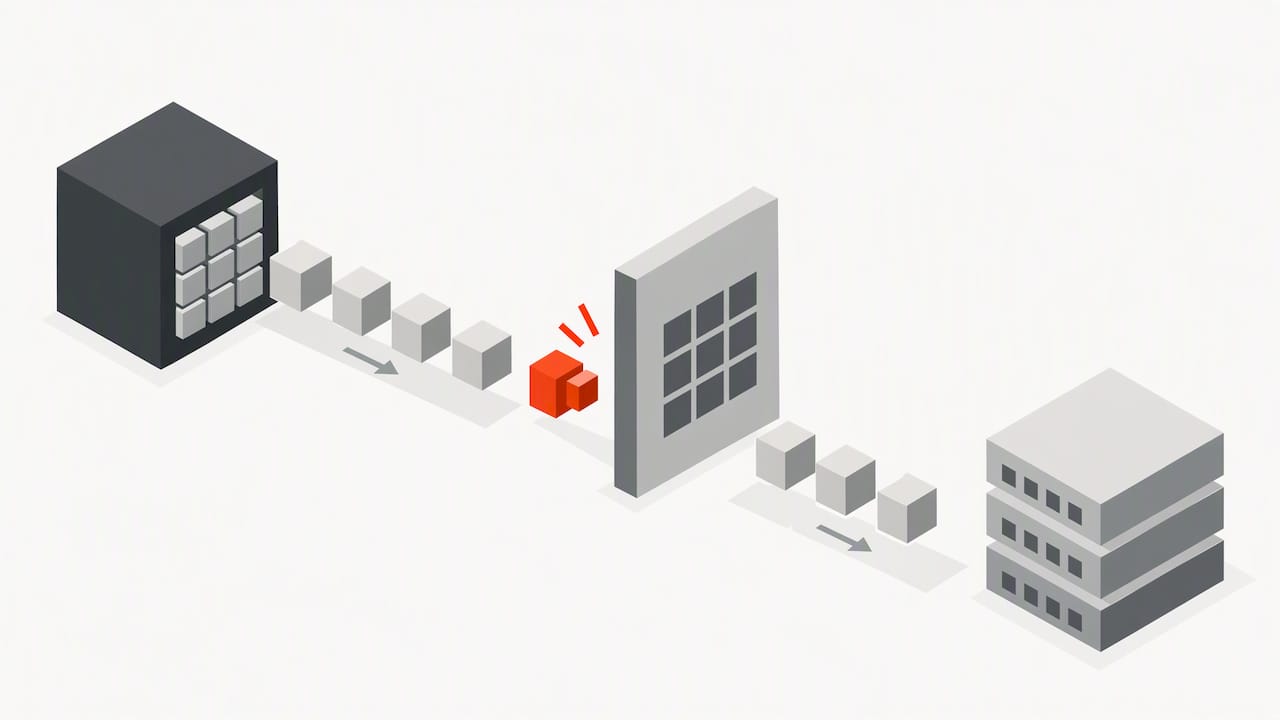
Architecture choice shapes everything downstream, from engineering effort to ongoing cost. AWS’s guidance for building a CDP lays out a stepwise pattern covering ingestion, entity resolution, curated data zones, and activation, which maps closely to the three patterns most teams choose between.
Regardless of pattern, the core components stay the same: an ingestion layer, an identity resolution engine, a profile store, a segment store, and activation connectors that push audiences to destination systems. The decision is less about which components you need and more about where each one lives and who maintains it.
Not every data source deserves the same engineering effort on day one. High-value sources typically include your CRM, e-commerce platform, analytics tool, email service provider, and point-of-sale system, connected through APIs, streaming feeds, or batch exports depending on freshness needs. AWS documentation and most platform guides describe these ingestion modes consistently across vendors.
On the activation side, prioritize destinations that unlock revenue fastest: ad platforms, your email service provider, any personalization engine on your website or app, and your analytics or BI tool for measurement.
A connector that looks easy on a vendor’s integration page can still take weeks to validate properly, so budget time for testing, not just connection.
A pilot proves value fast and limits the blast radius if something goes wrong, which is why a crawl, walk, run approach consistently outperforms a big-bang rollout.
Skipping the governance step to move faster is the single most common cause of regressions once a pilot expands into a company-wide rollout.
Realistic timelines vary by organizational scale. Small implementations with a handful of sources typically run three to six months, mid-market projects six to twelve months, and enterprise rollouts with complex identity needs nine to eighteen months or longer.
Many implementation guides note that teams routinely underestimate integration and staffing costs, which is why practitioner guidance recommends budgeting for sustained engineering effort rather than a one-time setup cost.
The fastest way to prove a CDP’s value is picking use cases with a direct line to revenue or retention.
For each use case, track a metric that maps directly to it: conversion rate for personalization, retention rate for lifecycle campaigns, and incremental lift for measurement workflows. A pilot that proves one of these clearly is worth more than five that each move the needle slightly.
We follow the same discovery, pilot, and scale sequence outlined above, because that sequence is what reliably produces usable profiles instead of stalled projects. We start with a short discovery phase to map your data sources and prioritize use cases, then run a scoped pilot that proves value on one activation workflow before expanding governance and connectors across the organization.
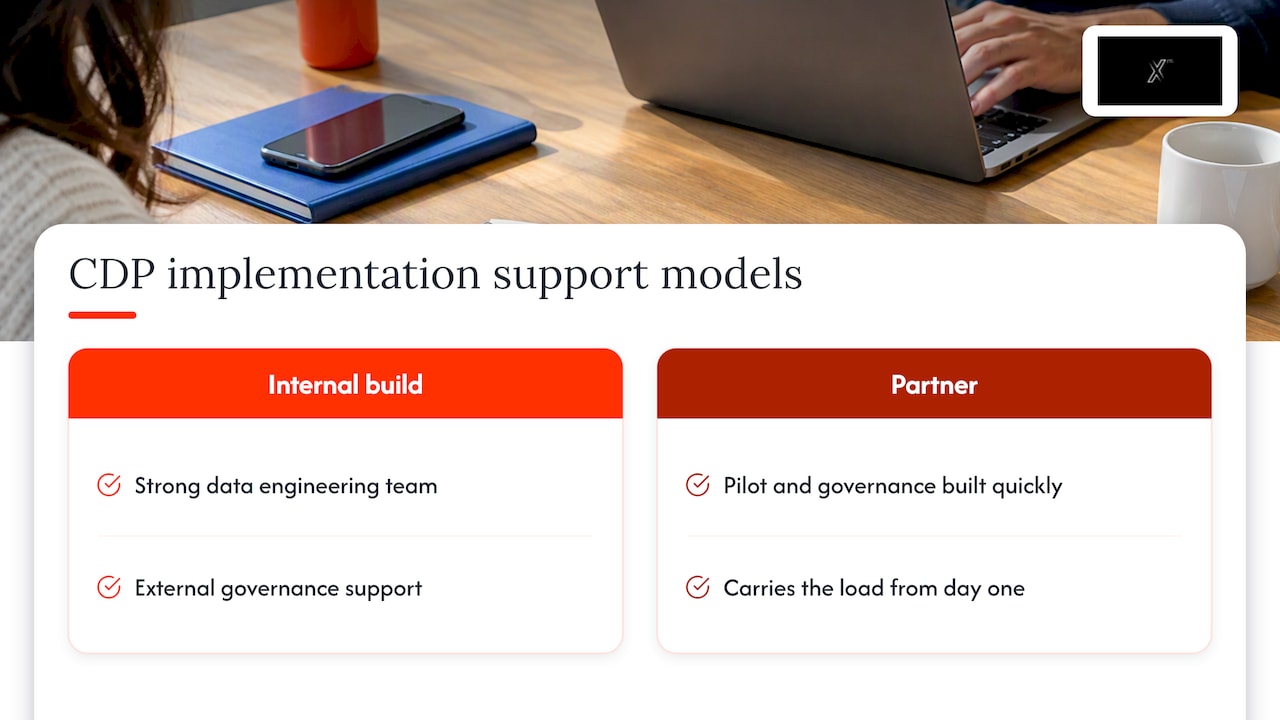
Clients bring us in specifically when internal engineering capacity is tight or when a pilot needs to move faster than existing teams can manage alongside other priorities. If your team has strong data engineering already, an internal build with external governance support often makes sense. If you need both the pilot and the governance structure built quickly, a partner can carry that load from day one.
The single biggest predictor of CDP success is not the platform you choose, it is whether governance and pilot discipline happen before activation does. Teams that skip the data audit to hit a launch date almost always pay for it later with broken segments and distrustful stakeholders. Keep the pilot narrow, document everything, and get leadership aligned on success metrics before the first connector goes live. That discipline matters more than any feature comparison.
— Xpert
Planning a CDP rollout alongside your regular marketing calendar is hard, and most teams underestimate how much governance and connector work sits between a signed contract and a working pilot. We bring Données & analytique expertise to the discovery and audit phase, then pair it with Services avancés for architecture and integration work, so your pilot moves from scoping to live activation without stalling on engineering gaps.
Our Stratégie & Conseil services also help you build the business case and stakeholder alignment that keep a CDP project funded past the pilot stage. We work alongside your team rather than replacing it, which means governance processes stay documented and repeatable long after launch.
Ready to see what a scoped pilot could look like for your data stack? Explore our services and start the conversation.
A customer data platform (CDP) in marketing is a system that unifies customer data from multiple sources into a single profile, which teams then use to build audiences and activate them across channels. It is distinct from a CRM or data warehouse because it is purpose-built for marketing activation and identity resolution.
A CDP is worth the investment when it is tied to specific, measurable use cases like personalization or retention, rather than purchased as a general data tool. Analyst guidance from Gartner recommends building the business case around quantifiable outcomes before committing budget, since ROI depends heavily on how well the pilot and rollout are executed.
A CDP ingests data from sources like your CRM, website, and point-of-sale system, resolves those records into unified customer profiles through identity matching, and then makes those profiles available for segmentation and activation across marketing channels. AWS’s architectural guidance outlines this flow as a sequence from ingestion through entity resolution to curated activation zones.
CDP stands for customer data platform, a category of software designed to unify customer data for marketing and analytics use. It is sometimes confused with “CDP” in other industries, but in marketing and data contexts it always refers to this unified profile system.
Timelines depend heavily on scale: small implementations often take three to six months, while enterprise rollouts with complex identity needs can run nine to eighteen months or longer. The variation comes mostly from the number of data sources, identity complexity, and how much governance work is required before activation.
Bonjour ! Parlez-nous de votre activité et de vos besoins, nous vous répondrons sur WhatsApp.
Remplissez le formulaire et notre équipe vous recontactera rapidement.