

Marketing Agency Pricing: What You Will Pay in 2026
Marketing agency pricing comes down to three things: how the agency charges (retainer, project or hourly), how much work sits inside the scope, and how much of your budget goes to media rather than fees. Published 2026 guides put small-business retainers at roughly $1,000 to $5,000 a month, mid-sized businesses at $5,000 to $15,000, and enterprise work above that. The number on a proposal matters less than what it covers, and the cheapest quote is often the one with the most items missing.
This guide is for business owners in the US and Australia who are weighing an agency for a rebrand, a go-to-market plan, a new website or ongoing content. It shows the ranges, what drives them, what is usually left out, and how to compare proposals on equal terms. Figures are in US dollars unless stated.
TL;DR
- Agencies charge in three main ways: monthly retainers, fixed project fees and hourly rates. Project work and retainers together make up most agency revenue.
- Typical retainers run about $1,000 to $5,000 a month for small businesses and $5,000 to $15,000 for mid-sized ones. Full-service retainers commonly sit between $5,000 and $20,000.
- Ad spend is separate from the agency fee, and a management percentage often sits on top of it. Ask for it as its own line.
- Compare proposals on identical scope, named staff, hours and third-party costs, never on the headline total.
- A single agency that handles strategy, creative and execution removes the hand-offs between vendors, which is where budgets leak.
Sommaire
- The three ways agencies charge
- What marketing agencies cost in 2026
- Retainer, project or hourly: how to choose
- What is usually included, and what is not
- Worked example: a startup’s first-year budget
- How to compare proposals fairly
- When the cheapest quote costs more
- How to set a marketing budget before you call anyone
- Why a single integrated team changes the math
- Where Xpert Marketing fits
- FAQ
- Sources
The three ways agencies charge
Every proposal you receive will use one of three structures, or a mix of them. Knowing which one you are looking at tells you who carries the risk if the work takes longer than planned.
Monthly retainer. You pay a fixed amount each month for an agreed scope: for example, social media management, SEO and a monthly report. It suits work that never really ends, such as content, search and paid media. According to Swydo’s 2026 analysis of agency pricing, which draws on an industry survey, retainers account for about 44% of agency revenue.
Project fee. You pay a fixed price for a defined result: a brand identity, a website, a campaign launch. The same analysis reports that project-based models make up roughly 50% of agency revenue, the largest share. It suits work with a clear start and finish.
Hourly rate. You pay for time. The same source gives ranges of $50 to $100 for junior staff, $100 to $175 for mid-level, $175 to $300 for senior and $300 to $500 or more for principals. Hourly billing is common for consulting and for small add-ons outside a retainer.
There are also value-based and commission models, but together they are a small slice of the market: roughly 10% and 1% respectively in the same survey figures. Most businesses will choose between the first three.
Which model fits which situation
| Situation | Usual model | Pourquoi |
|---|---|---|
| Rebrand or new visual identity | Project fee | Defined deliverables and an end date |
| New website or landing pages | Project fee | Scope can be fixed up front |
| SEO, social, email, content | Retainer | Results build month over month |
| Paid media | Retainer plus percentage of ad spend | Work scales with budget |
| One-off audit or strategy session | Hourly or small project | Short, specific need |
| Launching a startup | Project, then retainer | Build first, then keep going |
What marketing agencies cost in 2026
There is no single price, because “marketing agency” covers everything from a two-person social studio to a full-service team. These ranges give you a realistic frame.
Retainers by business size
Swydo’s 2026 breakdown, citing the industry survey, gives typical retainers of $1,000 to $5,000 a month for small businesses, $5,000 to $15,000 for mid-sized ones and $15,000 to $50,000 or more for enterprise.

Retainers and fees by service
LaunchAdvisor’s April 2026 guide, which cites Clutch and industry surveys, gives these market ranges:
| Service | Typical range |
|---|---|
| SEO local | $1,000 to $2,500 per month |
| National SEO | $2,500 to $10,000 per month |
| Google Ads management | $1,500 to $5,000 per month, plus 10% to 15% of ad spend |
| Social media management | $1,500 to $4,000 per month |
| E-mail marketing | $1,500 to $5,000 per month |
| Full-service retainer | $5,000 to $20,000 per month |
| Hourly rate, most digital services | $75 to $250 per hour |
Treat these as a map, not a quote. The spread inside each row is wide because of the factors below.
Why two quotes for the same service can differ by 3x
- Scope and volume. Four blog posts a month and twenty are different jobs. So are two social channels and five.
- Seniority. A senior strategist costs several times what a junior coordinator does, as the hourly bands above show.
- Competition in your market. Ranking for a national keyword takes more work than ranking for a suburb.
- Production quality. Video, photography and custom design cost more than templates and stock images.
- Technology. Analytics, CRM and automation tools carry licensing and setup costs.
- Integration. One team running strategy, creative and media needs fewer meetings and less rework than three vendors who never talk to each other.
A note for Australian businesses
If you are in Sydney or elsewhere in Australia, expect prices in Australian dollars, and check whether a quote includes GST, the 10% goods and services tax, since a quote can be shown with or without it. The ranges above come mostly from US sources and are a starting frame, not a conversion table. For a local read, ask each agency to state the currency and whether GST is included.
Retainer, project or hourly: how to choose
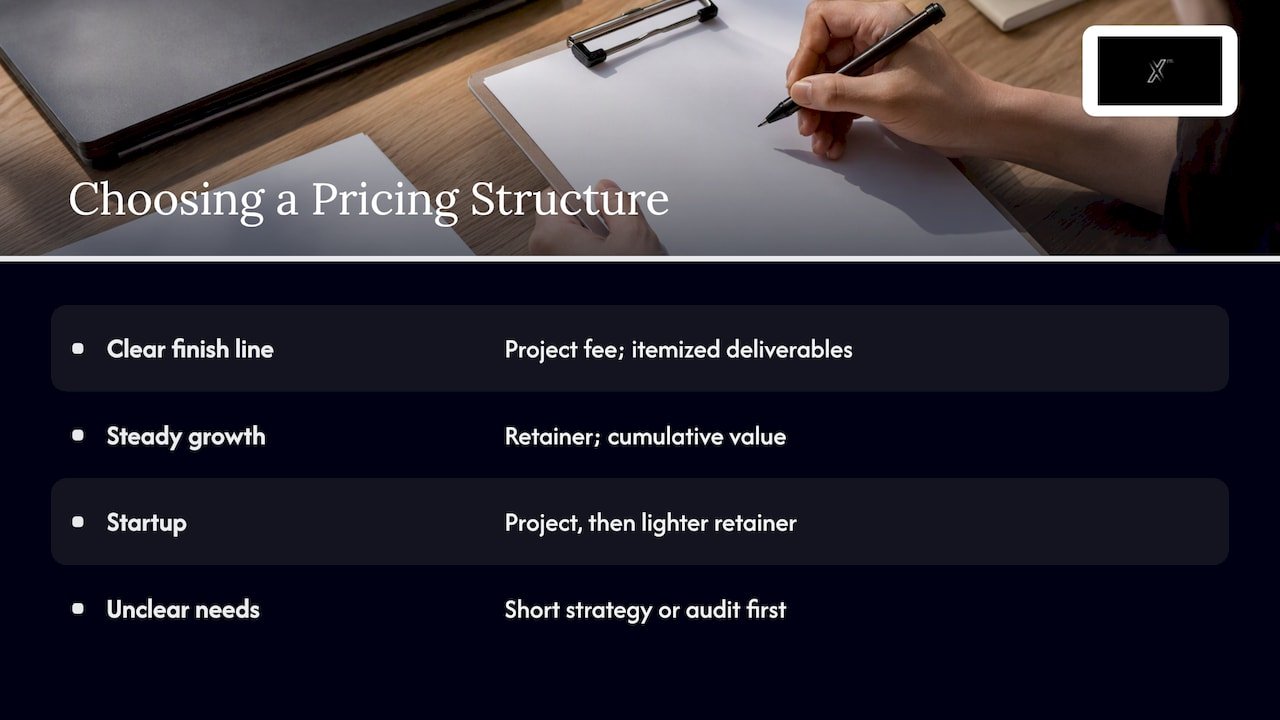
Start with the outcome, not the structure.
If you want a new identity, a website or a campaign with a clear finish line, ask for a project fee with itemized deliverables and a set number of revision rounds. You know the total before work starts.
If you want steady growth in search, social or email, a retainer fits better, because the value is cumulative. Set a minimum term you are comfortable with and agree what reporting you will receive.
If you are a startup, the common path is a project to build the foundations (positioning, identity, website, tracking) followed by a lighter retainer to run campaigns. That keeps the first outlay predictable and lets you scale spend as revenue arrives.
If your needs are unclear, pay for a short strategy or audit engagement first. A scoped plan turns a vague request into something every agency can price the same way.
What is usually included, and what is not
Most retainers cover the core work, planning, regular calls, and a monthly report. Ask the agency to list each of these in writing:
- Number of deliverables per month (posts, articles, emails, ad variations)
- Revision rounds per deliverable
- Named team members and the hours allocated to your account
- Reporting frequency and what the report contains
- Strategy sessions and how often they happen
Then look for what sits outside the fee.
Ad spend and management percentages
Ad spend is the money paid to Google, Meta or other platforms. It is not agency revenue, and it is usually the largest line in a paid media budget. Many agencies add a management fee on top, commonly a percentage. Adzooma’s 2025 UK survey found PPC agencies commonly charging 10% to 20% of advertising spend, with minimum client budgets ranging from £400 to £10,000 a month. The survey is British, but the structure is the same in the US and Australia. Agree who holds the ad accounts and who pays the platforms.
Technology, tools and third-party costs
Analytics dashboards, stock licenses, hosting, CRM seats, email platforms and freelancers can all be passed through. The commercial guide from TrinityP3, a consultancy that advises on agency fees, recommends asking for transparent disclosure of third-party charges, markups and technology fees. If a website or app is part of the work, look beyond design to ongoing costs: hosting, support and cost resourcing belong in your first-year budget, not a later surprise.
Setup and onboarding
Some engagements begin with a paid discovery phase covering research, audits and planning. That is reasonable when it produces a document you own. Ask what you receive at the end of it.

Worked example: a startup’s first-year budget
Say a software startup needs positioning, a visual identity, a website and three months of launch campaigns. Here is how a budget could be structured, using illustrative numbers inside the ranges above, not a quote.
| Line | Structure | Illustrative amount |
|---|---|---|
| Brand strategy and identity | Projet | $12,000 |
| Website with landing pages | Projet | $15,000 |
| Content and social, 12 months | Retainer at $3,000 per month | $36,000 |
| Paid search, 12 months | Retainer at $2,500 per month | $30,000 |
| Ad spend paid to platforms | Direct to platforms, $4,000 per month | $48,000 |
| Tools, hosting and licenses | Pass-through | $4,000 |
| Total | $145,000 |
Notice that fees are about half of the total. Founders who compare only agency fees miss the ad spend, and founders who compare only the total miss that some of it can be scaled down or paused. Line-by-line budgets let you adjust the right lever.
How to compare proposals fairly
TrinityP3’s January 2026 guidance is to compare proposals against an identical scope, with the same deliverable quantities, campaign assumptions and revision limits, and then to review staffing and allocated hours rather than the headline total. Turn that into a routine:
- Write one brief and send it to every agency. If each one invents its own scope, you cannot compare them.
- Put the quotes in a table with the same rows: deliverables, revisions, hours, people, tools, ad spend, management fee, reporting.
- Ask who does the work. A senior name in the pitch and a junior on the account changes the real value of the hours.
- Ask for rates in writing, including what happens when you request work outside scope.
- Check the exit terms: notice period, ownership of assets, ad accounts and data, and whether you keep logins.
- Match fees to goals. Ask which metrics the agency will report on and how often, so you can judge whether the spend is working.
Our own list of questions founders should ask before hiring covers the conversation side of this process in more detail.
When the cheapest quote costs more
A low quote is not wrong in itself, but it deserves a closer look at the items it leaves out. Three patterns recur:
- Thin scope. The price covers a handful of deliverables and charges extra for every revision, call or report.
- Fragmented delivery. You hire separate vendors for strategy, design, web and media. Each is cheap, but you become the project manager, and the messaging drifts between them.
- Unclear ownership. Without agreed ownership of creative files, ad accounts and analytics, switching later means paying twice.
When you compare, add the hours you will spend coordinating. For an owner running a business, those hours have a price too.
How to set a marketing budget before you call anyone
You do not need a formula to start. You need three numbers.
- What a new customer is worth to you. Average first-year revenue or margin per customer.
- How many customers you want to add. A target for the next twelve months.
- What you can invest before results arrive. Search and brand work often need months to compound.
With those, an agency can tell you whether your goal fits your budget or whether to narrow the scope. A good first conversation sounds like that: scope against goals, not a rate card.
Why a single integrated team changes the math
Most budget overruns come from the gaps between disciplines: the brand does not match the website, the website does not support the campaigns, and the campaigns are not measured the same way as the sales pipeline. An integrated agency is built to close those gaps. Our approach joins strategy, creative and execution in one connected system, so each piece is planned with the others in mind.
For a rebrand, that means identity, messaging and web are developed together. For a startup, it means the go-to-market plan, the site, the content and the paid media share one set of goals and one set of measurements. For companies with no in-house team, we can act as an external marketing department.
Our view on marketing agency pricing
We think the question owners should ask is not “what does an agency cost?” but “what does each piece of the work have to do for the business?” Price follows scope, and scope should follow a goal.
That is why we integrate strategy, creativity and execution in one agency. When the brand, the website, the content and the media are planned together and measured with data, fewer hours are lost to rework and hand-offs, and you can see how each part of the budget connects to a result.
Clients such as Market Nerd and Privè have worked with us on brand presence and operational processes. We also offer digital marketing training, so your own team can build skills alongside the work we carry out.
Xpert
Where Xpert Marketing fits
We are a full-service agency covering strategy and consulting, branding and visual identity, creative and content production, digital marketing, media planning and buying, web and tech, data and analytics, PR, events and training. That breadth lets you scope one engagement across several needs instead of managing separate vendors. You can see the full list on our services page, and examples of finished work in our portfolio.
We do not publish fixed prices, because the right scope depends on your goals, market and channels. Tell us what you want to achieve and we will help you shape a scope you can compare against anything else on your desk. If search is your priority, our guide on SEO agency costs goes deeper into that one service.
FAQ
How much does a marketing agency cost per month?
Published 2026 ranges put small-business retainers at about $1,000 to $5,000 a month and mid-sized businesses at $5,000 to $15,000, according to Swydo’s analysis. Full-service retainers commonly run $5,000 to $20,000 a month, per LaunchAdvisor’s guide. Ad spend is usually extra.
Is a retainer or a project fee better?
Choose a project fee when the outcome has a clear end, such as a rebrand or a website. Choose a retainer for work that compounds over time, such as content, search, social and paid media. Many businesses start with a project and move to a retainer once the foundations are in place.
Do agency fees include ad spend?
Usually not. Ad spend goes to the advertising platforms, and the agency fee is separate. Many agencies also charge a management percentage of spend; a UK survey from Adzooma found 10% to 20% common for PPC. Ask for both numbers as separate lines in the proposal.
How do I know if a proposal is fair?
Send every agency the same brief, then compare deliverable counts, revision limits, named staff, allocated hours and third-party costs side by side. TrinityP3 advises reviewing staffing and hours instead of the headline total. If two proposals cannot be put in the same table, ask the agencies to rework them until they can.
What should a startup budget for marketing?
Split it into three parts: a one-time build (positioning, identity, website), a monthly retainer for content and channels, and ad spend paid to platforms. Set the amounts from what a customer is worth to you and how many you want to win, then scale the retainer and ad spend as revenue grows.
Sources
- Agency Pricing in 2026 (Swydo)
- Marketing Agency Pricing Models: Retainer vs Project vs Ad Spend (LaunchAdvisor)
- Marketing Agency Costs in 2026: Pricing, Fees and Rates (TrinityP3)
- The Average Cost of UK Marketing Agencies (Adzooma)


