

Marketing Automation Strategy: A Practical Plan for Growth
A marketing automation strategy is a plan for which marketing tasks software handles, for whom, and when, tied to a business goal you can measure. The tool is the easy part. The strategy decides who gets a message, what it says and what it is supposed to achieve. This guide gives you a plan and a roadmap you can follow, whether you run a startup or a mature company.
TL;DR
- Start with a measurable business goal, then choose the audience, triggers and workflows that serve it. Pick the software last.
- Automate repeatable, rule-based work such as welcome sequences, lead nurturing and re-engagement. Keep complaints, relationship-building and sensitive approvals human.
- Connect automation to your CRM and customer data from day one, or you will build another silo.
- Launch a few workflows, test them end to end, measure return early, then expand.
- Track both business metrics (revenue, cost per customer) and engagement metrics (clicks, unsubscribes).
Sommaire
- What a marketing automation strategy actually is
- Marketing automation and CRM: how they fit together
- What a marketing automation plan should include
- A step-by-step roadmap
- What to automate and what to keep human
- Organize your data, content and tools first
- How to measure and improve results
- Our perspective
- Get help building your automation plan
- FAQ
- Sources
What a marketing automation strategy actually is
One guide from September 2026 defines it as a plan for deciding which marketing tasks software should handle automatically and when. Goals and triggers come first, and workflows then carry them out. The same guide draws the line that matters most: strategy determines who receives a message, what it says and how it supports business goals, while the software only executes predefined rules.
That is why two companies with the same platform get very different results. One has a clear audience, a sequence tied to a buying stage and a number it is trying to move. The other has a pile of emails that fire on a schedule.
It also helps to see how this differs from automation in general. General automation covers repetitive work in any department. Marketing automation specializes in marketing objects: campaigns, leads, segments and sends. Typical jobs include lead generation, nurturing, scoring, cross-selling, upselling and audience segmentation.
It is also broader than email. A definitive industry guide notes that automation can support campaigns across direct mail, phone, online and social channels, combining data from CRM, lead-management and web-analytics systems.
Marketing automation and CRM: how they fit together
People often ask whether marketing automation is the same as a CRM. It is not. According to Zoho’s integration overview, marketing automation is marketing-owned software for campaigns, nurturing, segmentation and lead scoring before a lead is sales-ready. A CRM is sales-owned software for managing conversations and pipelines.
The value comes from connecting them. When integrated, contact data, lead scores, campaign outcomes and engagement history flow in both directions. Marketing sees which leads become customers. Sales sees what a prospect read and clicked before the first call.
This matters when you choose tools. EMARKETER’s implementation guidance calls CRM and customer-data integration a make-or-break consideration, because without it automation becomes one more silo disconnected from sales.
What a marketing automation plan should include
A workable plan fits on a few pages. Drawing on a nine-step framework and several vendor guides, these are the parts that matter:
- Opportunity and goal. What problem are you solving, and what number will prove it? Typical macro goals include growing marketing-qualified leads, improving conversion rates, shortening the sales cycle, raising average order value and lifetime value, and re-engaging former customers.
- Audience. Who receives what? Define segments by behavior, lifecycle stage or persona, not only by demographics.
- Channels. Email is usually the start, but decide where else messages appear: your site, social, SMS, ads or sales outreach.
- Data needs and flow. Which fields do you need, where do they come from, and which system owns them?
- Communications and triggers. Which messages go to which customers, under what circumstances and when.
- Testing. How you will check workflows before real contacts see them.
- Launch, monitoring and improvement. Who watches results, and how often you revisit the plan.
One point that is easy to miss: automation is not only a marketing project. Klaviyo’s guide says sales, IT, developers, customer support and creative teams should all take part. Monday’s guide adds finance and customer success, and recommends turning objectives into measurable targets with clear timelines. Name an owner for each part before you build anything.

A step-by-step roadmap
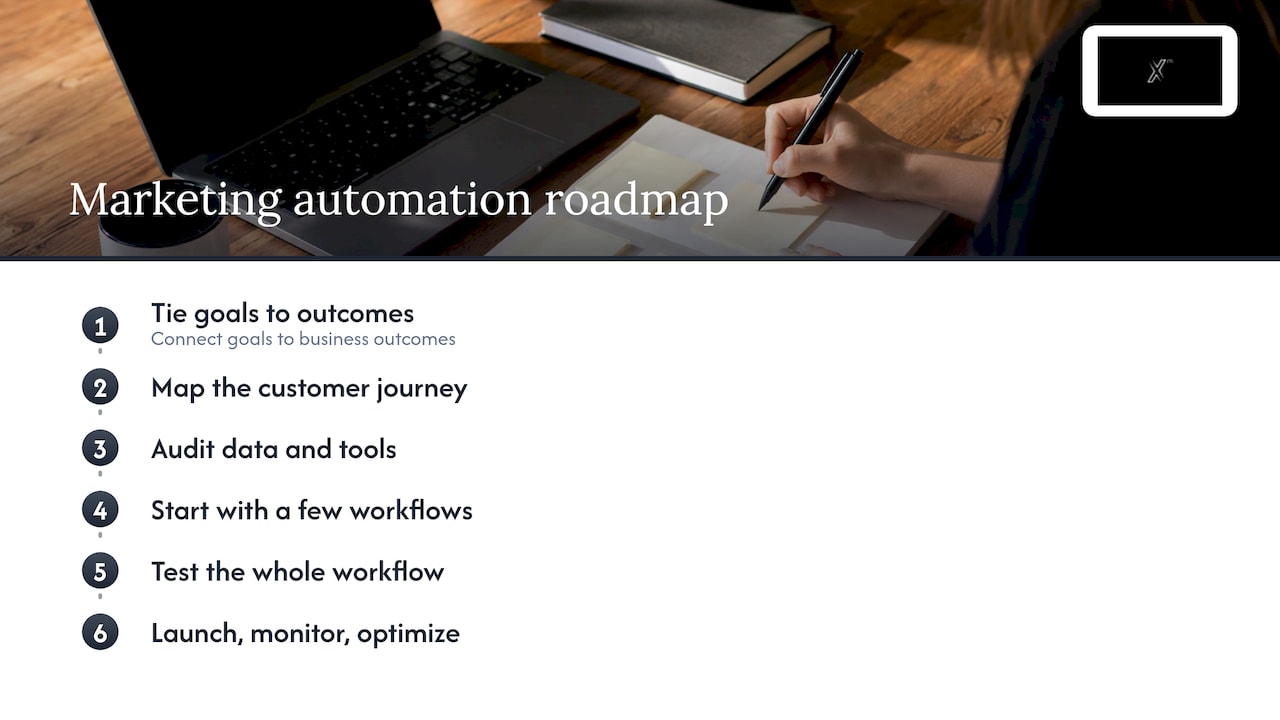
If you want a sequence rather than a checklist, use this one. It follows the order that experts consistently recommend: goals, then data, then build, then measure.
Step 1: Tie the goal to a business outcome
Write one sentence: “We want to [outcome] by [measurable change] using [audience and journey].” For example, “We want to convert more free-trial users to paying customers by improving onboarding emails.” EMARKETER’s guidance says platform selection should begin with goals tied to business outcomes and be driven by processes and use cases rather than feature lists.
Step 2: Map the customer journey
List the lifecycle stages your customers pass through. One framework uses awareness, research, evaluation, purchase, usage and advocacy. For each stage, define its purpose and what should happen there. Personalization only works when every touchpoint has content suited to the segment and the stage, so check what content you have before you plan messages you cannot fill.
Step 3: Audit your data and tools
Decide what data you need, where it lives and how it reaches the automation platform. Clean it before you connect it. We cover this in detail below.
Step 4: Start with a few high-impact workflows
Resist the urge to automate everything. Monday recommends starting with repeatable programs such as welcome sequences, persona-based lead nurturing and re-engagement campaigns, proving value with simple workflows, and only then adding multi-channel orchestration and predictive routing. EMARKETER’s experts likewise suggest starting with a few campaigns, verifying data and integrations, and measuring return immediately rather than a full rollout.
Step 5: Test the whole workflow
Run representative contacts through the entire automation. Built In’s guide says to check data handling, triggers, splits, segments, contact properties and how emails render across inboxes. A workflow that works for your test contact can still fail for a contact with a missing field.
Step 6: Launch, monitor and optimize
Pilot first, watch the early results, collect feedback, then improve. Monday suggests testing subject lines, content, timing, conversion paths and scoring models one at a time so you know what caused a change.
What to automate and what to keep human
The best automation removes repetitive work and leaves judgment to people. Pipedrive cautions that tasks needing human judgment should stay under human monitoring, otherwise customer experience and bottlenecks can suffer. DreamHost’s guide puts complaints, relationship-building, crisis communication and reputation-sensitive approvals on the human side.
Here is a simple way to sort your tasks:
| Task | Automate? | Pourquoi |
|---|---|---|
| Welcome sequence after signup | Yes | Rule-based, same every time |
| Lead nurturing by persona | Yes | Triggered by behavior and stage |
| Lead scoring and routing to sales | Yes, with review | Rules do the sorting, sales confirms |
| Re-engagement of inactive contacts | Yes | Repeatable, easy to measure |
| Abandoned cart or trial reminders | Yes | Clear trigger, clear goal |
| Responding to a complaint | No | Needs empathy and context |
| Crisis or reputation-sensitive messages | No | Needs senior approval |
| Key account outreach | Mostly human | Relationship decides the outcome |
A useful rule: if a mistake would damage a relationship rather than waste a send, a person should be in the loop.
Organize your data, content and tools first
Most failed automation projects fail on housekeeping, not on ideas. Before you build, get these in order:
- Contact properties. Decide which fields you capture (role, company size, source, lifecycle stage) and keep them consistent.
- Forms. Every form should feed the same fields, so a lead from a landing page looks like a lead from an event.
- Naming conventions. Agree on how campaigns, lists and workflows are named. In six months, nobody will remember what “Test final 2” does.
- Documentation. Write down each workflow’s trigger, audience, goal and owner.
- Content inventory. List the emails, pages and assets you have for each journey stage, and the gaps.
- Integration. Confirm the platform syncs with your CRM and analytics, as described above.
How to measure and improve results
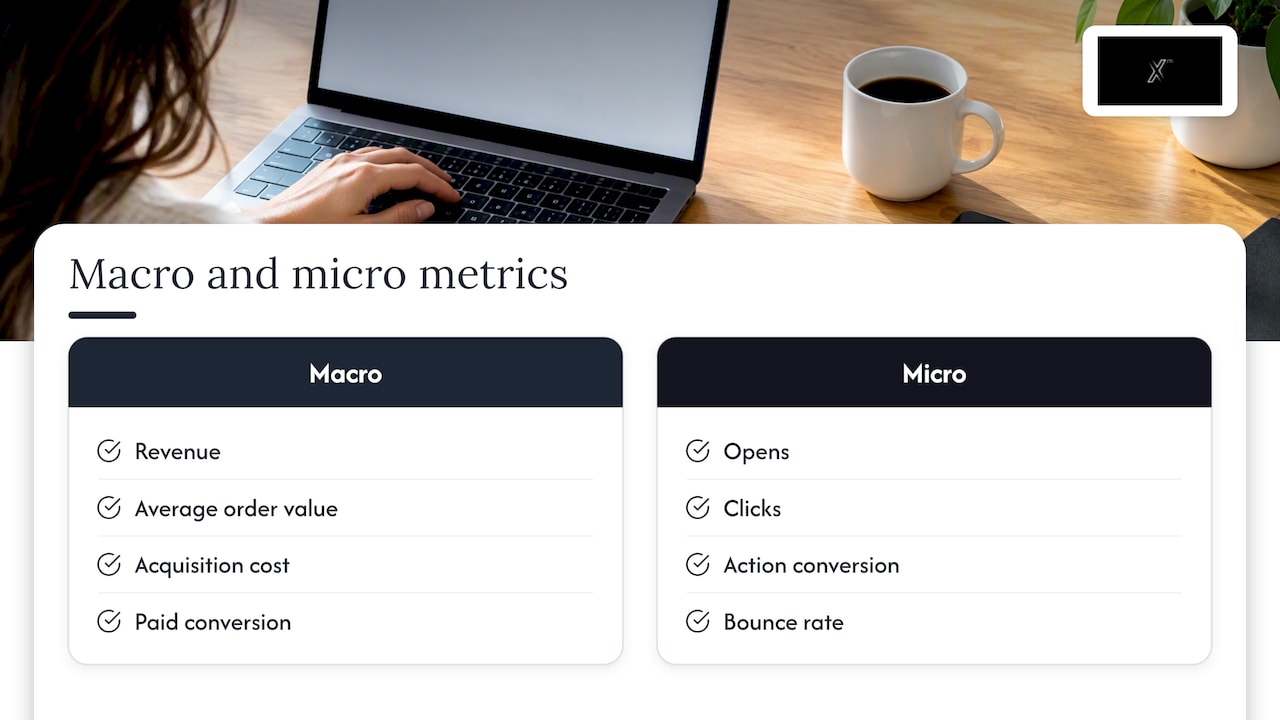
Separate two kinds of numbers. Sitecore’s framework splits macro metrics (revenue, average order value, acquisition cost, paid conversion, productivity) from micro metrics (opens, clicks, action conversion, bounce, unsubscribe and time-on-site rates). Micro metrics tell you whether a message works. Macro metrics tell you whether the strategy works.
HubSpot’s measurement guide recommends watching behavioral triggers, open and click-through rates, site traffic, reconversions, cost per customer, revenue, investment versus revenue and the close rate on marketing-sourced leads. It also notes that an unsubscribe rate above 1% can signal poor relevance or weak segmentation, which is a prompt to revisit your audience rules rather than your subject lines.
For reporting, an industry guide advises using a marketing database as the system of record, testing emails, landing pages and forms, and measuring each program’s revenue contribution and marketing ROI. If your data lives in several tools, a data and analytics setup that brings it together makes this much easier.
Set a review rhythm. Check early results weekly during the pilot, then monthly, and revisit the full plan every quarter or when your offer, audience or channels change.
Our perspective
We see the same pattern in many businesses: the platform is bought first and the strategy is written afterward, if at all. We would reverse that order. Automation is a connected system, and it only performs when strategy, content and execution are planned together.
That is how we work at Xpert Marketing. We combine strategy, creativity and execution in one team, and when a business needs it, we act as its external marketing department. For automation, that means we start from your market and your data, define the journeys and triggers, produce the content that fills them, and set up the measurement so the results are visible.
We also believe in training. Your team should understand why each workflow exists and how to adjust it, so the system keeps improving after launch. Our approach is designed to make automation a lasting capability rather than a one-off project.
Xpert
Get help building your automation plan
If you would rather not build this alone, we can help across the whole chain: strategy and consulting, content production, digital marketing, CRM and sales automation, and analytics. We can also train your team to run it, through our Formations.
Tell us your goal and your current tools, and we will suggest where to start. You can reach us through Xpert Marketing.
FAQ
What is a marketing automation strategy?
It is a plan that decides which marketing tasks software handles, for which audience, and at what moment, based on defined goals and triggers. The software executes the rules, and the strategy decides what those rules should be and how they support business results.
Is marketing automation the same as CRM?
No. Marketing automation is typically owned by marketing and manages campaigns, nurturing, segmentation and lead scoring before a lead is ready for sales. A CRM is typically owned by sales and manages conversations and pipelines. They work best integrated, so data and lead scores flow between them.
How do I start with marketing automation?
Pick one measurable goal and one journey, such as a welcome sequence or lead nurturing. Check that your data and CRM integration work, test the workflow end to end with sample contacts, launch it, and measure the return before you add more workflows.
Which marketing tasks should I not automate?
Keep human judgment for complaints, relationship-building with key accounts, crisis communication and anything reputation-sensitive that needs approval. Automate the repeatable, rule-based work around them so your team has time for these tasks.
Who should be involved in the plan?
Marketing leads it, but sales, customer support, IT or developers, creative and finance all have a part. Sales needs to agree on what a qualified lead is, and support knows what customers actually ask. Name one owner per workflow.
Sources
- Your Guide To a Successful Marketing Automation Strategy
- Marketing Automation: The Complete Guide (2026)
- How to Create a Successful Marketing Automation Strategy
- The Definitive Guide to Marketing Automation
- Marketing automation and CRM integration
- 5 steps to choosing and implementing a marketing automation platform
- 9 Steps for a Successful Marketing Automation Strategy
- Create an effective marketing automation strategy
- How to set up a strong marketing automation strategy
- Marketing Automation Strategy: 6 Steps To Drive Results
- Marketing Automation Strategy: 5 Steps to More Leads
- The Metrics You Need to Measure Marketing Automation Effectiveness


