

Social Media Management Plan: How to Build One
A social media management plan is the working document that turns your social goals into daily action: who posts what, on which channels, on what schedule, with whose approval, and how you will know it worked. It sits beneath your strategy and above your calendar. This guide shows you how to build one in seven steps, what belongs in it, and how it relates to a playbook, a content plan and a governance policy.
TL;DR
- A management plan connects strategy to execution: goals, audience, channels, content, calendar, roles, approvals and measurement in one document.
- Pick one or two channels you can run well before adding more.
- Plan content a quarter ahead, build the calendar monthly, and put approval dates into the schedule.
- Write down who plans, creates, reviews, approves, publishes and replies, including who acts in a crisis.
- Review results monthly or quarterly, and give any strategy about three months before changing its core.
Sommaire
- What a social media management plan is (and what it is not)
- Step 1: Set goals tied to the business
- Step 2: Define your audience from evidence
- Step 3: Choose a manageable number of channels
- Step 4: Audit what you have and what competitors do
- Step 5: Build the content plan and the calendar
- Step 6: Assign roles, approvals and rules
- Step 7: Measure, review and adjust
- A one-page template you can copy
- Our perspective
- When to get help
- FAQ
- Sources
What a social media management plan is (and what it is not)
People use several overlapping terms, so it helps to separate them. Think of the plan as the document that links the others.
| Document | What it answers | How often it changes |
|---|---|---|
| Stratégie | Why are we on social media and what business result do we want? | Yearly, or when business priorities shift |
| Management plan | How will we run it: channels, content, people, timeline, metrics? | Quarterly |
| Playbook | What are our standing rules for voice, visuals, replies and approvals? | Rarely |
| Content plan and calendar | What exactly goes out, and when? | Weekly to monthly |
| Governance policy | Who has access, who is responsible, and what is off limits? | Yearly, or after an incident |
The strategy works like a compass and the plan like a roadmap of specific tactics, as Canva’s guide to social media plans describes it. A useful test for the playbook versus the calendar comes from Oppira’s playbook guide: the playbook holds the standing rules, while the calendar holds the changing list of posts those rules produce. Your management plan should reference both rather than replace either.
If you want the broader picture of how social fits into a connected marketing system, see our view on why marketing 360 is a system, not just ads and social media.
Step 1: Set goals tied to the business
Start with the outcome the business needs, then translate it into social terms. “Grow our following” is rarely a business goal. “Generate 40 qualified demo requests a quarter from LinkedIn” is.
The American Marketing Association’s strategy guide recommends goals that are specific, measurable, attainable, relevant and time-bound, and tied to business objectives. In practice, write each goal in this form:
- Business objective: what the company wants (more leads, higher retention, a product launch).
- Social goal: the contribution social makes (qualified conversations, sign-ups, event registrations).
- Metric and target: the number and the deadline.
- Owner: one named person.
Keep the list short. Three goals you track are better than eight you forget.
Step 2: Define your audience from evidence
Build audience profiles from what you actually know: customer interviews, CRM data, sales call notes, and the analytics of any accounts you already run. The same AMA guide points to interests, needs, roles, locations and behavior as the attributes to define, and to using buyer personas alongside platform evidence.
For each audience, write down:
- Who they are (role, industry, company size, or life stage for consumer brands).
- The problem that brings them to your category.
- What they want from you on social: education, proof, entertainment, access to people.
- Where they spend time, and what they ignore.
If your sales team is already hearing the same five questions, those questions are your first five content topics.
Step 3: Choose a manageable number of channels
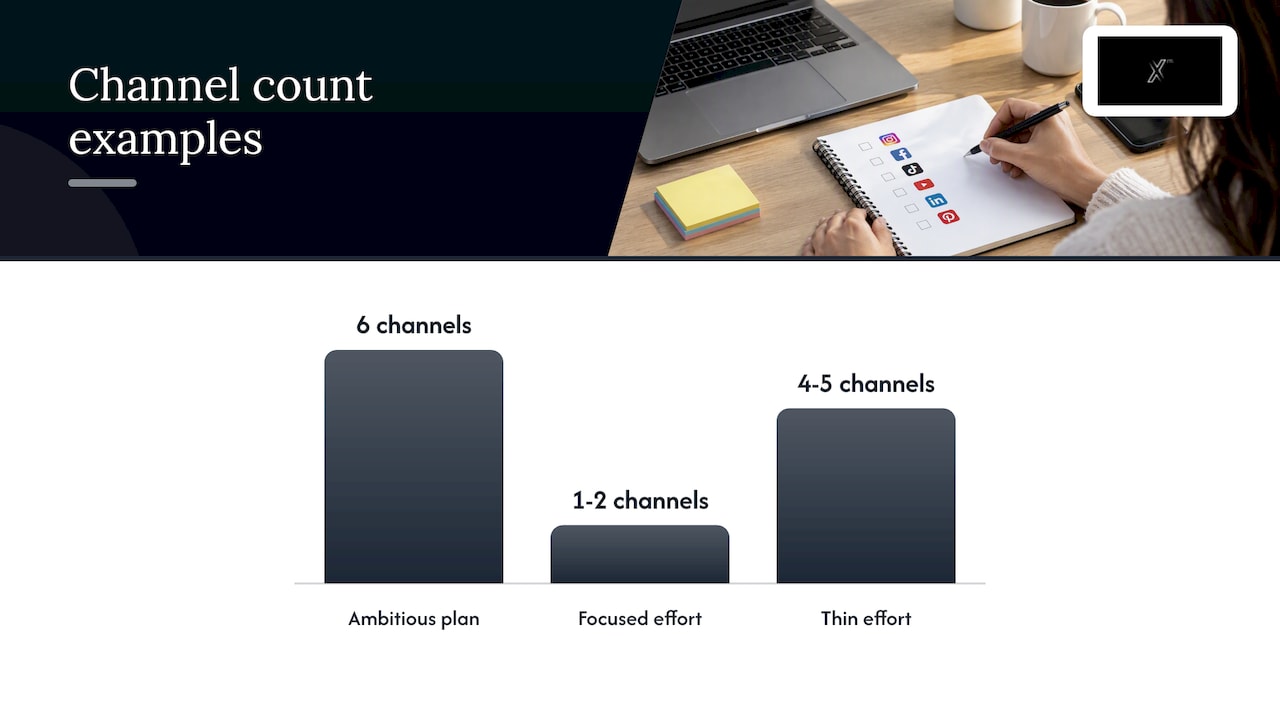
The most common failure in a management plan is ambition: six channels, no capacity. Choose platforms where your audience is active and where your goals, content formats and team resources fit. The AMA advice is to concentrate effort instead of chasing every channel. Buffer’s strategy guide makes the same practical point: small brands usually get better results from one or two platforms done well than from four or five done thinly.
A simple channel decision grid:
| Question | If yes | If no |
|---|---|---|
| Is our buyer active here? | Keep on the shortlist | Drop it |
| Can we make the native format (short video, carousels, long posts) every week? | Gardez en tête la | Drop or delay |
| Does it connect to a goal in Step 1? | Gardez en tête la | Drop |
| Do we have someone to reply within a business day? | Gardez en tête la | Do not open the channel yet |
For B2B companies, the channel decision should also trace back to pipeline. Our 90-day B2B social media roadmap shows how to connect channel activity to leads rather than to vanity numbers.
Step 4: Audit what you have and what competitors do
Before planning new work, review the existing work. List every account (including old ones nobody uses), who has access, how often each posts, and which posts produced results. Then look at three or four businesses your audience also follows, including direct rivals and adjacent brands. Note their formats, posting rhythm, and the topics that draw real comments rather than passive likes.
The output of this step is a one-page baseline: current follower counts, engagement rates, traffic from social, and leads attributed to social. Without a baseline you cannot show progress later.

Step 5: Build the content plan and the calendar
The content plan is the thinking; the calendar is the schedule. Do the thinking first.
Content pillars and mix
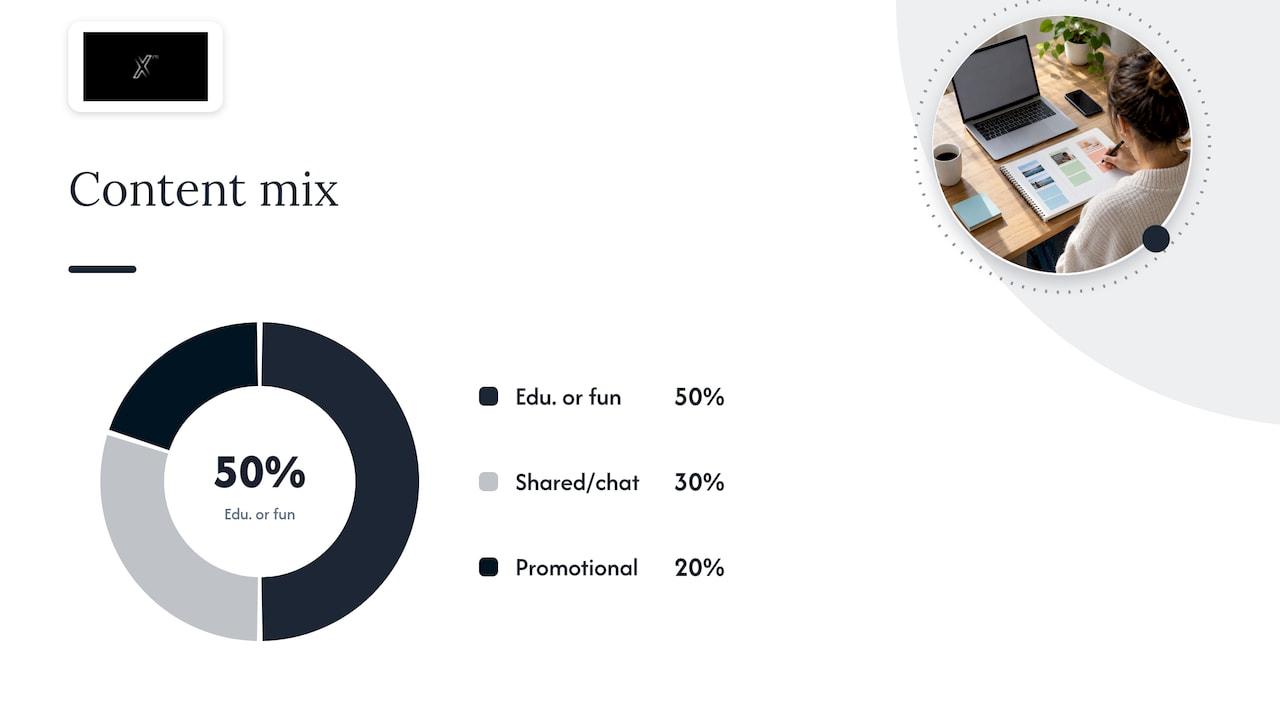
Choose three to five pillars, recurring themes that serve your audience and your goals. A B2B services firm might use: practical how-tos, client results, behind the scenes, industry commentary, and offers. Then set a rough mix. You will see rules of thumb such as 50/30/20, which usually means about half educational or entertaining content, a third shared or conversational content, and a fifth promotional. Treat these as starting ratios to test, not laws. Your own engagement and lead data should decide the final split.
Need help with the written, visual and video side? That is part of what we cover in our content marketing strategy guide.
The calendar
The Chicago Network’s social media content playbook suggests planning key messages a quarter ahead where possible and listing them together in one calendar. It also recommends building due dates, start dates, and review and approval dates into the development schedule, then testing message timing and revising it against audience response and KPIs.
A workable calendar has these columns:
- Publish date and time
- Channel and format
- Pillar
- Caption or copy status
- Creative status (brief, draft, approved)
- Owner and approver
- Link, call to action and tracking tag
- Result (filled in after publishing)
You can keep this in a spreadsheet or a project tool. If you want a lightweight option, this content calendar planning walkthrough shows how creators and marketing teams turn a content approach into a publishing schedule.
A rhythm that works for small teams: plan themes quarterly, fill the calendar monthly, and hold a short weekly check to swap in anything timely.
Step 6: Assign roles, approvals and rules
This is the part most templates skip, and the part that prevents expensive mistakes. The Chicago Network describes a governance plan as identifying the strategic and tactical team behind planning, developing and analyzing social strategy, and setting roles and responsibilities, especially in crisis communications.
For a small business, a one-page version is enough. Write down:
- Who plans the calendar and owns the goals.
- Who creates copy, graphics and video.
- Who reviews and approves, and how many working days they have.
- Who publishes, and from which tool.
- Who replies to comments and messages, and within what time.
- Who escalates: what counts as a complaint, a legal threat or a crisis, and who decides the response.
- Who holds the logins, with admin access for at least two people, never a single employee’s personal account.
Voice and disclosure rules
Put your voice rules in the playbook, and make them concrete: words you use, words you avoid, how you handle humor, how formal replies are. We go deeper in our guide to brand voice guidelines for marketing teams.
If you work with influencers, employees or affiliates, add a disclosure rule. The US Federal Trade Commission explains in its Endorsement Guides Q&A that the Guides were revised in 2023 and covers when connections to a brand must be disclosed. Write the rule into your policy, brief every partner on it, and have a legal adviser review it if you run paid partnerships at scale.
The same document should also say who speaks for the company when something goes wrong. Communication during a crisis is closely tied to your PR and communication approach, so decide the escalation path before you need it.
Step 7: Measure, review and adjust
Choose a small set of metrics per goal, grouped like this:
- Reach and attention: impressions, video views, profile visits.
- Engagement : comments, saves, shares, replies (more telling than likes).
- Action: link clicks, sign-ups, demo requests, purchases.
- Efficacité : hours spent and cost per lead.
How often to review
The AMA recommends reviewing strategy monthly or quarterly to spot trends, pivot if necessary and keep it aligned with business priorities. Buffer advises monthly tracking over weekly, because weekly numbers are noisy, and notes that most strategies need about three months of consistent execution to show real impact. So the rhythm looks like this:
| Cadence | What you do |
|---|---|
| Weekly | Check scheduled posts, reply backlog, anything urgent |
| Monthly | Report on metrics against targets, note top and bottom posts, adjust the next month’s calendar |
| Quarterly | Revisit goals, channels and content mix; update the plan |
| Yearly | Review governance, access, and the link to the business strategy |
If you want a practical way to decide what to measure, this guide to asking ten questions before building self-service analytics helps small businesses start from decisions rather than dashboards. Our data and analytics service covers the same ground for teams that want reporting set up properly.
Avoid rewriting the plan after one weak week. Change tactics (formats, timing, hooks) quickly; change the core approach only after a full quarter of consistent data.
A one-page template you can copy
Paste these headings into a document and fill them in:
- Business objective and social goals (with metrics, targets, owner)
- Audience profiles (two or three)
- Channels and why each was chosen
- Content pillars and target mix
- Posting frequency per channel
- Calendar location and planning rhythm
- Roles, approvals and turnaround times
- Reply standards and escalation path
- Paid support and budget, if any
- Reporting schedule and review dates
A complete first draft takes a few hours. A plan that fits on one page gets used; a forty-page plan gets filed.
Our perspective
We see the same pattern in many businesses: the strategy exists in someone’s head, the calendar exists in a spreadsheet, and nothing connects them. Posts go out because it is Tuesday, not because they serve a goal. The management plan is the connected system that fixes this.
We also believe the plan should be built backwards from the commercial result. If you cannot say how a post type contributes to leads, retention or reputation, it does not belong in the calendar. And social rarely works alone: it performs best when paid media, content, web experience and measurement are planned together, which is why we work as an integrated team, or as an external marketing department when a client needs one.
Finally, we teach as well as execute. Many teams do best when they learn the method and keep the day-to-day in-house, with an agency supporting strategy, creative and analytics.
— Xpert
When to get help
You can write this plan yourself. Outside support makes sense when no one has the time to run it consistently, when results have stalled, or when social needs to work with paid media, web and CRM. We offer digital marketing covering social media management, SEO, paid media and email, plus Formations if you want your team to run it. You can see everything on our services page.
FAQ
What should a social media management plan include?
At minimum: goals with metrics, audience profiles, chosen channels, content pillars, a calendar, roles and approvals, reply and escalation rules, and a reporting schedule. If any of these is missing, someone will improvise, and improvisation is where inconsistency and risk come in.
How is a social media management plan different from a content calendar?
The calendar is a schedule of specific posts. The plan explains why those posts exist, who produces and approves them, and how results are judged. The calendar is one component inside the plan.
How often should I update my plan?
Review results monthly and revisit the plan itself quarterly. Because strategies often need around three months to show reliable impact, avoid changing the core approach more often than that unless something major shifts in the business.
How many social platforms should a small business use?
Start with one or two where your buyers are active and where you can publish consistently. Add a third only when the first two run smoothly and you have the capacity to reply and measure.
Sources
- 8 Steps to Build a Successful Social Media Strategy, American Marketing Association
- Social media content playbook, The Chicago Network
- FTC’s Endorsement Guides: What People Are Asking
- How to Create a Social Media Marketing Strategy in 2026, Buffer
- Social Media Playbook Template, Oppira
- How to Make Social Media Plans, Canva


