

Website Redesign Cost: What to Budget and Why
A website redesign can cost anywhere from a few hundred dollars to six figures. The honest answer depends on three things: who does the work, how many pages and features the site has, and how much of the job is strategy and content rather than visual design. HubSpot’s published figures, last updated in October 2023, put DIY builds at $100 to $3,000, freelancers at roughly $2,000 to $20,000+, agencies at $15,000 to $30,000+, and large, complex sites at $40,000 to $75,000 or more. This guide explains what sits behind those ranges so you can build a budget you can defend.
TL;DR
- There is no standard price. Cost follows scope: page count, custom functionality, content work, integrations and who builds it.
- Published ranges run from about $100 for DIY to $75,000+ for large, complex sites, with agency projects commonly starting around $15,000.
- The design itself is often a minority of the bill. Strategy, content, development, testing and migration make up the rest.
- Budget for the year after launch too: hosting, maintenance, security, analytics and ongoing optimization.
- Ask every provider for a line-by-line scope, not a single number, so quotes can be compared fairly.
Sommaire
- What website redesign pricing looks like by type of builder
- What actually drives the total
- A typical redesign cost breakdown
- Hidden costs businesses miss
- How long a redesign takes, and why it affects cost
- Costs after launch
- How to decide what you should spend
- How to compare quotes
- Our perspective
- Plan your redesign with Xpert Marketing
- FAQ
- Sources
What website redesign pricing looks like by type of builder
The quickest way to place your project is by who will build it. Each option fits a different kind of business, and each has a different risk profile.
| Option | Typical published range | Best for | Main trade-off |
|---|---|---|---|
| DIY with a site builder | $100 to $3,000 | Very small sites, a tight budget, time to learn | Your time, limited customization, no strategy input |
| Freelancer | About $2,000 to $20,000+ | Defined projects with one or two specialties | One person’s skill set and availability |
| Agency | $15,000 to $30,000+ | Businesses that need strategy, design, development and content together | Higher upfront investment |
| Large or complex site | $40,000 to $75,000+ | Many pages, custom features, integrations | Longer timeline and more stakeholders |
These ranges come from HubSpot’s redesign cost guide, published in October 2023. Treat them as orientation, not quotes. Prices vary by market, by year and by how much of the work you bring in-house.
Two points about reading ranges like these. First, a low number is only low if the scope matches. A $3,000 site that needs a rebuild in 18 months costs more than a $20,000 site that lasts five years. Second, a high number is only justified if the work behind it is visible: research, content, testing and measurement, not just a nicer homepage.
What actually drives the total
When two quotes for “a redesign” differ by a factor of four, the difference is almost always in the scope items below.
Size of the site
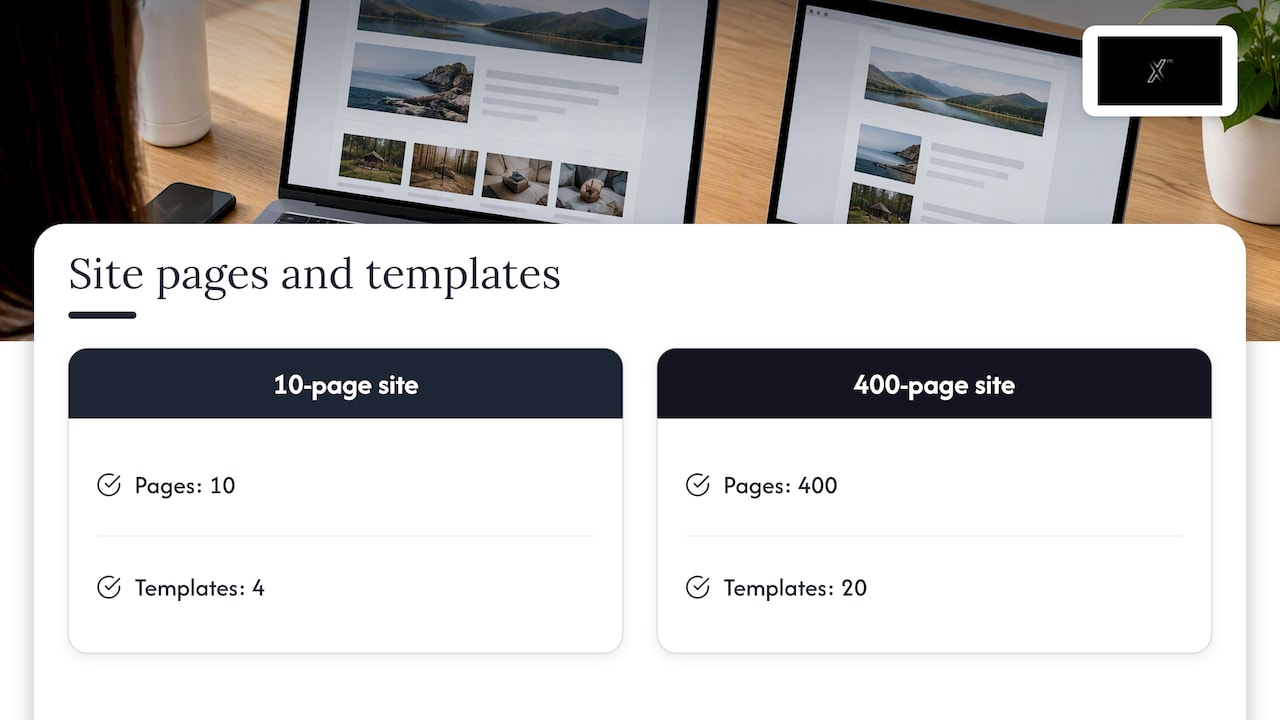
Every unique template needs design, development and testing. A ten-page brochure site might need four templates. A 400-page site with product pages, a blog, location pages and resource libraries might need twenty. Page count matters less than template count, because pages built from the same template are cheap to add.
Custom functionality
A standard contact form is nearly free. A booking engine, a customer portal, a quote calculator, a membership area or a product configurator is a software project in its own right, with its own design, build, security and testing costs. If a feature is a differentiator for your business, it deserves its own line in the budget.
E-commerce
Online stores add product data structure, checkout design, payment and shipping integrations, tax handling and inventory sync. Moving a catalog from one platform to another is a project inside the project. The more products and variants you have, the more important a clean migration plan becomes.
Content: new, rewritten or migrated
Content is the most underestimated line in redesign budgets. Moving existing text onto a new template is the cheapest option, but it rarely improves results. Rewriting key pages, adding photography or video, and restructuring navigation around what customers actually search for costs more and usually pays back more. Decide early which pages get new content and which are only moved.
Integrations
A site that talks to your CRM, email platform, booking tool, ERP or analytics stack needs those connections rebuilt and tested. Each integration is small on its own, but five of them across a redesign can add weeks of work. If lead data stops flowing into your CRM on launch day, the redesign has cost you money, not saved it.
SEO and redirects
A redesign that changes URLs without a redirect plan can lose the search visibility you spent years earning. Mapping old URLs to new ones, preserving titles and metadata where they perform, and checking indexing after launch are standard parts of a careful project. If your organic traffic matters, make this an explicit line item. Our guide to SEO agency costs covers the ongoing side of search budgets.
Who is involved
A project with one decision-maker moves faster and costs less than one with six reviewers and conflicting feedback. Rounds of revision are a cost driver that never appears on the proposal until it is too late. Agree on the number of review rounds and the single person who signs off.
A typical redesign cost breakdown
Here is how the work usually divides across a mid-sized business project. The percentages are our working guide from planning projects like this, not a published industry statistic, so use them to check proportions in a quote rather than as a rule.
| Phase | What it covers | Rough share of the budget |
|---|---|---|
| Discovery and strategy | Goals, audience, analytics review, competitor review, sitemap | 10 to 15% |
| UX and visual design | Wireframes, templates, style, responsive layouts | 20 to 25% |
| Contenu | Copy, imagery, video, SEO-informed page briefs | 15 to 25% |
| Développement | Theme or custom build, CMS setup, features, integrations | 25 to 35% |
| Testing and launch | QA across devices, performance, redirects, tracking | 5 to 10% |
| Project management | Coordination, reviews, communication | 5 to 10% |
If a quote shows only “design” and “development”, ask where discovery, content, migration and testing sit. Missing lines tend to reappear later as change requests.
Hidden costs businesses miss
These are the items that turn a comfortable budget into an overrun.
- Content creation. Photography, video, case studies and product descriptions take time and often outside help.
- Stock or licensed assets. Fonts, images, icons and plugins can carry annual licenses.
- Migration cleanup. Old pages with broken formatting, duplicate content or outdated offers need decisions, not just copying.
- Third-party tools. Booking, chat, forms, popups and personalization tools often bill monthly.
- Accessibility work. Making the site usable with keyboards and screen readers is cheaper to design in than to retrofit.
- Staff training. Your team needs to be able to edit the site without calling a developer for every change.
- Internal time. Your people will spend hours on briefs, feedback and approvals. That time has a cost even if no invoice shows it.

How long a redesign takes, and why it affects cost
Time is money in agency work, so timeline and price move together. A small brochure site can often be designed and launched within a couple of months. Mid-sized business sites commonly take several months once discovery, content and testing are included, and large sites with custom features or complex migrations take longer. Those are planning guides from our project experience, not fixed rules.
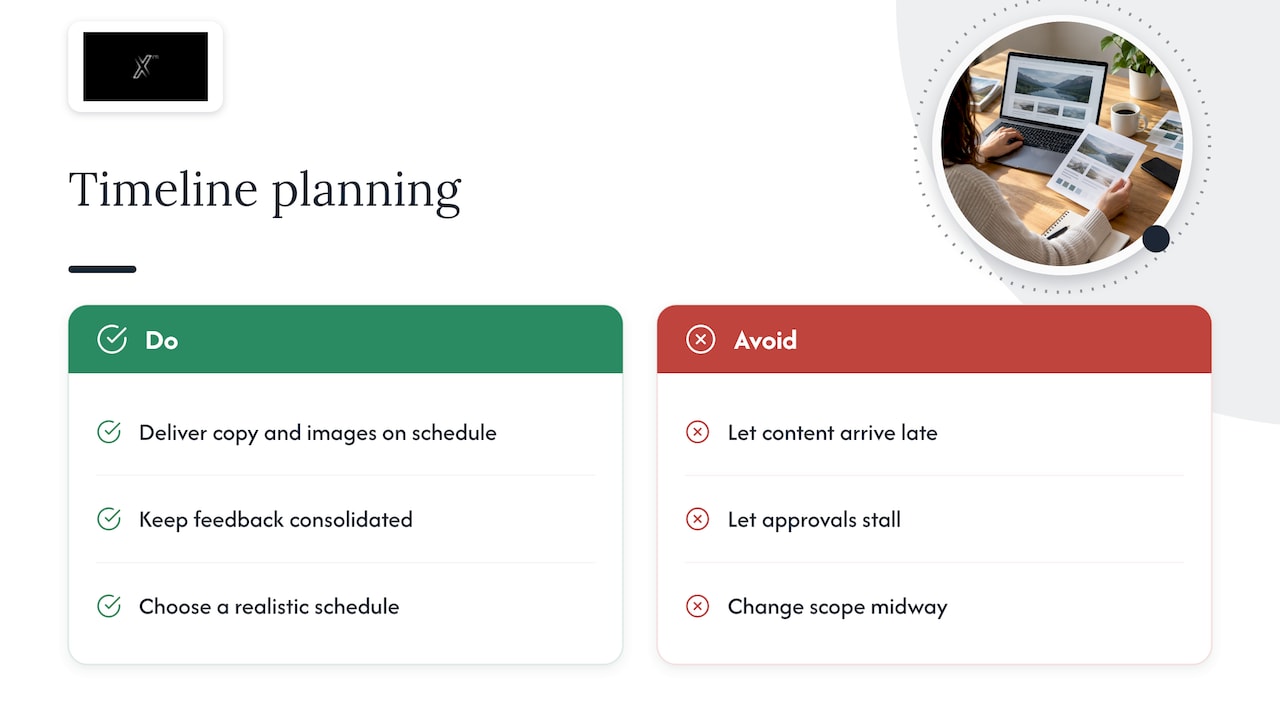
The biggest delays rarely come from design or development. They come from late content, slow approvals and changing scope midway. If you can deliver copy and images on schedule and keep feedback consolidated, you shorten the project and reduce the risk of paying for extra rounds.
A rushed timeline also costs more. Compressing a project means parallel work, more people and less room for testing. If there is no hard business deadline, a realistic schedule is the cheapest option.
Costs after launch
The invoice for the redesign is not the last invoice. Plan for these recurring costs from the start:
- Hosting and domain. Prices vary from shared plans to managed or cloud hosting, depending on traffic and performance needs.
- Maintenance and security. Updates for the CMS, themes and plugins, backups, uptime monitoring and security scans.
- Analytics and reporting. A redesign is only a success if you can measure it. Tracking setup and monthly review keep decisions grounded in data. Our data and analytics service is built around exactly this.
- Conversion optimization. Launch is the start of learning, not the end. Testing headlines, forms and page layouts is how a new site earns its cost back; see our practical guide to conversion rate optimization.
- Content and SEO. New pages, updates and link building keep the site growing.
A common planning habit is to reserve a yearly maintenance and improvement budget as a percentage of the build cost. The right percentage depends on how much the site drives revenue, so set it with your provider rather than copying a rule of thumb.
How to decide what you should spend
Start from the value of the site, not from the price of sites.
- Name the job the site must do. Generate leads, sell products, support existing customers, recruit, or build credibility. Different jobs justify different budgets.
- Look at current numbers. Traffic, conversion rate, average customer value and the share of revenue that starts online. If the site influences $500,000 of revenue a year and a redesign lifts conversion modestly, the payback math is easy to run.
- Separate refresh from rebuild. If your structure, content and platform still work, a visual and usability refresh is enough. If the platform is slow, hard to edit or insecure, or your offer has changed, a rebuild is the better investment.
- Set a range, not a number. Tell providers your ceiling and your goals, then ask what they would do at three levels. You learn what each extra dollar buys.
- Phase it. Launch the pages that carry the revenue first, then add secondary sections afterward. This protects cash flow without compromising the core result.
When a redesign is worth it
Common signals: the site does not work well on phones, it is slow, your brand has changed, you cannot update it without a developer, your leads or sales have stalled while traffic holds, or your analytics show visitors leaving at the same step every time. If your issue is one page or one funnel, a targeted fix is usually cheaper than a full redesign.
How to compare quotes
Two proposals at the same price can contain very different projects. Compare them on these points:
- Does the proposal include discovery and a written strategy, or does design start on day one?
- How many unique templates and pages are included?
- Who writes the content, and who sources the images?
- What happens to your old URLs and search rankings?
- Which integrations are in scope?
- How many revision rounds are included, and what does an extra round cost?
- Who owns the code, the design files and the accounts at the end?
- What support is included after launch, and for how long?
- How will success be measured, and who reports on it?
A provider who answers these clearly is easier to trust than one with the lowest price.
Our perspective
We have seen the same pattern in redesigns across industries: the projects that disappoint are rarely the ones that cost too much. They are the ones where the website was treated as a design exercise, separated from brand, content, search and sales. A new look on top of an unclear message produces a better-looking version of the same results.
That is why we work on websites as part of a connected system. Strategy decides what the site must achieve and for whom. Brand and content give it something worth saying. Development makes it fast, maintainable and easy to measure. Analytics and optimization keep it improving after launch. When these pieces sit with one team, you avoid the hand-off gaps where budgets leak.
Our advice on budgeting is simple. Spend where the site touches revenue, keep a reserve for the first months after launch, and do not pay for features you cannot connect to a business goal. If a provider cannot explain how a line item helps you win customers, remove it or challenge it.
— Xpert
Plan your redesign with Xpert Marketing
We are a full-service marketing agency, and web development sits alongside strategy, branding, content, digital marketing and analytics in what we offer. That means your redesign can start with research and a clear brief, and continue after launch with measurement and optimization. Pricing depends on scope, so we scope each project individually rather than publishing a fixed rate. You can see what we build on our Web, Tech & Innovation page and examples of past work in our portfolio.
If you want a scoped estimate with the line items above, tell us your goals, current site and timeline through our services page, and we will help you work out what the project should include and what it can leave out.
FAQ
How much does a website redesign cost?
It depends on who builds it and how complex the site is. HubSpot’s published figures cover DIY at $100 to $3,000, freelancers at roughly $2,000 to $20,000+, agencies at $15,000 to $30,000+, and large, complex sites at $40,000 to $75,000 or more. Your own number will come from page count, features, content and integrations.
How much does it cost to pay someone to design your website?
A freelancer or agency price is usually built from discovery, design, content, development and testing. Freelance projects generally cost less than agency projects, but you may need to coordinate several specialists yourself. Ask for a line-by-line scope so you can see what each price includes.
How long should a website redesign take?
Small sites can take a couple of months, while mid-sized business sites often take several months and complex builds longer. Late content and slow approvals are the most common causes of delay, so prepare copy and decision-makers before the project starts.
What costs come after the redesign?
Expect hosting, domain renewal, security and software updates, analytics, and ongoing content or optimization. Third-party tools such as booking or chat software may also bill monthly. Ask your provider for an estimated yearly figure before you sign.
Should I redesign the whole site or just fix the weak pages?
If the platform, structure and message still work, fix the weak pages or funnel first. A full redesign makes sense when the site is slow, hard to update, off-brand or built on a platform that no longer fits your business. Analytics will show which case you are in.


