

Brand Positioning Strategy: How to Define and Apply It
A brand positioning strategy is a decision about the place you want to hold in your customers’ minds: who you serve, which alternatives they compare you with, what you do better than those alternatives, and why they should believe it. Get that decision right and your website, ads, sales calls and pricing all pull in the same direction. Leave it vague and each channel tells a different story. In our work as a full-service agency, positioning is where strategy, creative and execution have to meet, so this guide walks through it in the order you would actually do it.
TL;DR
- Brand positioning is how customers perceive you relative to the alternatives, so it has to be built from the customer’s point of view, not from your own list of strengths.
- A solid position has four parts: a target, a frame of reference (your competitive set), a point of difference and a reason to believe.
- Write it as a one-sentence internal statement, then test it against real customers and competitors before it reaches any campaign.
- A position only works if it shows up everywhere: product, pricing, sales, content, design and the people who talk to customers.
- Rebrands, launches and growth plans all start here, and an agency that handles strategy and execution together keeps the position intact in the work.
Indice
- What brand positioning strategy actually means
- The four components of a brand position
- How to define your brand positioning, step by step
- Positioning frameworks and how they differ
- Types of positioning, with examples
- Applying the position across the business
- Perspective: why we treat positioning as the first deliverable
- Working with an agency on positioning
- FAQ
- Fonti
What brand positioning strategy actually means
HubSpot describes brand positioning as the process of positioning your brand in the mind of your customers, a strategy that sets you apart from competitors and focuses on how customers perceive you. Harvard Business School Online puts it more formally: establishing competitive advantages in consumers’ minds through a differentiated customer value proposition.
Two things follow from those definitions.
First, positioning lives in the customer’s head. You do not get to declare it. You propose it through everything you do, and customers accept it or ignore it.
Second, positioning is not a slogan or a logo. The Harvard Business Publishing core reading on the subject by Jill Avery and Sunil Gupta describes positioning statements as internal strategic documents that answer the question “Why should I buy?”, not as taglines. The tagline is one possible output. The position is the decision behind it.
Why it matters to the business
When products look alike, the promise is what separates them. Tina Edmondson of Marriott International makes the point in HBS Online’s article: where functional value is the same, the distinct promise a brand makes is what shapes the choice. HubSpot’s guide adds that differentiation supports awareness and helps justify pricing, which is why positioning reaches the bottom line and not only the brand deck.
For the businesses we work with, the trigger is usually practical:
- A rebrand, because the company has outgrown what its name, look and message say about it.
- A launch, because a startup needs to enter a market with a clear reason to be chosen.
- A website or content rebuild, because nobody can write good copy for a business that has not decided what it stands for.
- A growth plateau, because ads and outreach bring traffic that does not convert when the promise is generic.
The four components of a brand position
Academic sources use slightly different vocabulary, but they converge on the same four building blocks. Kevin Lane Keller’s brand planning framework names a competitive frame of reference, points of difference, points of parity and a short brand mantra. The Avery and Gupta reading frames the same ground as target segment, value, evidence and competitive set.
In plain terms:
| Component | The question it answers | What a weak version sounds like |
|---|---|---|
| Target | Who exactly are we for, and in what situation? | “Businesses of all sizes” |
| Frame of reference | Which alternatives does the customer compare us with, including doing nothing? | Naming only the competitors you like to be compared with |
| Point of difference | What can we offer that they cannot get to the same degree elsewhere? | “Quality, service and innovation” |
| Reason to believe | What proof makes the difference credible? | “Trust us, we are experts” |
Two related terms are worth knowing. Points of parity are the things customers expect from anyone in your category, such as reliable delivery or secure checkout. You need them to be in the conversation at all. Points of difference are the associations customers hold strongly, view favorably and believe they cannot find to the same extent elsewhere, as Kotler and Keller define them. A position needs both: parity gets you considered, difference gets you chosen.
The test for a point of difference
Will Barron of Salesman.org, quoted by HubSpot, argues that you only get to position your brand when you are doing something remarkable; anything else is just comparison. The practical reading is that a difference has to be real and provable. Ask three questions of every claim:
- Does the customer care about it, or only we do?
- Can a competitor say the same thing truthfully tomorrow?
- Can we show evidence: results, process, specialization, track record?
If a claim fails the first, drop it. If it fails the second, it is parity. If it fails the third, it is a hope, not a position.

How to define your brand positioning, step by step
HBS Online lays out five steps: define the audience, understand the competition with a perceptual map, articulate differentiators and reasons to believe, craft the statement and sharpen it with real-world examples. The sequence below follows that logic and adds the working detail most teams skip.

Step 1: Define who you are for
Start with the customers who get the most value from you and are easiest to serve well, not with everyone who could buy. Look at demographics, but also at the situation: what has just changed in their business that makes them look for you? A startup leaving the founder-led sales stage and a 20-year-old company facing a new competitor are different buyers, even in the same industry.
This step depends on evidence. Interviews with customers, sales call notes, search data and survey results beat internal opinion every time. If you have no research yet, our market research strategy guide shows how to gather it without a large budget.
Step 2: Map your real alternatives
List what your target customer would do if you did not exist. That includes direct competitors, adjacent solutions, an in-house hire and simply keeping the current way of working. Then plot the main ones on a perceptual map: a two-axis chart where each axis is an attribute customers care about, such as price level versus level of customization. Kotler and Keller note that such maps can reveal gaps, openings that suggest unmet needs.
The common mistake is choosing axes where you happen to win. Choose them from customer research, then see where you honestly sit.
Step 3: Pick the difference and the proof
From the map and the research, choose one primary point of difference, with at most one or two supporting ones. Pair each with evidence. Evidence can be a specialization, a process, measured results, certifications, a distinctive method or a named client outcome.
April Dunford’s advice, reported in her 2026 conference talk, is to keep asking “So what?” about each feature until the customer-facing value is clear. A feature is not a difference until the customer can see what it does for them.
Step 4: Write the positioning statement
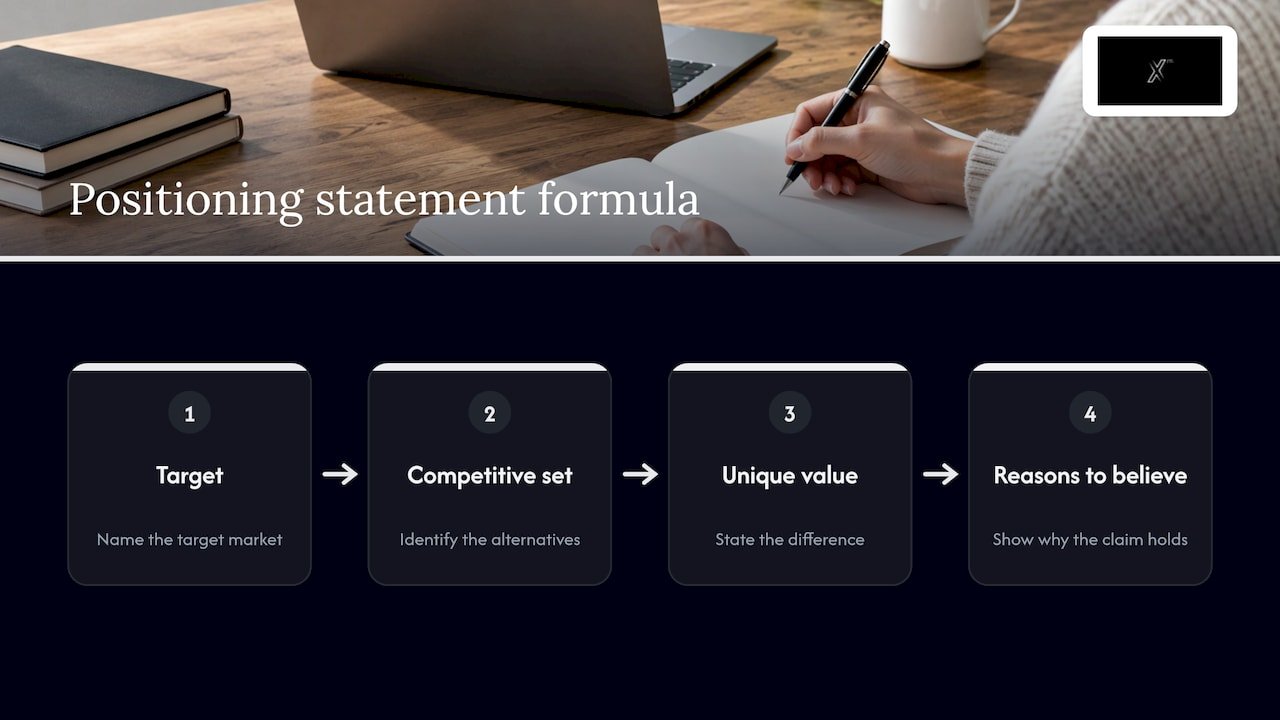
HBS Online gives this formula: “For [target market], our brand is the only one among all [competitive set] that [unique value claim] because [reasons to believe].” The Stanford Graduate School of Business uses a variant in its brand course material: for a target segment with a need, the product is a category that delivers a core benefit, and unlike the competing alternative, it has a key point of difference.
A worked example for an imaginary company:
For regional accounting firms with 10 to 50 staff, our platform is the only one among client-portal tools that automates document chasing end to end, because it connects directly to the major tax-prep systems firms already use.
Notice what it does. It names a narrow audience, a clear competitive set, one difference and a reason the claim holds. It is not meant for publication; it is the sentence every marketing decision is checked against. If you want help turning positioning statements into sales conversations, this breakdown of sales messaging frameworks shows how the components become what reps actually say.
Step 5: Test it before you build on it
Show the statement to people in the target group and to your own customer-facing team. Do they recognize themselves? Do they understand the difference without explanation? Would a competitor’s salesperson be able to say the same thing? Rewrite until the answers are yes, yes and no.
Once live, track whether the position is landing: search demand for your brand, win rates, the language prospects use back to you, and conversion by audience segment. Campaign reporting tools that pull ad and analytics data into one place make this easier to watch. For testing specific messages against each other, our A/B testing strategy guide covers how to plan and prioritize tests.
Positioning frameworks and how they differ
People use “statement”, “map” and “framework” loosely, so it helps to separate them.
- Positioning statement: one internal sentence that records the decision (target, category, difference, proof).
- Perceptual map: a diagram of how customers see you relative to competitors on attributes that matter. It is an analysis tool that feeds the statement.
- Positioning framework: the whole structured process that produces and applies the position: research, competitive set, difference, statement, and the plan to carry it through the organization.
Several well-known frameworks exist. Keller’s model uses frame of reference, points of parity, points of difference and a three-to-five-word brand mantra. Avery and Gupta use four components: target, value, evidence and competitive set. Dunford’s approach starts from true alternatives and moves to unique attributes, value and best-fit customers. HubSpot’s longer guide lists a 12-step process that includes a brand essence chart and an evaluation stage.
You do not need to pick the “correct” one. They all force the same discipline: decide the customer, the comparison and the proof before you decide the creative. Our guide to a brand strategy framework shows how positioning connects to personality, voice and messaging.
Types of positioning, with examples
A position usually leans on one primary angle. Here are common ones, with brands most readers will recognize:
| Angle | How it works | Example |
|---|---|---|
| Price | Win on cost or value | Walmart’s “Everyday Low Prices” |
| Functional | Solve a specific job better | QuickBooks for small-business accounting |
| Emotional | Own a feeling | Nike’s “Just Do It” |
| Symbolic | Signal status or identity | Hermès, Ferrari |
| Experiential | Own the way it feels to use | Travel and entertainment brands |
These categories come from Shopify’s positioning guide. The lesson from the examples is not to copy them. Each of these brands commits to one angle and repeats it in product, price, tone and channel. A mid-size B2B company rarely wins on a price or symbolic angle, and a functional position built on a specific audience and a provable method is often the stronger route: be the best at one job for one type of customer.
What B2B and service businesses can learn
If you sell services, your product is partly invisible, so the position has to be made visible through proof: case studies, a named method, a specialization, results with numbers. A phrase like “full-service” is a category, not a position. “Full-service for scaling e-commerce brands that need strategy and execution under one roof” starts to be one.
Applying the position across the business
A position written and filed is wasted. Stanford’s material warns that the statement must be communicated throughout the organization so employees can convey the value proposition externally. A five-step approach from the HOK anthology similarly ends with consistent communication and ongoing monitoring of effectiveness, sales, market share and image.
Use this checklist to carry it through:
- Message: the homepage headline, product pages and sales deck all state the same difference to the same audience.
- Visual identity: colors, typography, imagery and layout express the position. A premium position with discount-style design confuses people. See our guide to visual identity design.
- Story: the founding story, customer stories and proof points reinforce the reason to believe. Our piece on brand storytelling covers how.
- Channels: content, SEO, paid media, email and PR each carry the same core idea in a format native to the channel.
- People: sales, support and account teams can explain the position in their own words. Shared templates and branded materials help; a guide to brand consistency across teams shows how teams keep customer-facing details aligned.
- Go-to-market: launches, pricing and sales plays are built on the position. See our go-to-market strategy guide.
- Review: revisit the position when your market, product or customer base shifts, and on a regular schedule such as yearly.
Common mistakes
- Positioning on features nobody asked for.
- Choosing an audience so wide that no message fits.
- Comparing yourself only with competitors you beat.
- Borrowing claims a rival could make in the same words.
- Changing the message every quarter, so customers never learn it.
- Treating positioning as a design exercise instead of a business decision that touches product, price and sales.
Perspective: why we treat positioning as the first deliverable
In our experience as an agency that covers strategy, creative and execution, the most expensive marketing problem is a good campaign built on an unclear position. It produces nice assets that do not add up.
That is why we approach positioning as a connected system. The research, the choice of audience and difference, the visual identity, the content, the website and the media plan are one job, not five handoffs. Our aim is to act as a dedicated external marketing department when a business needs it, so the position set in strategy is the one customers meet in every channel.
We also see positioning as something to measure. Data and analytics belong in the process from the start, so the position can be tested and sharpened as results come in. For businesses planning a rebrand, a launch or a rebuild, we recommend starting with positioning and letting everything else follow from it.
Xpert
Working with an agency on positioning
Positioning needs outside perspective for one simple reason: owners are too close to their business to see how customers compare it. A team that combines research, strategy, branding, content, web and media can also turn the decision into assets without losing it along the way.
Xpert Marketing offers Strategy & Consulting and Branding & Visual Identity, alongside creative content production, digital marketing, web and tech, media planning and buying, data and analytics, and training. Clients such as Market Nerd and Privé have worked with us on brand presence and operational processes. If you are planning a rebrand, a go-to-market launch or a site rebuild and want the position set before the creative starts, see our full list of services and get in touch.
If your team would rather build the capability in-house, our digital marketing trainings pass on the same methods.
FAQ
What are the four components of brand positioning?
The core elements are a target customer, a frame of reference (the alternatives customers compare you with), a point of difference and a reason to believe. Keller adds points of parity and a short brand mantra. Together they say who you serve, against whom, why you are better and why that claim is credible.
How long should a brand positioning statement be?
One sentence, or two at most. It is an internal reference, so clarity matters more than style. Use a formula such as the one from Harvard Business School Online, then derive the public-facing tagline, headlines and messaging from it.
How is positioning different from branding?
Positioning is the strategic choice about the place you want in customers’ minds. Branding is the full expression of it: name, visual identity, voice, story and experience. Positioning comes first and guides the branding decisions.
When should a company revisit its positioning?
Revisit it when you enter a new market, launch a major product, see a new competitor change the comparison, or find that your best customers no longer match the audience you wrote down. Otherwise, a yearly review against customer research and sales data keeps it current.
Fonti
- HubSpot: brand positioning strategy guide
- Harvard Business School Online: how to craft a brand positioning statement
- Harvard Business Publishing core reading: Brand Positioning
- Kevin Lane Keller: Brand Planning
- Stanford GSB: What is a brand
- Shopify: brand positioning guide


