

B2B Influencer Marketing: A Practical Guide for 2026
B2B influencer marketing means partnering with credible industry experts, so that buyers hear about your company from a voice they already trust. It works because business buyers weigh the opinion of peers and specialists heavily. The programs that perform are planned as long-term, always-on relationships, matched to the audience you actually sell to, and measured against pipeline rather than likes. If you are a business owner or marketing lead in the US, Australia or anywhere else, this guide walks you through the strategy, the selection process, the channels and the measurement.
TL;DR
- A B2B influencer is a specialist buyers respect: a practitioner, analyst, author, customer or niche creator, not a celebrity.
- Pick by audience fit, engagement quality and expertise. A small, relevant following usually beats a big, passive one.
- LinkedIn is the main channel for most B2B programs, and creator-led formats such as Thought Leader Ads give you paid reach behind an expert’s voice.
- Treat it as an always-on program, and measure it with self-reported attribution, CRM tracking and sales-cycle signals, not last click alone.
- Disclose paid relationships clearly. In the US, the FTC expects it.
Indice
- What B2B influencer marketing is, and who counts as an influencer
- Why it works: buyers trust people before brands
- Build the strategy before you pick a name
- How to find B2B influencers
- How to vet them: audience first, followers last
- Which channels and formats to use
- Measure it across a long buying journey
- A 90-day starting plan
- Our perspective
- How we can help
- FAQ
- Fonti
What B2B influencer marketing is, and who counts as an influencer
In B2B, an influencer is an expert or thought leader in a specific industry or professional niche, chosen for credibility in their field. They help a company stand out, reach its target audience and guide informed purchasing decisions. They might co-create and share social content, or host events and webinars with you.
That is different from consumer influencer work. Nobody buys a payroll platform or an industrial component because a creator looks good using it. They buy because someone they respect explained why it solves a problem. The influencer’s job is to educate and lower the perceived risk of a decision.
The people who qualify are wider than most owners expect. B2B Marketing groups them into several types:
- Professional influencers: keynote speakers and published authors with large followings.
- General influencers: journalists, bloggers and senior employees in your industry.
- Subject matter experts: academics and specialists whose word carries weight.
- Micro-influencers: smaller accounts with more engaged, more specific audiences.
- Customers: people with real authority among the audience you want.
That last group matters. If your best customers are already respected in your sector, they may be your first influencer program.
Why it works: buyers trust people before brands
The case rests on how business buying actually happens. Forrester’s 2025 Buyers’ Journey Survey, discussed in a Forrester analysis of B2B influencer relations, found that industry experts are often the trigger that gets buyers to engage with a vendor. External commentary can also be the reason a purchase stalls. Influencers can speed up the buying process or stop it.
The same logic shows up in paid media. Ipsos and LinkedIn’s B2B Institute tested 113 creator-led ads and around 11,000 Thought Leader Ads in The Credibility Code whitepaper (July 2026). They predict creator-led ads outperform short-form video by 1.2x on consideration and deliver 1.5x stronger brand impact. Their conclusion is that creators are a full-funnel force: most B2B buyers are not buying at any given moment, and creators build the familiarity and trust that make a brand the natural choice when the moment arrives.
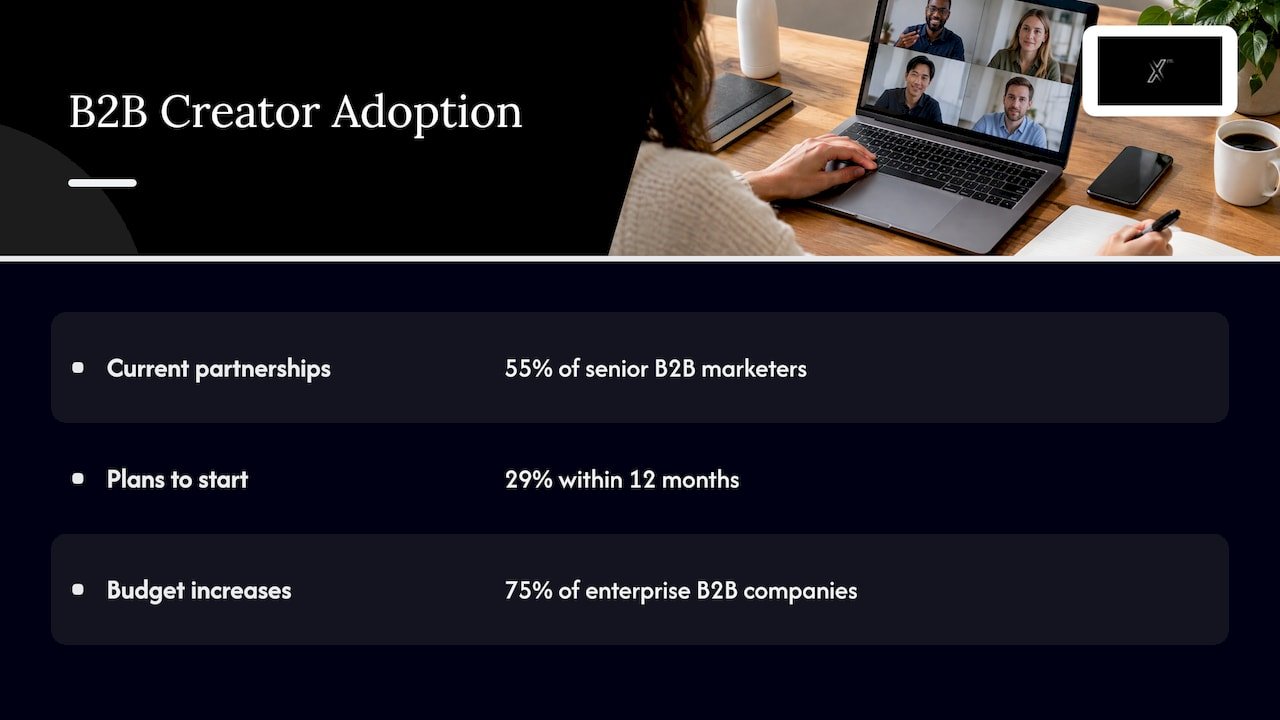
Adoption is already broad. State of Brand reported in April 2026 that 55% of senior B2B marketers already partner with creators and subject-matter experts, and another 29% plan to start within 12 months. It also notes Forrester’s prediction that 75% of enterprise B2B companies will raise influencer-relations budgets in 2026.
For a startup or a company repositioning itself, this is the practical takeaway: a trusted outside voice can do what your own brand cannot yet do, which is earn belief before the first sales call.
Build the strategy before you pick a name
The most common mistake is starting with a list of famous accounts. Start with the business goal and the buyer.
Define the goal and the audience
Write down one primary goal for the first six months. It might be awareness in a new market, credibility for a rebrand, demand for a product launch or better-qualified pipeline. Then describe the buyer in job titles, not demographics: who signs, who evaluates, who influences quietly.
Forrester’s analysts argue that B2B providers should make influencer engagement core to brand and demand strategy rather than episodic. They suggest mapping influence across the whole lifecycle: discover, evaluate, commit and post-sale. They also suggest prioritizing influencers by trust, relevance and reach, and building partnerships that benefit both sides.
In practice that means asking, for each stage, who the buyer listens to:
- Discover: who do they follow to learn about the problem?
- Evaluate: whose comparison or teardown would they read?
- Commit: whose endorsement would calm a risk-averse committee?
- Post-sale: whose advice keeps them using, and renewing, the product?
Go long, go niche
eMarketer points out that effective B2B influencer marketing is about value creation, trust and collaboration, not celebrity status. Successful programs fold influencers into long-term, always-on strategies, and micro and niche influencers are generally preferred over the biggest accounts for their specific audiences and subject expertise.
A one-off sponsored post rarely moves a buyer who needs 88 touchpoints before buying. Plan for a series of pieces over months: a webinar, a co-authored guide, a recurring video segment, a podcast appearance.
Connect it to the rest of your marketing
Influencer content needs somewhere to land. If a respected expert sends buyers to a weak website or an unclear offer, the trust is wasted. Before you invest, check that your positioning, landing pages and follow-up are ready. Our guide to B2B influencer strategy, selection and measurement goes deeper on the planning side, and our B2B social media roadmap shows how the organic side fits into a 90-day pipeline plan.
How to find B2B influencers
You will not find the best partners by searching a hashtag. Use the places your buyers already look.
- Ask recent customers. Ask whose advice they trusted when they were choosing. The answers are usually more precise than any database.
- Check where experts gather. Conference agendas, podcast guest lists, industry newsletters and association panels show who your market invites to speak.
- Look at the conversation on LinkedIn. Search the topics your product solves and note who gets thoughtful replies from people with buyer job titles.
- Review who already works with adjacent vendors. A specialist who partners with complementary, non-competing brands already understands sponsored collaboration.
- Look inside your own company. Senior employees and founders are often the most credible voices you have, and they cost nothing to brief.
For a team in Sydney, Melbourne or Austin, the same method applies, but add local anchors: regional industry bodies, local conferences and country-specific communities. A voice that matters to US buyers may be unknown to Australian ones, and the reverse is just as true.
How to vet them: audience first, followers last
Follower counts are the weakest signal in B2B. A sound vetting routine checks five things:
| Check | What to look for | Red flag |
|---|---|---|
| Audience fit | A good share of commenters and followers hold the job titles you sell to | Audience is mostly students, job seekers or other marketers |
| Engagement quality | Thoughtful replies, saves and reshares | Generic comments, engagement pods, sudden spikes |
| Expertise | Their experience supports the claim you want them to make | They cover everything and specialize in nothing |
| Consistency | Regular posting over many months | Long gaps, or a recent burst of activity |
| Voice | They can explain your topic in their own words | They only repeat your brief |
Treat the numbers as a guide, not a rule. A creator with a few thousand engaged practitioners can be worth more than one with tens of thousands of passive followers, because the people who matter to a B2B sale are few and specific.
Also ask who else pays them. If the same person promotes three of your direct rivals this quarter, the endorsement will carry less weight.
Disclosure is part of the job
In the US, the FTC says an endorsement should make it obvious when the influencer has a material connection with the brand, such as payment or free product. Build disclosure into the contract and the brief, and agree on the wording and placement in advance. This protects your brand as well as the influencer. If you run campaigns across several countries, check each market’s own advertising rules.
Which channels and formats to use
For most B2B brands, LinkedIn is the core channel because the audience is defined by job and industry. Dreamdata’s 2026 benchmark, summarized by State of Brand, reported that LinkedIn returned 121% on ad spend against 67% for Google Search and 51% for Meta, and took 41% of B2B paid social budgets. The same report puts the median click-through rate of Thought Leader Ads at 2.68%, against 0.42% for standard single-image ads, across 119 campaigns.

Those are benchmarks from one dataset, so use them to set expectations rather than promise results. They do show why pairing an expert’s organic post with paid distribution has become a common approach.
Formats that work well in B2B include:
- Co-created content: a guide, a benchmark study or a webinar where the expert brings the insight and you bring the data.
- Video series: in-depth explainers that make complex products understandable. See our B2B video marketing plan.
- Podcasts and live events: long-form conversations build credibility that a single post cannot.
- Thought Leader Ads: paid promotion of an expert’s or executive’s own post to a defined audience. Our LinkedIn Ads playbook covers how to build the audience and budget.
- Customer advocacy: case-based stories from respected customers.
A real example: Würth Elektronik
A case study published by Springer documents Würth Elektronik’s partnership of more than five years with the YouTube electronics creator GreatScott!. The collaboration uses in-depth videos on EMC testing, DIY projects and tutorials to bring complex technical topics to the global electronics community. Three lessons carry over to almost any B2B company: the partner was a genuine practitioner, the content taught something useful, and the relationship ran for years rather than weeks.
Measure it across a long buying journey
This is where many programs lose their budget. State of Brand reports that the average B2B buyer journey runs 272 days, involves 10 stakeholders and 88 touchpoints, and spends 81% of its length before a sales pipeline opens. Creator content sits in that early phase, where last-click attribution cannot see it.
So measure in layers:
- Self-reported attribution. Add a “how did you hear about us?” field to demo and contact forms, and have sales ask the same question on calls. Buyers often name the expert who convinced them.
- Quality of engagement. Count reactions and comments from people who match your target accounts, not total impressions.
- Referenced pipeline in the CRM. Tag opportunities where the influencer or their content was mentioned, and follow them to close.
- Account-level movement. Watch whether target accounts visit more pages, return more often or respond to outreach after a campaign.
- Sales-cycle signals. Compare time to close and win rates on influenced deals with the rest of the pipeline.
A CRM that captures source and stage cleanly makes steps three to five possible. If you want to see how scoring can then route the best leads to your reps, this explanation of predictive lead scoring for B2B sales is a useful next read. For choosing a model that fits long cycles, see our guide to marketing attribution models.
Set the review rhythm at the start: monthly for engagement quality, quarterly for pipeline and sales-cycle effects. Influence compounds, so judging a program after three weeks is the surest way to cancel a good one.
A 90-day starting plan
If you are launching your first program, this is a sensible sequence:
- Weeks 1 to 2: set one goal, define the buyer by job title, and audit your landing pages and follow-up process.
- Weeks 3 to 4: build a longlist of 20 to 30 candidates from customers, events, podcasts and LinkedIn conversations, then vet them with the table above.
- Weeks 5 to 6: brief three to five partners. Agree on the topic, format, disclosure wording, usage rights and how you will share results.
- Weeks 7 to 10: publish the first co-created pieces, and put paid distribution behind the strongest ones.
- Weeks 11 to 13: review engagement quality, self-reported attribution and early CRM signals, then decide whom to extend, replace or expand.
Keep the brief light on scripts. Experts keep their audience’s trust by speaking in their own voice, so give them facts, access to your people and a clear point of view to react to, not lines to read.
Our perspective
Most B2B companies we meet treat influencer work as a campaign: one expert, one post, one report. Buyers do not behave that way, and neither does trust.
We see influencer marketing as one part of a connected system. The strategy decides who your buyer listens to. The creative and content work turns an expert’s insight into something worth sharing. Paid media and social give it reach, and analytics show which relationships feed the pipeline. When those pieces are planned together, the expert’s credibility has somewhere to go.
That is why we integrate strategy, creativity and execution in one agency, and why we can act as a dedicated external marketing department for companies that do not want to coordinate several suppliers. Our approach is built on market research and data, so each influencer decision rests on who your buyers are and how they move.
Xpert
How we can help
Xpert Marketing is a 360° agency that covers the pieces an influencer program depends on: strategy and consulting, branding, content production, digital marketing, media planning and data and analytics. We work with startups preparing a go-to-market, companies repositioning their brand and organizations that want to deepen customer engagement through content. If you want a program planned and run as a connected system, start with our Digital Marketing service, or see how we have worked with clients such as Market Nerd and Privè in our portfolio.
FAQ
What is the difference between B2B and B2C influencer marketing?
B2C influencers usually sell on lifestyle appeal and reach. B2B influencers sell on expertise: they explain complex topics and help buyers feel safe about a decision. The audience is smaller, the sales cycle is longer, and credibility matters more than follower count.
Who is a good fit for a B2B influencer partnership?
Look for practitioners, analysts, authors, niche creators and respected customers whose audience contains your buyers. Micro and niche specialists often fit better than the biggest accounts, because their followers are specific and engaged.
How do you measure the ROI of B2B influencer marketing?
Combine self-reported attribution, engagement from target accounts, CRM-tracked opportunities and sales-cycle comparisons. Because buyers spend most of their journey before a pipeline opens, last-click reporting understates the effect. Review results monthly and quarterly, not after a single post.
Do I have to disclose paid influencer relationships?
In the US, the FTC says endorsements should make any material connection to the brand obvious, which includes payment and free products. Put the disclosure wording in the contract and brief. For campaigns in other countries, follow that market’s advertising rules.
Where should a first program start?
Start on LinkedIn, where your audience is defined by job and industry. Pick three to five relevant experts, agree on co-created content and disclosure, put paid distribution behind the best pieces, and review results after 90 days.
Fonti
- B2B influencer marketing is a growing field (eMarketer)
- B2B influencer marketing essentials: how to identify your influencers (B2B Marketing)
- It’s Time To Reinvent B2B Influencer Relations (Forrester)
- The Credibility Code whitepaper (Ipsos and LinkedIn B2B Institute)
- B2B Creator Marketing Has Entered Its Performance Era (State of Brand)
- B2B + Influencer Marketing = An Impossibility? Würth Elektronik case study (Springer)
- Disclosures 101 for Social Media Influencers (FTC)
- Predictive Lead Scoring for B2B Sales (Forefront Industries)


