
Experiential Marketing Strategy: A Practical Guide for 2026
An experiential marketing strategy is a plan for getting people to do something with your brand, not just see it. That might be a pop-up, a sampling booth, a live event or an interactive installation. The plan ties that experience to a business goal, a defined audience, a budget and a way to measure the result. This guide shows you how to build one, which formats and activation ideas fit which goals, and what real campaigns can teach you.
TL;DR
- Experiential marketing puts customers inside an activity, event or interactive campaign so they form an emotional connection that ordinary advertising rarely creates.
- Start with one clear goal (awareness, trial, social engagement, loyalty or sales), then pick the format that serves it, not the other way round.
- A solid plan covers research, audience, concept, logistics, technology, budget and evaluation.
- Measure more than ticket counts: costs, revenue impact, non-financial value and the social, web, email and feedback data around the activation.
- The strongest campaigns connect the live moment to digital channels so the experience keeps working after the crowd leaves.
Indice
- What an experiential marketing strategy actually is
- Formats to choose from
- How to build an experiential marketing strategy
- How to measure an experiential campaign
- Experiential marketing examples worth studying
- Brand activation ideas by situation
- What about the four E’s?
- Our perspective
- Plan your next activation with us
- FAQ
- Fonti
What an experiential marketing strategy actually is
Salesforce describes experiential marketing as involving customers in activities, events or interactive campaigns that build emotional connections beyond traditional advertising, with possible gains in engagement, reach and recognition. Live events, pop-ups and brand activations are the usual examples.
Academic work frames it the same way. A 2023 Delphi study in the Journal of Brand Management describes experiential marketing as using the subjective, elaborative nature of experience to influence consumers and positively affect brand salience. The same study found that immersion works at experiential, brand and conceptual levels, and that the impact depends on people’s ability and motivation to become immersed.
That last point matters for planning. An activation is not automatically powerful because it is big. It works when the right people are willing and able to engage with it, and when the experience says something true about the brand.
Strategy versus a one-off stunt
A stunt is an idea. A strategy answers four questions in order: why are we doing this, for whom, in what form, and how will we know it worked? Without those answers, even a beautiful activation becomes an expensive photo opportunity.
Formats to choose from
The format should follow your goal and your audience’s habits. Common options include:
- Live events, trade shows, demo days, webinars and conferences. Ahrefs lists these as experiential formats and links them to benefits such as awareness, search demand, emotional bonds, product trial and sales conversion.
- Roadshows, in-store events, exhibitions, interactive trade-show booths and ride-and-drive events. Un’ 2021 peer-reviewed study based on expert interviews names these as commonly cited formats.
- Pop-ups and sampling. Short-lived spaces where people try a product in a setting built around the brand story.
- Private events for existing customers. Salesforce notes that VIP access, exclusive offers, early product access and private events can strengthen relationships with people who already buy from you.
- Street marketing. Small, mobile, high-visibility interventions in public places, useful when you want reach in a specific neighborhood or around a specific event.
- Virtual and hybrid experiences. Virtual tours, livestreamed launches and interactive web experiences extend an activation to people who cannot attend.
How to build an experiential marketing strategy
1. Research the market and the audience
Salesforce lists market research, goal setting, audience segmentation, positioning and messaging, and budget and resource allocation as the core components of an experiential framework. Begin with the audience. Where do they spend time, what do they already do with brands like yours, and what would make them stop for ten minutes?
Segment before you design. A first-time buyer, a loyal customer and a trade partner want different things from the same event. If you are still shaping your positioning, a clear brand strategy framework gives the experience something consistent to express.
2. Set one primary goal
Experiential goals are broader than immediate sales. Shopify points out that they can include awareness, free sampling, social engagement and brand goodwill. Pick one primary goal and no more than two supporting ones, and write each as something you can count.
| Primary goal | Good-fit formats | What to count |
|---|---|---|
| Awareness | Street marketing, large pop-ups, installations | Reach, press and social mentions, branded search |
| Product trial | Sampling, demo days, in-store events | Samples given, trial-to-purchase rate, coupon redemptions |
| Social engagement | Photo-led installations, interactive games | User-generated posts, hashtag use, shares |
| Loyalty | Private events, VIP access, early product access | Repeat purchase, attendance, referrals |
| Lead generation (B2B) | Trade-show booths, workshops, roadshows | Qualified conversations, meetings booked, pipeline value |
3. Map the customer journey
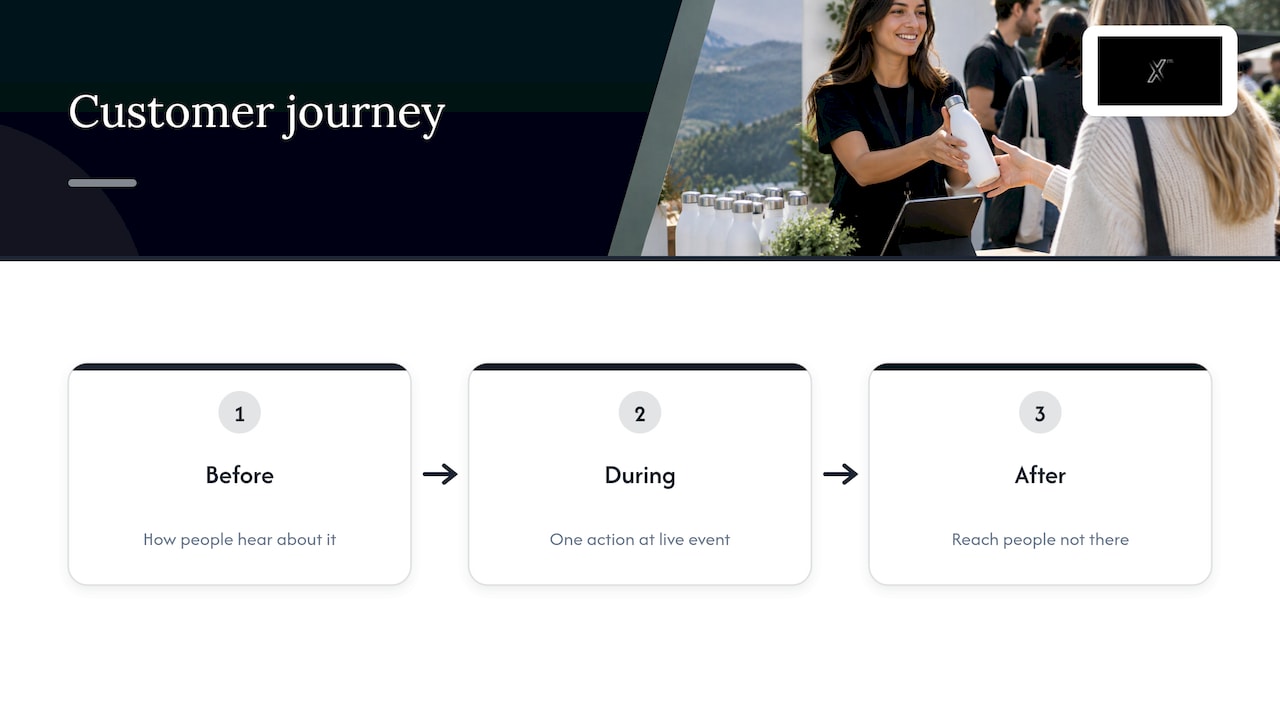
Decide what happens before, during and after the experience. Before: how do people hear about it? During: what is the one action you want them to take? After: how do you reach them again? Salesforce’s planning advice includes defining the customer journey and coordinating multichannel activity, which is where many activations fall short. The live moment reaches hundreds or thousands. Digital follow-up is what carries it to the people who were not there.
This is where a connected approach pays off. Our view of marketing as a system rather than separate ads and posts applies directly: the activation, the content around it and the paid and owned channels should be planned as one thing.
4. Develop the concept
A good concept does three things. It expresses a truth about the product, it asks for a simple participation, and it is easy to describe in one sentence. Test your idea against that sentence. If you need a paragraph to explain what people do, simplify.
The expert study above lists concept development, promotional-event management, brand activation, technology selection, financial management, budget execution and evaluation as the implementation activities. Treat that as your production checklist, with an owner for each item.
5. Plan logistics, technology and budget
Location, permits, staffing, insurance, safety, data capture and weather contingencies decide whether a great concept survives contact with reality. Choose technology only where it makes the experience better: an AR layer, a photo capture station, a registration system that feeds your CRM. Budget for the activation, but also for promotion before it and content capture during it. Many teams spend everything on the build and nothing on telling people about it.
6. Integrate with digital and media
The experience should feed your other channels. Capture photo and video, collect opt-in contacts, and plan paid and social amplification before launch. If the activation is meant to build awareness at scale, media planning that tests incremental lift before scaling helps you decide where extra spend actually adds reach. Our digital marketing work covers social, search, email and paid media that carry an activation beyond the venue.
7. Plan the evaluation before launch
Decide on the metrics, the data sources and the review date while you are still designing. It is much harder to prove value if you try to reconstruct the numbers afterward.
How to measure an experiential campaign
Salesforce’s guidance is to measure goals and objectives, costs, revenue impact, non-financial value, and relevant social media, website, email and feedback data. In practice, build a simple scorecard:
- Participation: attendees, samples handed out, interactions, dwell time.
- Reach: social impressions, press pickups, user-generated content, livestream views.
- Behavior after the event: branded search, site visits, sign-ups, redemptions, purchases in the following weeks.
- Sentiment: survey responses, comments, direct feedback from staff on the ground.
- Cost and return: total spend divided by each outcome that matters to you, such as cost per qualified lead or cost per trial.
Set a baseline before the activation. Without it you cannot tell whether a spike in site traffic came from your pop-up or from something else. Our Dati & Analisi team builds this kind of tracking so the results of a live campaign sit next to your digital numbers.
Experiential marketing examples worth studying
The examples below are useful because each links a simple participation to a clear brand idea.
- Daiya’s Crustbuster pizza rental pop-up. More than 500 New Yorkers visited a VHS-filled, Blockbuster-inspired space, picked a spoof VHS case that represented a flavor and then sampled a slice, according to Event Marketer. The sampling was wrapped in a familiar cultural reference.
- Teavana and Starbucks mobile festival pop-up. G2 describes attendees tasting three new iced-tea flavors, choosing one and receiving a freshly prepared drink from a barista. Trial, choice and a small reward in one flow.
- Airbnb’s floating house. Skift reports a fully functional house on London’s River Thames that guests could book or win for a night, which made the brand’s unique-stay proposition literal.
- Nike’s Reactland. Per Skift, customers ran on a treadmill in Nike React shoes while controlling an avatar in a game, turning product comfort into participation.
- Ghostbusters at Waterloo station. In 2016, a Marshmallow Man appeared to burst through the concourse floor, and a themed pop-up sold tickets and souvenirs, as Econsultancy describes. The same article also covers Coca-Cola’s 2018 World Cup AR experience, WaterAid’s Hope Lockers and a check-up clinic built for a children’s TV brand.
What they share: one idea, one action, a product or story at the center, and content that people want to share.
Brand activation ideas by situation
Use the examples as patterns, then adapt them to your scale.
Sampling campaign ideas. Turn the sample into a choice, as Teavana and Daiya did. Let people pick a flavor, a card or a character, then taste. Choice makes the moment feel personal and gives you something to photograph.

Street marketing ideas. Put a surprise where your audience already walks: a transit stop, a market, a campus or a festival fringe. Keep the interaction under a minute, brand it clearly and give people a reason to post it.
Product demonstrations. If the benefit is physical (comfort, speed, taste, sound), build an activity that lets people feel it, in the spirit of Nike’s treadmill game.
Customer appreciation. For existing customers, early access, private previews and small-group events are practical, lower-cost activations. They support retention and referrals rather than mass awareness.
B2B activations. Replace the stunt with a useful experience: a hands-on workshop, a demo day, a roundtable or a well-designed trade-show booth where visitors actually try your solution. Our BTL and events service covers this kind of live activation, from concept to on-site execution.
What about the four E’s?
People often ask for the four E’s of experiential marketing, but there is no single standard model. A Forbes article on retail uses Experience, Exchange, Evangelism and Everyplace as a replacement for the traditional four Ps. Other activation guides use Experience, Emotion, Exclusivity and Engagement. If you use a four-E framework in a plan or a pitch, say which one you mean.
Our perspective
Most experiential projects we see fail in the same place: the idea is strong, but it sits alone. The activation is designed in one room, the social content in another and the media plan in a third.
We approach experiential marketing as part of a connected system. Strategy decides what the experience must achieve. Creative turns that into something people want to join. Execution handles production, content capture, digital amplification and measurement. When one team holds all of that, the live moment and the digital layer reinforce each other.
That is why we can act as a dedicated external marketing department when a business needs one. We bring research, concept, content production, media and analytics together, so a pop-up or event is judged on measurable outcomes and not only on how it looked on the day.
Our advice: start with the business goal, choose the smallest experience that can deliver it well, and plan the follow-up before the doors open.
Xpert
Plan your next activation with us
If you are weighing an event, pop-up or brand activation, we can help you turn the idea into a plan with a clear goal, a production path and a measurement setup. Xpert Marketing combines strategy, creative, content, digital, media and analytics in one agency, so the experience and the channels around it work as one campaign.
See all of our services, or look at our portfolio for the kind of work we deliver. When you are ready to talk about your project, start from our home page.
FAQ
What is an example of experiential marketing?
Daiya’s Crustbuster pop-up is a clear one. More than 500 people in New York chose a spoof VHS case for a pizza flavor and then tasted a slice in a video-store setting, as Event Marketer reports. It combined sampling, a cultural reference and a simple choice.
How much should I spend on an experiential campaign?
There is no standard figure, because costs depend on format, location, staffing and production. Set your goal first, then allocate budget across the build, pre-launch promotion, content capture and measurement. Salesforce lists budget and resource allocation as a core part of the framework. We scope this with you based on the outcome you need.
Is experiential marketing only for consumer brands?
No. B2B companies use trade-show booths, demo days, roadshows and workshops to let buyers experience a solution directly. The formats are the same family, but the goal is usually qualified conversations and pipeline rather than mass reach.
How do I measure whether an activation worked?
Choose your metrics before launch and record a baseline. Then track participation, reach, behavior afterward, sentiment and cost per outcome. Salesforce suggests including costs, revenue impact, non-financial value and social, web, email and feedback data in the evaluation.
What are the four E’s of experiential marketing?
There is no single universal version. One well-known retail framework in Forbes uses Experience, Exchange, Evangelism and Everyplace. Other guides use Experience, Emotion, Exclusivity and Engagement. Pick one and state it in your plan.
Fonti
- Experiential Marketing: A Guide, Salesforce
- Revisiting experiential marketing: a Delphi study, Journal of Brand Management
- Experts’ Perspective on the Development of Experiential Marketing, MDPI
- What Is Experiential Marketing? 22 Examples and Takeaways, Ahrefs
- Marketing Experiences: Experiential Marketing Guide, Shopify
- Inside Crustbuster, Daiya’s Dairy-free Pizza Rental Pop-up, Event Marketer
- What Is Experiential Marketing? 14 Examples, G2
- Experiential Marketing for Events: 21+ Examples, Skift
- 10 very cool examples of experiential marketing, Econsultancy
- Retailers Need New Tools For Marketing: Embrace the 4Es, Forbes


