

Local SEO Strategy: A Practical Plan for 2026
A local SEO strategy is a repeatable plan for making your business show up when nearby customers search for what you sell. It rests on three things Google weighs for local results: how well your business matches the search, how close it is to the searcher, and how well known and trusted it is. You work on the first and third. Distance you can only manage by being accurate about where you operate. This guide gives you the plan in order, including how to scale it across several locations or a franchise network.
TL;DR
- Local rankings come mainly from relevance, distance and prominence, so your plan should improve the first and third and keep your location data accurate for the second.
- Start with a verified, complete Google Business Profile, then fix your website’s local pages, keep listings consistent, collect reviews and earn local links.
- Multi-location brands need one central source of location data, a clear approval process and bulk tools, not 40 profiles edited by hand.
- Measure by location: rankings, calls, direction requests and conversions, tagged so each branch can be tracked in GA4.
- Local SEO is ongoing work. Results build as your reputation and prominence build.
Indice
- How local SEO actually works
- The five actions at the core of a local SEO plan
- Step 1: Build a Google Business Profile that earns its place
- Step 2: Find the local keywords customers really use
- Step 3: Make your website a clear local signal
- Step 4: Earn reviews and answer every one
- Step 5: Keep listings consistent and build local links
- Local SEO for multiple locations and franchises
- How to measure local SEO and how long it takes
- Where AI search fits in
- Our perspective: local SEO is a system, not a checklist
- Work with a team that connects the pieces
- FAQ
- Fonti
How local SEO actually works
Google states that local results are mainly based on relevance, distance and prominence. That one sentence is the skeleton of every local SEO strategy.

Relevance is how well your Business Profile matches the search. Google says complete, detailed business information helps it understand what you do and match you to the right queries.
Distance is how far your business is from the location in the search. When no location is named, Google estimates it from what it knows about the searcher. You cannot change where a customer stands, so your job here is to be accurate about your address or service area and to have a presence in each area you truly serve.
Prominence is how well known your business is. Google points to links, reviews and ratings as contributors. This is where reviews, citations, local links and your wider brand activity pay off.
Who benefits? According to Search Engine Land, local SEO suits businesses that serve at least some customers face to face and have a street address and phone number, with benefits that include visibility, calls, foot traffic and sales. If you run a clinic, a restaurant, a law practice, a home services company or a retail chain, it is usually one of the highest-intent channels you have.
The five actions at the core of a local SEO plan
If you want a short version to pin on the wall, it is these five actions, in this order:
- Build and maintain an accurate Google Business Profile.
- Keep your business identity consistent everywhere it appears.
- Make your website say clearly where you operate and what you do there.
- Earn and answer reviews.
- Build citations and local links.
The sections below take each one in turn, then cover keyword research, multi-location setup, measurement and timing.
Step 1: Build a Google Business Profile that earns its place
Your profile is often the first thing a local searcher sees, so it comes first. Google’s own advice is to verify your profile, keep information complete and current, respond to reviews and add photos. Verification matters because it establishes that you are authorized to represent the business.
Work through this checklist:
- Verify the profile. Unverified profiles are limited in what they can do.
- Choose your primary category carefully. Google’s guidelines say to choose as few categories as possible to describe your core business. Pick the most specific one for what customers actually buy from you, such as Emergency plumber rather than a broad services label.
- Complete every field. Address or service area, phone, website, hours, services, products and attributes such as parking or Wi-Fi where they apply.
- Keep hours current. Update holiday and seasonal hours before they happen. Wrong hours cost you customers and reviews.
- Add real photos and video. Storefront, interior, team, finished work. Photos of your actual business help people decide to visit.
- Respond to reviews. Google says replies show you value feedback.
One profile per business is the rule. The same guidelines ask you to maintain one profile per business and to represent yourself as you do in the real world. Duplicate profiles, keyword-stuffed business names and virtual offices posing as storefronts create suspensions, not rankings.
Service area businesses
If you travel to customers, such as a mobile detailer, an electrician or a cleaning company, you can still be found locally. Google’s guidelines ask you to use an accurate address or service area, so describe the areas you really cover rather than listing every town within a three-hour drive. Then back it up on your website: a page for each major area you serve, with real details about the work you do there (typical jobs, neighborhoods, local regulations or conditions, completed projects). A thin page that only swaps the city name does little for readers or for search.
Step 2: Find the local keywords customers really use
Local keyword research is less about volume and more about intent and place. Customers combine a service with a city, a neighborhood, a landmark or the phrase near me, and many queries are conversational.
Search Engine Land suggests using Google Autocomplete and People Also Ask to find geo-modified and long-tail queries. Here is a simple workflow:
- List your services, then pair each with every area you serve.
- Type each pair into Google and note the autocomplete suggestions.
- Open the People Also Ask box and record the questions that repeat.
- Group the terms by page: one service-and-location page per intent, not one page for everything.
- Check the results page. If Google shows a map pack, the query is local, and your profile matters as much as your page.
A useful habit is to check queries from a few locations, because results shift with the searcher’s position.
Step 3: Make your website a clear local signal
Your profile and your site should tell the same story. On the website:
- Location pages. Each physical location gets its own page with its name, address, phone number, hours, embedded map, directions, parking or transit notes, staff, services offered there and reviews or case studies from that area.
- Service pages. Keep services separate from locations, then link them where they overlap.
- Title tags and headings. Name the service and the place naturally. Avoid repeating the city in every sentence.
- Click-to-call and mobile speed. Local searchers are often on a phone and ready to act. Page experience matters, and our guide to Core Web Vitals explains what to measure and fix.
- Structured data. Google’s documentation explains that LocalBusiness structured data can tell Google about business hours, departments, reviews and more, and recommends the most specific subtype available, such as Restaurant.
If you want the broader picture of how site structure, content and links work together, our article on building a strong SEO strategy to grow traffic covers the foundations that local pages sit on.
Step 4: Earn reviews and answer every one
Reviews feed both prominence and conversion. Google notes that more reviews and positive ratings can help your local ranking, and that replies show you value feedback. They also influence the person deciding between you and the next listing.
A review process that works without crossing lines:
- Ask at the moment of satisfaction: after a completed job, a good appointment or a delivered order.
- Send a direct link to your review form by text or email so it takes two taps.
- Train staff to ask, and make it part of the checkout or handover routine.
- Reply to positive reviews briefly and specifically. Reply to negative ones calmly, offer to fix the issue offline and stay factual.
- Never pay for reviews or filter who gets asked. It breaks platform rules and trust.
Track review volume and rating by location, not just in total. A brand average of 4.6 can hide one branch at 3.8 that is quietly losing customers.
Step 5: Keep listings consistent and build local links
Citations are mentions of your business name, address and phone number on other sites: directories, chambers of commerce, industry bodies, map apps. Consistency is the rule. Google’s guidance asks you to represent your business consistently, and every mismatch in a name, suite number or phone number makes it a little harder for search engines to trust the data.
Practical steps:
- Decide on one canonical format for your name, address, phone number and website. Write it down.
- Audit the major data aggregators, map apps, and the directories that matter in your industry.
- Fix or merge duplicates and close old listings from past addresses or former names.
- Add new listings only where real customers or partners look.
Links are the other half of prominence. Local links come from places that know you exist: neighborhood associations, sponsorships of local teams or events, supplier and partner pages, local press, charity partnerships and community resources you contribute to. A handful of relevant local links beats dozens of generic directory submissions.
Local SEO for multiple locations and franchises
Scaling is where most local SEO plans break. Ten locations managed by ten different people, each editing hours and descriptions in their own way, produces inconsistent data and uneven rankings.
Build a single source of truth
Semrush advises using a central source of truth for location data, bulk-management tools and access controls, plus a process for approving changes. That source of truth can be a spreadsheet or a database, as long as it is the one place where names, addresses, phone numbers, hours, categories and URLs are decided.
The process around it matters as much as the data. Define:
- who can update information,
- who approves major changes (a new category, a name change, a relocation),
- how changes get pushed to profiles, the website and listings,
- and who checks that the updates reached every downstream system.
Use the bulk tools Google provides
Businesses with 10 or more locations can bulk-create, verify and manage Google Business Profiles. Larger brands and agencies can also use the Business Profile APIs to manage listings at scale and receive real-time alerts about new reviews and location updates. Alerts matter because a one-star review at a single branch should not wait a week for anyone to see it.
Give every location its own page and its own proof
For franchises especially, the temptation is a single store locator and nothing else. Resist it. Each location needs a crawlable page with unique content: local team, local offers, local reviews, local photos, and the services available at that site. Link the pages from a clear locations hub, mark them up with the most specific LocalBusiness subtype, and keep location details identical to what appears on the profile.
Balance brand control with local voice
Corporate teams should control the data, categories, templates and review-response standards. Local managers know the neighborhood, the events and the customers. The best structure gives local staff a way to contribute photos, posts, event details and review requests inside a brand-approved framework.
A simple multi-location rollout
| Phase | What you do | Output |
|---|---|---|
| 1. Audit | Compare profiles, listings and site pages against your master data | List of mismatches and duplicates |
| 2. Standardize | Set naming, categories, hours format and approval workflow | One source of truth |
| 3. Fix | Merge duplicates, verify profiles, correct listings | Clean, verified footprint |
| 4. Build | Create or upgrade location pages, add structured data | Unique page per location |
| 5. Grow | Run review requests, local link outreach and local content | Rising prominence |
| 6. Report | Track each location and roll up to region and brand | Comparable performance data |
How to measure local SEO and how long it takes
Search Engine Land recommends tracking local and organic rankings, user behavior metrics and conversion rates, and using UTM tagging for branch-level attribution in GA4. For multi-location businesses, it also suggests rolling all locations into a unified analytics layer so you can see patterns locally and regionally, and catch problems early.
A practical local dashboard has these lines per location:
- visibility in the map pack and organic results for your top service-and-place terms,
- profile actions: calls, website clicks, direction requests,
- review count, average rating and response time,
- website sessions from local pages and conversions (form fills, bookings, calls),
- number of new local links and citation errors fixed.
Tag the website link in each profile with UTM parameters so branch traffic does not blur into general organic traffic. If you want help turning those numbers into decisions, our data and analytics service is built for exactly that.
As for timing: local SEO is continuous optimization, and Search Engine Land notes that results typically develop over time as you build prominence and reputation. We do not promise a number of weeks. Competitive categories in dense cities move slower than a niche service in a small market, and a profile with clean data and steady reviews will usually outpace one that gets a burst of attention and then goes quiet.
Where AI search fits in
People increasingly ask AI assistants for local recommendations. The inputs are largely the same ones that power your local plan: accurate entity data, consistent listings, reviews, clear pages and trustworthy mentions. If you strengthen those, you help both classic results and AI answers. Our pieces on SEO vs GEO and turning AI search research into team KPIs explain how to prepare.
Our perspective: local SEO is a system, not a checklist
We see the same pattern in local SEO again and again. Businesses treat the profile, the website, reviews and listings as separate chores owned by different people, then wonder why nothing compounds. The work that moves a brand is the connected version: one set of accurate data, a website that backs up the profile, a review habit built into daily operations, and reporting that shows each location what is working.
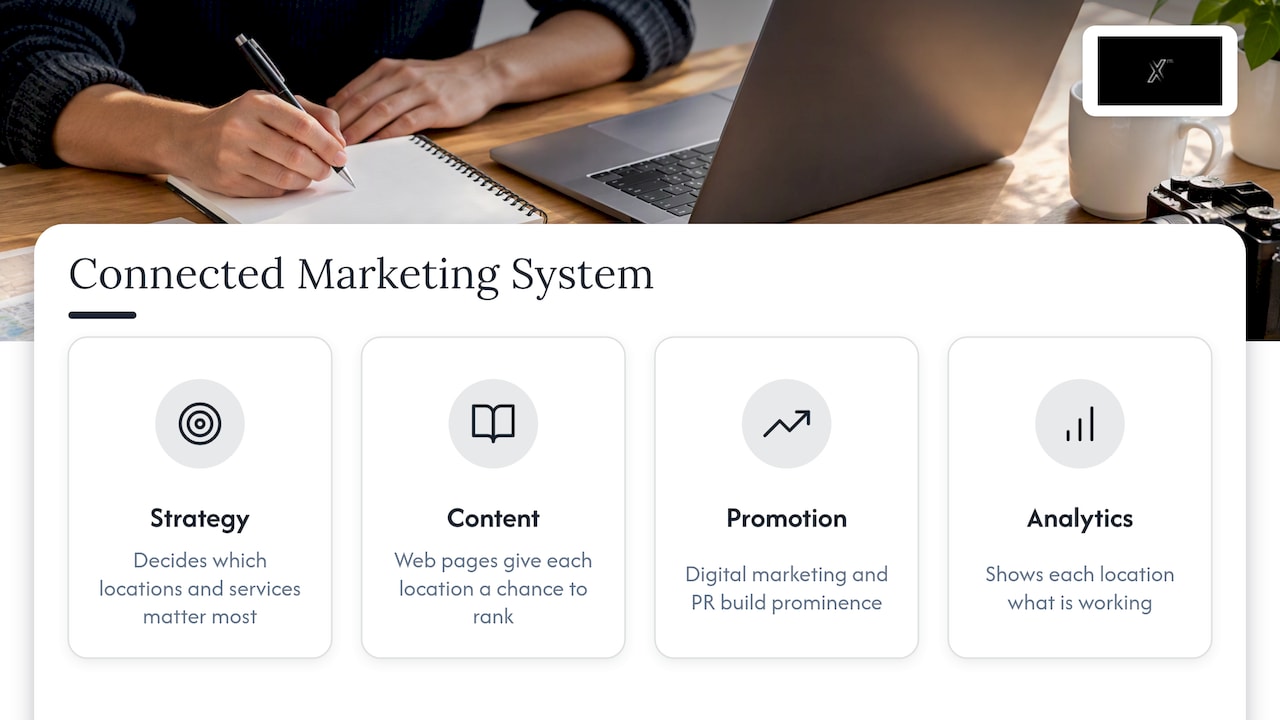
That is why we approach it as part of a wider marketing system. Strategy decides which locations and services matter most. Content and web development give each location a page worth ranking. Digital marketing and PR build the prominence. Analytics shows what to do next. When one agency holds those pieces, a change in hours, a new branch or a campaign does not have to be explained four times to four vendors.
We can also act as your external marketing department. For a franchise or multi-site business, that means owning the process around the data, not just the tactics, and training your local teams so the work continues after launch.
— Xpert
Work with a team that connects the pieces
If you would rather have a partner own the plan, we combine strategy, web, content, digital marketing and analytics under one roof. We can audit your current local footprint, build location pages, set up the reporting and train your staff to keep it running. See our full list of services or look at our digital marketing work, then get in touch through our site.

We serve business owners in the United States, Australia and beyond, so your plan can reflect how people in each market search.
FAQ
What is a local SEO strategy?
It is a plan to improve your visibility in searches tied to a place, such as plumber near me or dentist in Sydney. It covers your Google Business Profile, local keywords, website location pages, reviews, citations and local links. Google bases local ranking mainly on relevance, distance and prominence, and the strategy works on each of them.
How do I target local SEO for several locations?
Give each location its own verified profile and its own unique page, and keep all data in one central source of truth. Set rules for who can change information and who approves it. Track results by location so you can see which branches need attention.
Is local SEO effective?
It can be, especially for businesses that serve at least some customers in person and have a street address and phone number. Search Engine Land lists visibility, calls, foot traffic and sales among the benefits. Results build gradually as your prominence and reputation grow.
Do service area businesses need a Google Business Profile?
Yes, if you want to appear in local results. Google’s guidelines ask you to use an accurate address or service area and to keep one profile per business. Pair the profile with website pages for the main areas you actually serve.
What are the most important local SEO actions?
Start with a complete, verified Google Business Profile. Then keep your name, address and phone number consistent, make your site clear about places and services, collect and answer reviews, and earn local links and citations.
Fonti
- Tips to improve your local ranking on Google, Google Business Profile Help
- How to improve your local ranking on Google, Google Business Profile Help
- Guidelines for representing your business on Google
- Local Business structured data, Google Search Central
- Local Keyword Research, Search Engine Land
- What Is Local SEO?, Search Engine Land
- Scalable Local SEO Practices That Actually Work, Search Engine Land
- Multi-Location SEO, Search Engine Land
- Multi-location SEO: How to build a scalable strategy, Semrush


