

Go-to-Market Strategy: How to Build One That Sells
A go-to-market (GTM) strategy is the plan for how you reach the right buyers with a product or service and turn them into paying customers. Gartner defines it as a plan detailing how an organization engages customers to convince them to buy and gain a competitive advantage, covering pricing, sales, channels and the buying journey. It applies to a new product, a new market or a rebrand. The strategy works when positioning, channels, sales and measurement are built as one connected system. At Xpert Marketing we cover strategy, creative and execution in one agency, so the plan and the launch are not handed between separate vendors.
TL;DR
- A GTM strategy answers four questions: what you sell, who it is for, where and how you reach them, and how you create and convert demand.
- Build it in order: customer and market research, value proposition, pricing, channels, metrics. Then turn it into a dated launch plan with named owners.
- Start with a few channels, not all of them, and set your success metrics before launch.
- GTM is not a marketing plan or a business plan. It is the bridge between a product and its first paying customers.
- Review it every quarter. A strategy that never changes stops fitting the market.
Përmbajtja
- What a go-to-market strategy is (and what it is not)
- Who needs one
- The core components of a GTM framework
- How to build a go-to-market strategy, step by step
- From strategy to a launch plan
- Measuring and improving after launch
- Common mistakes
- Our perspective
- How Xpert Marketing can help
- Pyetje të Shpeshta
- Burimet
What a go-to-market strategy is (and what it is not)
The terms get mixed up, so here is how they differ.
| Term | What it answers | Typical horizon |
|---|---|---|
| Business plan | Why the company exists, its goals and finances | Several years |
| Marketing strategy | How you build awareness and demand on an ongoing basis | Campaign cycles |
| Go-to-market strategy | How one product or offer reaches and converts a defined buyer | Launch through early traction |
| Market entry strategy | The legal, tax and operational setup for operating in a new country or region | Before you can sell |
A GTM strategy can sit inside a business plan, and it uses marketing as one of its tools. The difference is focus: marketing builds demand, while GTM moves that buyer through the whole journey, from first awareness to purchase and retention. That is why a go-to-market plan is usually the dated, resourced version of the strategy: timeline, budget, owners.
Market entry matters if you are crossing borders. A US company selling into Australia, or an Australian company selling into the US, first deals with entity type, tax registration and regulators. GTM starts once you are able to operate: messaging, channels, pricing and customer acquisition cost.
Who needs one
Three situations call for a GTM strategy most often:
- A startup launching its first product. You have no customer data yet, so the strategy is a set of testable assumptions about who buys and why. Our guide to go-to-market for startups goes deeper on that case.
- A company repositioning or rebranding. The product exists, but the market sees something different from what you want it to see. The strategy decides the new position and how to prove it.
- A business adding a new product, segment or region. Existing customers do not guarantee new buyers will respond the same way.
The stakes are real. An IESE study of deep-tech scale-ups found that only 29% of top executives believe their organizations implement GTM effectively. A June 2026 Info-Tech Research Group release warns that launches risk missing revenue targets when the strategy lacks buyer insight.

The core components of a GTM framework
Frameworks differ in labels but agree on substance. Gartner lists five components: target market identification, the first customer touchpoint (demand generation), sales compensation planning, corporate investments and the voice of the customer. In practical terms, you need these working parts:
- Market and ideal customer profile (ICP). The ICP is a precise description of the customers who get the most value from you and are easiest to win: industry, size, problem, who signs the contract.
- Value proposition and positioning. Why this buyer should choose you over the alternatives, said in their words.
- Pricing and packaging. What you charge and how the offer is bundled.
- Channels and sales motion. Where you reach buyers and who closes the sale: your own team, partners, or self-serve online.
- Metrics. The numbers that tell you whether it works, set before launch.
IESE’s research points the same way. The actions its experts rated most relevant were targeting the right market, crafting an irresistible value proposition, securing sales targets through leadership, generating inbound prospects and making decisions with OKRs and KPIs (objectives and key results, a way of linking goals to measurable outcomes).
How to build a go-to-market strategy, step by step
Step 1: Research the customer and the market
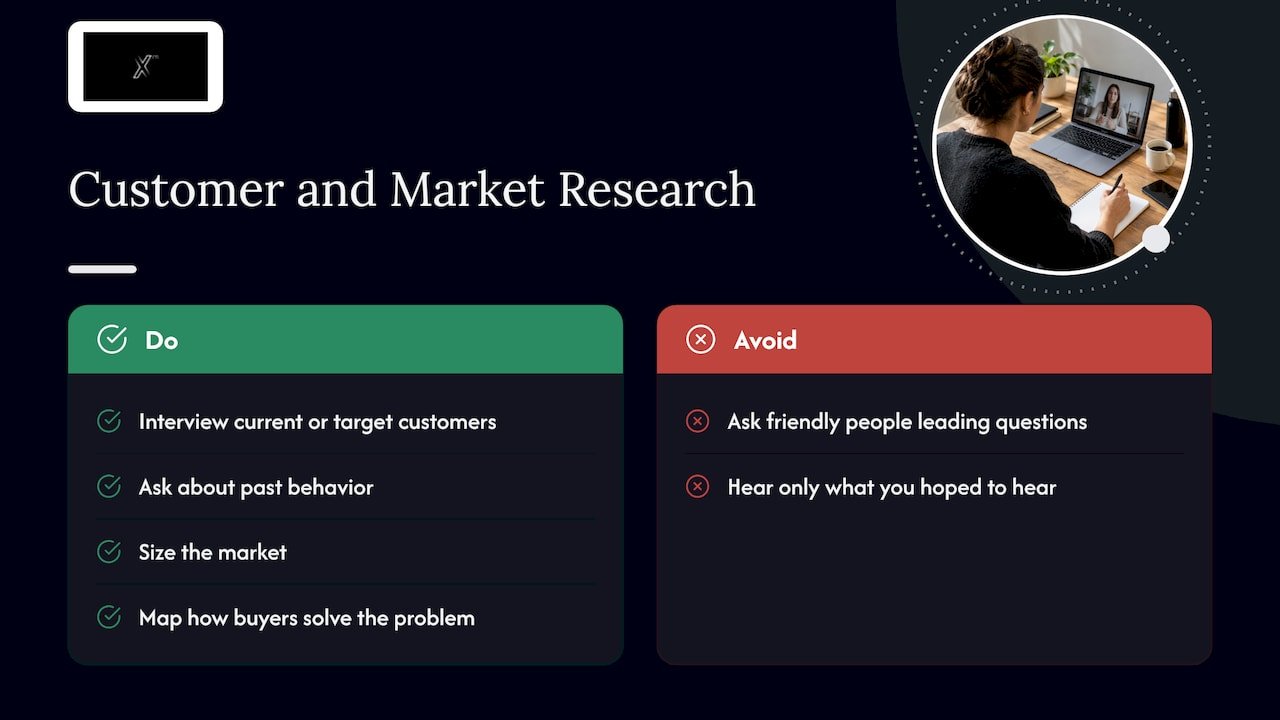
Start with the buyer, not the product. Interview current customers or people who match your target, and look at what they use today, what frustrates them and what they would pay to fix it. Size the market and map competitors by how buyers actually solve the problem, which is often not by buying a rival product at all.
The common failure here is asking friendly people leading questions and hearing what you hoped to hear. Ask about past behavior, such as how they solved the problem last time and what it cost them. Our market research guide for business owners shows how to structure that work so the findings can drive decisions.
Step 2: Define your ICP and buyer personas
Write down the company profile and the people inside it: the user, the person who decides and the person who pays. In B2B these are often three different people, and each needs a different message. Keep the ICP narrow at launch. A tight segment is easier to reach, easier to message and gives cleaner data about what works.
Step 3: Build the value proposition and positioning
A good value proposition fits in two sentences: who it is for, what problem it solves, and why you are the better choice. Test it with people in the ICP. If they restate it in different words, your wording is not yet their wording. For a business that needs a rebrand, this step is where visual identity and messaging are decided together, because the identity has to express the position. See our visual identity design guide for what that process includes.
Step 4: Set pricing
Price reflects the value the buyer sees, your costs and what alternatives charge. Decide the packaging at the same time: tiers, contract length, onboarding fees. Launch pricing is hard to move later without friction, so settle it before the first sales conversation, not during it.
Step 5: Choose a few channels
Harvard Business School Online, drawing on entrepreneurship lecturer Bussgang, advises founders to pick a few marketing tactics and channels at launch, choose the most cost-effective and aligned ones, and hold the rest for scaling. The same source describes three facets of every strong GTM strategy: distribution channels, product messaging with marketing tactics, and estimated customer acquisition cost.
Customer acquisition cost (CAC) is what you spend to win one customer. HBS Online gives the formula as sales costs plus marketing costs, divided by the number of customers acquired. Work out an estimate per channel before you commit budget.
Typical B2B channel options include:
- Search engine optimization and content, for buyers who research before talking to anyone.
- Paid media, for faster reach. Our guide on testing incremental lift before scaling explains how to prove a channel adds sales before you increase spend.
- LinkedIn advertising, when your buyers are defined by job title and company. See the LinkedIn ads B2B playbook.
- Email, events, PR and partnerships.
The common mistake is spreading a small budget across six channels so none gets enough volume to learn from. Pick two, run them properly and read the results.
Step 6: Set metrics and targets
Name the numbers before launch. The Reforge launch measurement guide recommends mapping the customer journey, with a target and timeframe for each metric, and warns that tracking only sign-ups can attract the wrong users, who then churn. A useful starting set:
- Përvetësimi: qualified pipeline, cost per opportunity, CAC.
- Conversion: win rate and sales cycle length.
- Activation: time for a new customer to reach first value.
- Retention and revenue: cohort retention and net revenue retention.
Keep the set short and pair leading indicators (activity now) with lagging ones (revenue later). Reliable tracking needs analytics set up before launch, which is part of our data and analytics service.
From strategy to a launch plan
The strategy says what and why. The plan says who, when and with what budget. A workable 90-day shape is:
| Weeks | Focus |
|---|---|
| 1 to 4 | ICP, positioning and messaging confirmed with real buyer input |
| 5 to 8 | Sales model, channels, pricing and KPIs fixed |
| 9 to 12 | Sales and team enablement, then launch |
Before launch day, check readiness: messaging approved, pricing approved, sales and support briefed, tracking live, and the website and landing pages ready to convert traffic. Info-Tech’s Wright says in that release that launch readiness is where strategy becomes operational. A strong plan clarifies who owns each decision, which buyers the launch targets, what messages will resonate and how success will be measured.
Assign one launch owner. When product, marketing, sales and customer success each decide separately, messages drift and handoffs fail. Our B2B product launch guide covers the coordination in detail.
Measuring and improving after launch
Launch is the start of the learning. Check results in three layers:
- Operational, in the first days. Is traffic arriving, are forms working, are leads being followed up?
- Buyer response, in the first weeks. What are prospects asking, which objections come up, who is winning and losing deals and why?
- Outcomes, over months. CAC payback, retention, revenue by segment.
The Product Marketing Alliance advises treating adoption as a core GTM discipline from the start, tracking indicators such as time to first value and the share of customers using a feature, rather than reacting once customers churn.
Repeat the customer research every quarter. Markets move, competitors respond and your best segment may turn out to be different from the one you planned for.
Common mistakes
- Targeting everyone. A broad audience produces vague messaging. Narrow the ICP first.
- Positioning from the inside. Describing features rather than the buyer’s problem.
- Too many channels at once. Budget gets diluted and nothing is learned.
- No owner and no metrics. Everyone is busy and no one can say whether it works.
- Treating launch as the finish line. The IESE research found that stakeholders such as investors and mentors value competitive assessment, business model optimization and metrics-led decisions more than the companies themselves do. These are the areas where teams most often underinvest.
Our perspective
We see go-to-market as a connected system, not a list of tactics. Strategy, creative and execution have to be designed together: the research decides the position, the position shapes the brand and content, and the channels and analytics prove whether it is working.
That is why we combine strategy and consulting, branding, content production, digital marketing, media planning, web and tech, and analytics in one agency. When these sit with separate vendors, the message the strategist wrote is not always the message that reaches the buyer.
For a startup, we can act as a dedicated external marketing department through launch. For a business that needs a rebrand, we work from the market research through identity to the website and campaigns. We also offer digital marketing training, so your own team can run what we build.
Xpert
How Xpert Marketing can help
If you want the strategy built and executed by one team, our services cover the full path: strategy and consulting, branding and visual identity, creative and content production, digital marketing, media planning and buying, web development and tech solutions, data and analytics, and trainings. Clients such as Market Nerd and Privè have worked with us on brand presence and operational processes. See the full list of services and tell us what you are launching.
If you are still deciding how the pieces fit, our article on why marketing 360 is a system shows how we connect them.
Pyetje të Shpeshta
What is the difference between a go-to-market strategy and a marketing strategy?
A marketing strategy builds awareness and demand continuously. A GTM strategy is focused on bringing a specific product or offer to a defined buyer and carrying them through the whole journey to purchase and retention. Marketing is one of its tools.
How long does a go-to-market strategy take to build?
A common structure is a 90-day cycle: about four weeks on customer profile and positioning, four on model, channels, pricing and metrics, and four on enablement and launch. Your timeline depends on how much customer research you already have and how many teams need to be aligned.
How is a go-to-market plan different from a market entry strategy?
Market entry covers the structural, legal and operational setup for working in a new country or region, such as entity type and tax registration. A go-to-market plan covers how you reach and convert customers once you can operate there. Companies expanding between the US and Australia usually need both.
How many channels should I launch with?
Few. Choose the one or two that best match where your buyers look for solutions and that you can afford to run properly. Estimate CAC for each, learn from the results and add channels when the first ones perform.
Burimet
- Gartner: Go-To-Market Strategy Framework
- IESE: Go-To-Market Strategy (deep-tech study)
- Info-Tech Research Group release on launch readiness, June 2026
- Harvard Business School Online: How to Develop a Go-to-Market Strategy for Your Tech Venture
- Reforge: Build a launch measurement plan
- Product Marketing Alliance: 6 best practices to balance launches and adoption


