
Brand Strategy Framework: How to Build One That Works
A brand strategy framework is the written structure that tells everyone in your business who the brand is, who it serves, why it is different and how it should sound and behave. It gives your team and any agency or freelancer one shared reference, so decisions on messaging, design, campaigns and hiring stop depending on whoever happens to be in the room. This guide covers what goes into a framework, which models are worth knowing, how to build your own step by step, and how to adapt it to a rebrand, a launch or a push for stronger customer engagement.
TL;DR
- A brand strategy framework puts your purpose, positioning, audience, personality and promise on paper in a form others can act on.
- “Framework,” “model” and “plan” overlap in daily use: the framework is the structure, a model is a particular way of organizing it, and the plan adds actions and budget.
- The most reliable build order is diagnosis first, then strategy, then tactics.
- Positioning is the element everything else depends on. If it is vague, the rest will be too.
- Pick the lightest framework that answers your current decision, then test it against real briefs.
Përmbajtja
- What a brand strategy framework is
- The building blocks of a brand strategy
- Brand strategy models worth knowing
- How to create a brand strategy, step by step
- Brand strategy examples: what a finished framework looks like
- Adapting the framework to your situation
- Our perspective: strategy is only useful when it reaches execution
- Get help turning the framework into results
- Pyetje të Shpeshta
- Burimet
What a brand strategy framework is
A framework defines who you are as a brand, what you stand for and how you communicate it. Its real value is discipline: it forces the strategy to be written down clearly enough that two people briefing two different agencies would produce recognizably similar work. If your brand lives only in the founder’s head, you do not have a framework yet. You have an opinion.
Framework, model and plan: how they differ
People search for all three terms and often mean the same thing. In practice:
- Framework: the set of questions and components your strategy must answer (purpose, audience, positioning, voice and so on).
- Model: a named way of arranging those components, such as a pyramid, a pillar list or a staged process.
- Plan: the framework turned into dated actions, owners and budget.
A useful rule: the framework should change rarely, the plan should change every year or so.
What it is not
A framework is not a logo, a color palette or a tagline. Those belong to brand identity and guidelines, and they are expressions of the strategy. Strategy comes first because design without it is decoration. If you want to see how the layers connect, our piece on how a marketing agency builds brands that scale walks through the sequence from strategy to execution.
The building blocks of a brand strategy
Different sources list different numbers of pillars, which is why “the 5 pillars” and “the 7 elements” both appear in search results. They describe the same territory with different grouping. A common core is purpose, positioning, personality, promise and target audience. Broader lists add mission, values, voice, story, emotion and visual and written communication.
Here is a practical version you can use, with the question each block must answer.
| Block | The question it answers | Weak version | Strong version |
|---|---|---|---|
| Purpose | Why does the business exist beyond revenue? | “To be the best” | A specific problem you exist to solve for specific people |
| Audience | Who are we for, and who are we not for? | “Everyone who needs our product” | A defined segment with a named need and buying context |
| Positioning | Where do we play and how are we different? | A list of features | One clear difference that matters to the audience |
| Promise | What can customers count on every time? | A slogan | A commitment your operations can actually keep |
| Personality and voice | How do we sound and behave? | “Friendly and professional” | Defined traits, with examples of what we would and would not say |
| Prova | Why should anyone believe us? | Claims | Results, cases, data, process |
Positioning carries the weight
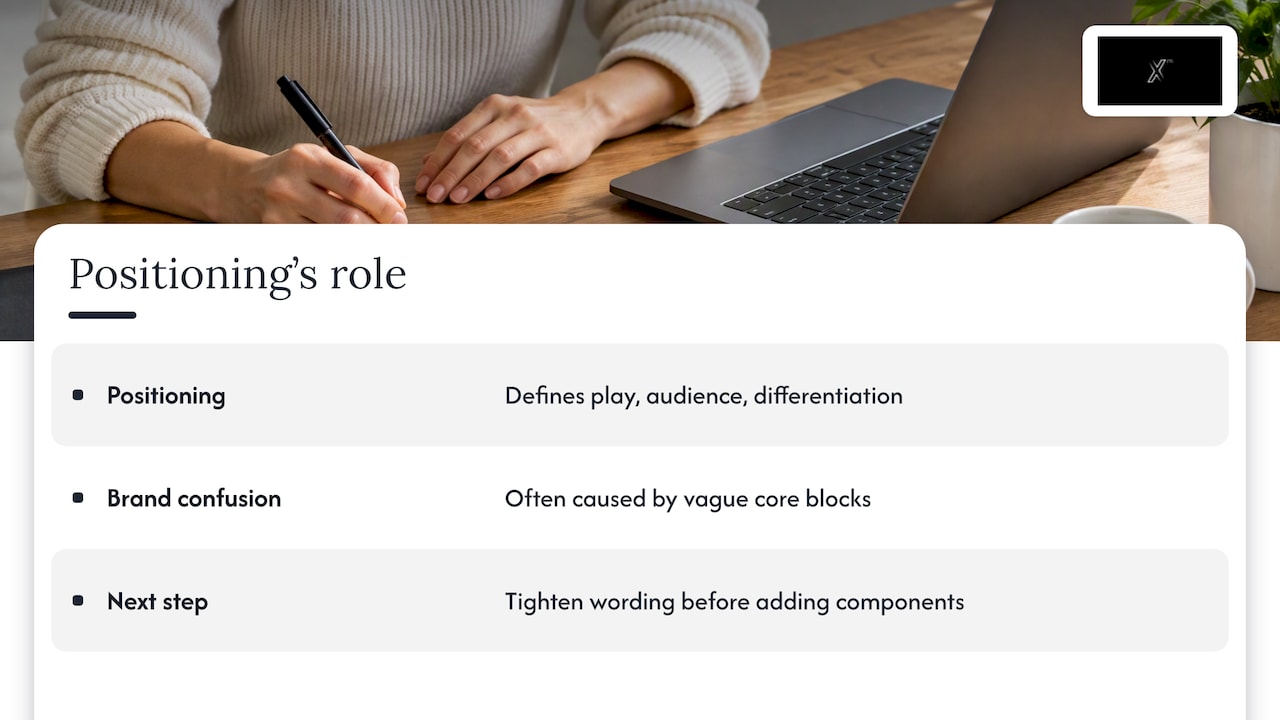
Practitioners describe positioning as the core of brand strategy, because it defines where the brand will play, who it will serve and how it separates itself from competitors. When a team says its brand feels confusing, the cause is often that one or more core blocks are vague, rather than that the blocks themselves are wrong. Tighten the wording before you add more components.
Where the 5 C’s fit
The 5 C’s (company, customers, competitors, collaborators and context) are an analysis tool rather than a brand model. Robert Dolan’s Harvard note on marketing strategy describes this analysis as underlying marketing decisions and leading to target-market selection and desired positioning. In a brand framework, it belongs at the front: you use it to gather the facts that your positioning then rests on.
Brand strategy models worth knowing
There is no single correct template. Mark Ritson, writing in Marketing Week, warns against hunting for a magic standard template and recommends building a robust structure of your own on the sequence of diagnosis, strategy and tactics. The models below are starting points for that structure.
Identity-led models
The best-known identity-led approach is associated with David Aaker. It moves from research (customers, competitors and your own organization), to a defined core and extended identity, to a value proposition. It suits established companies with several products or audiences, where the main risk is inconsistency across teams.
Positioning-led models
These start from the market. You define the audience, the frame of reference (what category you compete in), the point of difference and the reason to believe. They suit startups and challengers, because they force a clear answer to “why you instead of the alternative?” before money goes into creative work.
Pillar and purpose models
Pillar models organize the brand around a short list of elements, usually purpose, positioning, personality, promise and audience. They are the easiest to explain to a leadership team and the easiest to turn into a one-page document. Their weakness is shallow answers: five pillars filled with generic adjectives are worse than three filled with evidence.
Structure-led models
If you manage several products, regions or sub-brands, the question is not only what the brand stands for but how the pieces relate. That is a brand architecture decision, covered in our guide to brand architecture models.
Which one to pick
| Your situation | Start with | Main question it settles |
|---|---|---|
| Startup before launch | Positioning-led | Who are we for and why choose us? |
| Established brand losing relevance | Identity-led | What do we truly stand for today? |
| Small team needing speed | Pillar model | What do we say, to whom, in what voice? |
| Multiple products or markets | Identity-led plus architecture | How do the pieces fit together? |
How to create a brand strategy, step by step
The order matters more than the template. Ritson’s marketing planning approach moves from diagnosis using data, to strategy, to tactics and budget. The same sequence works for brand strategy.
Step 1: Diagnose where you stand
Before choosing a direction, assess the current situation to decide whether you need a new one at all. Gather:
- Customer evidence: interviews, reviews, support tickets, sales call notes, survey results.
- Competitor evidence: how alternatives describe themselves, what they promise, what they ignore.
- Internal evidence: what leadership and front-line staff say the brand is, written separately and then compared.
- Performance data: which channels, messages and segments already convert and retain.
The gaps between what you say, what staff say and what customers say are your first findings.
Step 2: Choose the audience
Pick the segment where you can be the clear first choice. A framework that serves everyone ends up distinctive to no one. Write the audience as a situation, not a demographic: what they are trying to do, what is in their way, what they currently use.
Step 3: Write the positioning
Use one sentence: for [audience] who need [outcome], we are the [category] that [difference], because [proof]. Then test it by asking whether a competitor could say the same sentence. If yes, rewrite.
Step 4: Define purpose, promise and personality
Purpose explains why the business exists. The promise is the standard customers can hold you to. Personality describes the traits that shape tone and behavior. Keep each to a few lines and attach an example to every trait. Once this is settled, turn it into working rules with a brand voice guideline that writers and designers can apply on day one.
Step 5: Build the message architecture
Derive from the positioning one core message, three to four supporting messages, and the proof behind each. Different audiences or stages of the buying journey get adapted versions, but all of them trace back to the core.
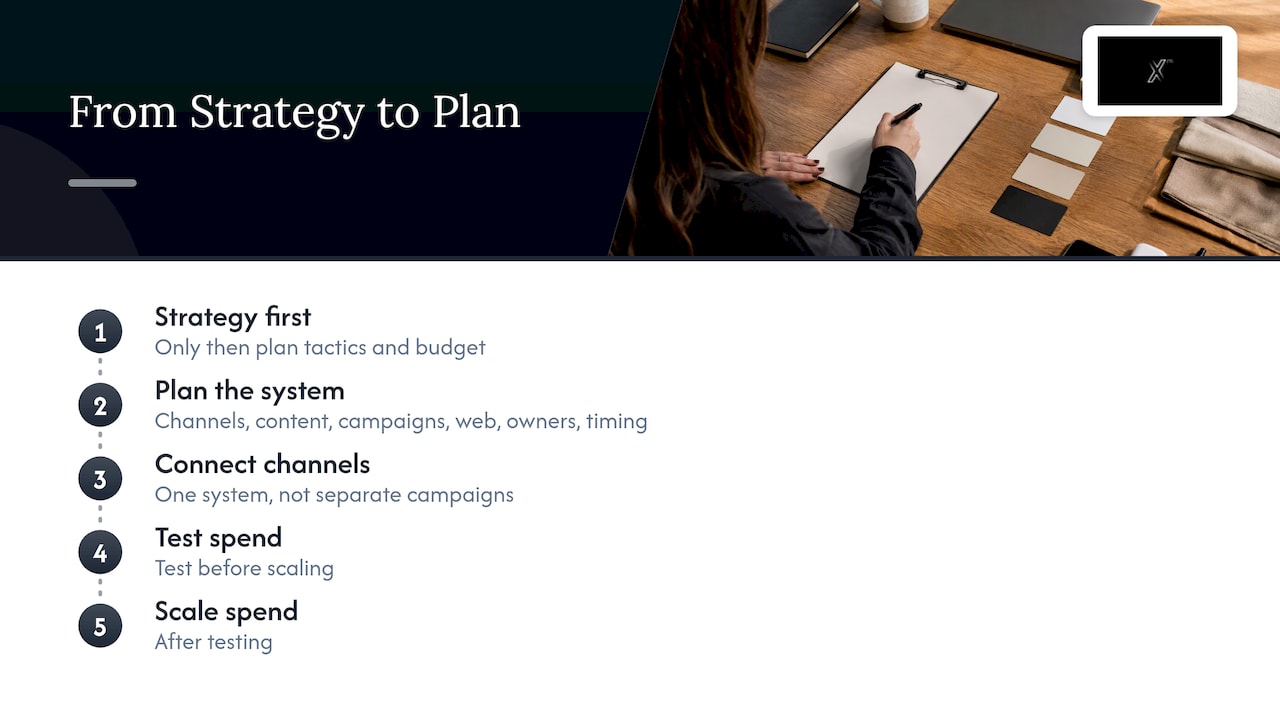
Step 6: Turn strategy into a plan
Now, and only now, plan tactics and budget: channels, content, campaigns, web experience, owners and timing. Connecting these into one system rather than separate campaigns is the idea behind our omnichannel marketing strategy approach. Media spend should follow the same logic: test before you scale, as outlined in our note on media planning strategy and incremental lift.
Step 7: Define measurement
Decide in advance what “working” means. Combine brand indicators (awareness among your target segment, consideration, share of search, sentiment) with business indicators (qualified leads, conversion, retention, average order value). Review quarterly and revisit the framework itself only when the diagnosis changes.

Brand strategy examples: what a finished framework looks like
The examples below are illustrative composites, not real client cases. They show the level of specificity to aim for.
Example 1: A B2B software startup
- Audience: operations managers at mid-sized logistics firms who still reconcile shipments in spreadsheets.
- Positioning: the shipment reconciliation tool that replaces spreadsheet work in a week, without an IT project.
- Promise: setup help included and a named contact for the first 30 days.
- Personality: plainspoken, practical, a little dry. Says “fewer errors,” never “revolutionary.”
- Proof: time-to-first-reconciliation, customer quotes, a public onboarding checklist.
The value here is exclusion. The tool is not for enterprise procurement teams, and the framework says so.
Example 2: A regional services company rebranding
- Diagnosis finding: customers describe the company as reliable but old-fashioned, while staff describe it as innovative.
- Decision: keep “reliable” as the anchor and make innovation visible through proof (new services, response times) rather than adjectives.
- Result in the framework: a promise built around dependability, a modernized voice, and a visual refresh that follows the strategy rather than leading it.
Example 3: A direct-to-consumer brand building engagement
- Audience: first-time buyers of a niche product who feel overwhelmed by choice.
- Positioning: the brand that explains before it sells.
- Content implication: guides, comparisons and short video explainers become core assets, not extras, and customer questions drive the editorial calendar.
Notice what these have in common: a narrow audience, one difference, a promise operations can keep, and proof. For real project work across industries, see our Portofoli ynë.
Adapting the framework to your situation
For a rebrand
Start with the diagnosis and resist the urge to open with visuals. Decide what to keep (equity customers already value) and what to change. Write it down before any designer sees a brief, so the visual identity solves a defined problem.
For a startup go-to-market
Use a positioning-led model and keep it to a page. Your framework will be tested by the market within months, so treat it as a hypothesis: write the audience, the difference and the proof, then adjust after the first rounds of customer conversations and campaign data.
For customer engagement
Focus on personality, voice, story and proof, because these shape content. Map each message to a stage of the customer journey and decide which channel carries it. Engagement improves when content answers real customer questions, so feed support and sales insights back into the framework.
Common mistakes
- Writing aspirations instead of decisions. If a statement does not rule anything out, it is not strategy.
- Skipping diagnosis because the answer “feels obvious.”
- Producing a beautiful deck that nobody uses. Test the framework by briefing someone new and checking the result.
- Treating the document as permanent. Revisit it when your market, product or audience shifts.
Our perspective: strategy is only useful when it reaches execution
We see the same pattern with many businesses that approach us: the strategy exists, but it stops at the document. The positioning is sound, yet the website says something different, the social content follows its own logic and the sales team improvises. A framework earns its keep when it changes what gets made and what gets declined.
That is why we work with strategy, creativity and execution in one team, and why we can act as an external marketing department when a company does not have one. When the people who wrote the positioning also brief the designers, writers and media planners, fewer ideas get lost between steps. Our advice is to keep the framework short, tie every element to a decision someone has to make, and measure it against business results, not only opinions.
— Xpert
Get help turning the framework into results
If you would rather not build this alone, our team covers strategy and consulting, branding and visual identity, content production, digital marketing, web development and analytics under one roof. We can run the diagnosis, write the framework and carry it into campaigns and your website. Explore the full list of services or contact us to discuss your brand.
Pyetje të Shpeshta
What are the 5 pillars of brand strategy?
Sources vary, but a common set is purpose, positioning, personality, promise and target audience. Some lists add voice, story, values and emotion. Treat the number as a grouping choice and focus on whether each element has a specific, usable answer.
What are the 5 C’s of branding?
The 5 C’s are usually company, customers, competitors, collaborators and context. They come from marketing strategy analysis and are best used in the diagnosis stage, before you write positioning.
How long should a brand strategy framework be?
Long enough to answer the core questions and short enough that people read it. A one-page summary backed by a few pages of detail and evidence works for most small and mid-sized businesses. If new team members cannot apply it in their first week, simplify it.
How is a brand strategy different from a marketing plan?
Brand strategy defines who you are, who you serve and why you are different. A marketing plan decides which channels, campaigns and budgets will carry that message. Ritson’s approach places strategy before tactics and budget, so the plan follows from the strategy.
How often should I update my brand strategy?
Review it yearly against your performance data, and rework it when something fundamental changes: a new audience, a new product line, a merger or a clear shift in how customers see you. Tactics will change far more often than the framework.
Burimet
- Brand Strategy Framework: Positioning Your Brand
- What is Brand Strategy? Why is it Important? (Amazon Ads)
- The six Ps of branding (MaRS)
- Planning for marketing planning: 14 steps to an effective plan (Marketing Week)
- Note on Marketing Strategy (Robert J. Dolan)


