The best B2B link building approach prioritizes relevance-first linkable assets paired with targeted partner outreach, not raw volume or generic directory submissions. This combination drives authority gains, referral traffic from buyers already evaluating solutions, and measurable pipeline impact. The first move: audit your current backlink profile and pick one high-value asset to pilot.
TL;DR:
- Linkable assets take two to four months to produce but can earn citations for years; start with a sales question buyers already ask.
- Rank prospects by buyer intent, audience fit, and ease of securing placement; research each site for three to five days before pitching.
- Follow up once after five to seven business days, then stop after a second attempt; log outcomes in a CRM or shared sheet.
- Use descriptive anchor text in standard links with href attributes, and favor in body editorial placements over footer badges or sidebar widgets.
- Ranking movement and referral traffic typically appear within three to six months; report referring domains monthly and pipeline impact quarterly.
B2B link building is the practice of earning backlinks from other websites to strengthen a business’s search authority and reach the professional buyers who make purchasing decisions. Unlike consumer-facing campaigns, B2B programs succeed or fail based on whether the right audience sees the link, not how many links exist.
Buyer intent separates B2B from B2C link building in almost every meaningful way. A consumer blog might benefit from thousands of generic links. A software company selling to procurement teams needs links from trade publications, analyst blogs, and partner sites where its actual buyers spend time researching vendors. Gartner’s research on the B2B buying journey shows that third-party citations and trusted references play a direct role in how buyers evaluate vendors, which means a link’s context matters as much as its source.
Links support two goals simultaneously in a B2B program:
A program built around these two outcomes looks very different from a traditional SEO link campaign focused purely on domain metrics.
Not every link carries the same weight, and B2B buyers are a narrower, more skeptical audience than general web traffic. A backlink earns its value through four factors: relevance, placement, anchor text, and crawlability.
Relevance comes first. A link from a logistics trade publication matters more to a supply chain software company than a link from a general business blog with ten times the traffic, because the logistics audience overlaps with actual buyers. Placement matters nearly as much: an in-body editorial mention carries more weight and visibility than a footer badge or a sidebar widget that readers tend to ignore.
Anchor text and technical implementation also affect whether a link helps at all. Google’s own guidance on crawlable links specifies that links need a proper href attribute in an anchor tag to be followed and credited, and that anchor text should describe the destination naturally rather than stuffing exact-match keywords.
One link from a publication your buyers actually read can outperform a dozen links from unrelated high-authority sites, because referral traffic from an aligned audience converts at a meaningfully higher rate than generic visits, according to Gartner’s framing of the B2B buying journey, which ties vendor research behavior to trusted, topic-relevant sources.
Not all tactics deserve equal investment. The list below is ordered by typical return relative to effort for a B2B program, starting with the highest-leverage plays.
Conseil : Build one linkable asset around a question your sales team hears constantly, since that question already has a built-in audience of buyers searching for the answer.
A strong tactic list means little without disciplined execution. Prioritize prospects using three filters before any outreach goes out:
Once prospects are ranked, run a three-step cadence:
A pitch that converts usually includes:
Track every outreach touch in a CRM or shared sheet with fields for target site, contact status, pitch date, and outcome, so the team can see which angles and publications produce links consistently.
A link program only earns continued budget when it ties to business outcomes, not just backlink counts. Track these metrics together rather than in isolation:
Attribution requires some setup. Build dedicated landing pages for major linkable assets, attach UTM parameters to outreach links, and tag resulting leads in your CRM so sales can trace a closed deal back to its originating link or asset. Our team’s work on SEO strategy and measurement covers how to set up this kind of tracking alongside broader ranking goals.
Most link-building programs need three to six months before ranking movement and referral traffic become visible, based on Gartner’s framing of how buyers research vendors, which treats third-party citations as a gradual trust-building signal rather than an immediate conversion lever. Report progress monthly on referring domains and quarterly on pipeline impact, since sales cycles in B2B rarely close fast enough to show revenue in month one.
B2C volume tactics, like mass directory submissions or low-quality guest post networks, waste budget in B2B because the links rarely reach an audience that buys. The fix is narrowing target lists to sites your actual buyers read, even if that list is shorter.
Our team integrates market research, asset creation, outreach, and measurement into one coordinated workflow rather than treating link building as an isolated task. For Gjergji H Tekstil, our SEO work paired technical site improvements with content built around the brand’s actual buyer searches, the same relevance-first principle that applies to link acquisition. We build linkable assets as part of broader digital marketing engagements, then run outreach sequences and measurement setups that connect directly to a client’s pipeline reporting.
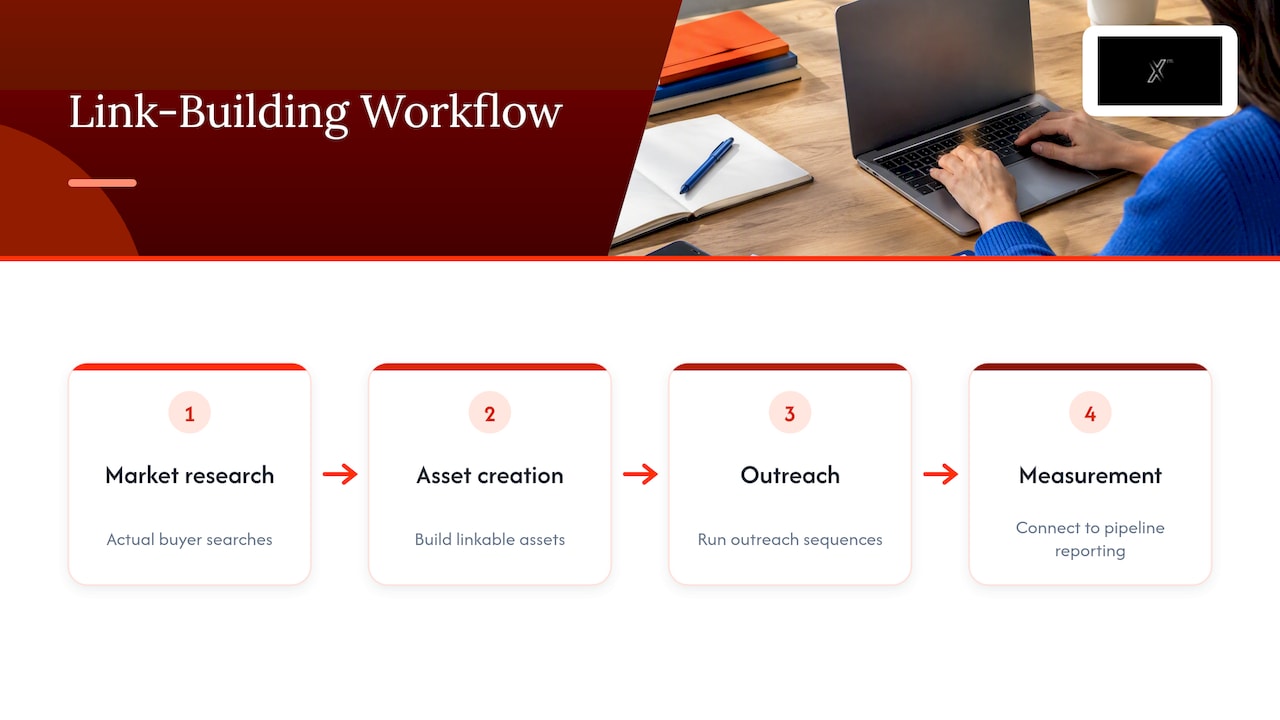
Most programs start with a narrow pilot, one or two assets and a short outreach list, then expand once a pattern of working links emerges. The clearest lesson across campaigns: buyer fit beats volume every time, and a program that skips measurement setup from day one loses the ability to prove its own value later.
Conseil : Share early referral traffic numbers with sales leadership before the first ranking gains appear, since a concrete early signal builds internal buy-in faster than a promise of future rankings.
— Xpert
If building relevance-first assets and running structured outreach sounds like more than your internal team has bandwidth for, we handle the full process: research, asset creation, outreach sequencing, and reporting tied to pipeline. A typical first deliverable includes a priority asset list matched to your buyer personas and a ranked outreach plan for the first thirty days.
Our services page outlines the full range of strategy, content, and digital marketing work we offer, and a short consultation is the fastest way to see where a link program fits into your broader growth plan.
Link building itself is not illegal and is a standard part of SEO practice. Search engines do penalize manipulative tactics like paid link schemes that violate Google’s guidance on crawlable, properly attributed links, so the practical question is whether a given tactic follows those guidelines rather than whether link building as a category is allowed.
Costs vary widely depending on whether you build assets in-house, hire freelancers, or work with an agency, and no single published rate applies across the industry. Our pricing for a full program, including research, asset creation, and outreach, is available on request through a strategy consultation.
B2B link building is the process of earning backlinks from relevant business and trade websites to strengthen search authority and reach professional buyers during vendor research. It differs from consumer link building by prioritizing audience relevance over sheer volume or domain metrics.
Most programs need three to six months before ranking movement and referral traffic become clearly visible, since third-party citations build trust with buyers gradually rather than instantly. Reporting on referring domains monthly and pipeline impact quarterly gives a realistic picture of progress.
The most common mistake is applying B2C volume tactics, like mass directory submissions, to a B2B audience that responds better to fewer, highly relevant placements. Prioritizing quality signals like referral traffic and audience overlap over raw link counts produces stronger commercial results.
Bonjour ! Parlez-nous de votre activité et de vos besoins, nous vous répondrons sur WhatsApp.
Remplissez le formulaire et notre équipe vous recontactera rapidement.