
B2B Link Building for Marketers: 4 Factors That Beat Link Volume
The best B2B link building approach prioritizes relevance-first linkable assets paired with targeted partner outreach, not raw volume or generic directory submissions. This combination drives authority gains, referral traffic from buyers already evaluating solutions, and measurable pipeline impact. The first move: audit your current backlink profile and pick one high-value asset to pilot.
TL;DR:
- Linkable assets take two to four months to produce but can earn citations for years; start with a sales question buyers already ask.
- Rank prospects by buyer intent, audience fit, and ease of securing placement; research each site for three to five days before pitching.
- Follow up once after five to seven business days, then stop after a second attempt; log outcomes in a CRM or shared sheet.
- Use descriptive anchor text in standard links with href attributes, and favor in body editorial placements over footer badges or sidebar widgets.
- Ranking movement and referral traffic typically appear within three to six months; report referring domains monthly and pipeline impact quarterly.
Indice
- What B2B Link Building Is and Why It Matters
- What Makes a Backlink Valuable for B2B
- Tactical Playbook: Prioritized B2B Link-Building Methods
- Outreach and Execution: Sequences, Templates, and Prioritization
- Measuring ROI and Reporting for B2B Link Programs
- Common Mistakes and Smarter Alternatives
- Xpert Marketing: How Our Link-Building Approach Works
- What Scaling a B2B Link Program Actually Teaches You
- Let Our Team Build Your B2B Link Program
- FAQ
- Fonti
What B2B Link Building Is and Why It Matters
B2B link building is the practice of earning backlinks from other websites to strengthen a business’s search authority and reach the professional buyers who make purchasing decisions. Unlike consumer-facing campaigns, B2B programs succeed or fail based on whether the right audience sees the link, not how many links exist.
Buyer intent separates B2B from B2C link building in almost every meaningful way. A consumer blog might benefit from thousands of generic links. A software company selling to procurement teams needs links from trade publications, analyst blogs, and partner sites where its actual buyers spend time researching vendors. Gartner’s research on the B2B buying journey shows that third-party citations and trusted references play a direct role in how buyers evaluate vendors, which means a link’s context matters as much as its source.
Links support two goals simultaneously in a B2B program:
- They signal topical authority to search engines, which can move rankings for commercial keywords.
- They generate direct referral traffic from readers who are already in a buying mindset, often further along the funnel than typical organic visitors.
A program built around these two outcomes looks very different from a traditional SEO link campaign focused purely on domain metrics.
What Makes a Backlink Valuable for B2B
Not every link carries the same weight, and B2B buyers are a narrower, more skeptical audience than general web traffic. A backlink earns its value through four factors: relevance, placement, anchor text, and crawlability.
Relevance comes first. A link from a logistics trade publication matters more to a supply chain software company than a link from a general business blog with ten times the traffic, because the logistics audience overlaps with actual buyers. Placement matters nearly as much: an in-body editorial mention carries more weight and visibility than a footer badge or a sidebar widget that readers tend to ignore.
Anchor text and technical implementation also affect whether a link helps at all. Google’s own guidance on crawlable links specifies that links need a proper href attribute in an anchor tag to be followed and credited, and that anchor text should describe the destination naturally rather than stuffing exact-match keywords.
- Choose anchor text that describes the linked page’s content, not a forced keyword phrase.
- Favor in-body editorial placements over footer or sidebar links.
- Confirm links use standard anchor tags with href attributes so they are crawlable.
One link from a publication your buyers actually read can outperform a dozen links from unrelated high-authority sites, because referral traffic from an aligned audience converts at a meaningfully higher rate than generic visits, according to Gartner’s framing of the B2B buying journey, which ties vendor research behavior to trusted, topic-relevant sources.
Tactical Playbook: Prioritized B2B Link-Building Methods
Not all tactics deserve equal investment. The list below is ordered by typical return relative to effort for a B2B program, starting with the highest-leverage plays.
- Build linkable assets first. Original research, industry benchmarks, interactive calculators, or diagnostic tools earn citations because they give journalists and bloggers something concrete to reference. These typically take two to four months to produce but keep earning links for years.
- Place guest articles and bylines on trade publications. Target publications your buyer persona actually reads, not high-traffic generalist sites. A single well-placed byline in a niche trade outlet often beats five guest posts on marketing blogs with no audience overlap.
- Build vendor and partner link programs. Co-marketing with complementary vendors, integration partners, or channel resellers produces natural, contextual links because the relationship already exists. These links tend to land within weeks since there is no cold outreach involved.
- Fix unlinked brand mentions. Monitor for mentions of your company name that lack a hyperlink, then reach out to the publisher asking for the link to be added. This is one of the fastest wins available since the writer already chose to mention you.
- Reclaim broken links on relevant resource pages. Find outdated or dead links on pages your buyers browse, then offer your asset as the replacement. Tools that crawl for broken links make this scalable.
- Submit to industry resource pages and directories. Many B2B niches maintain curated lists of tools, agencies, or vendors. These links are lower effort but still relevant when the directory serves your actual buyer audience.
- Pitch newsworthy data releases to press. Original survey data or benchmark reports give reporters a reason to cover your company. TechCrunch’s coverage of funding and product news shows how trade press picks up data-driven or event-driven stories when the angle is specific and timely.
- Secure analyst citations and case study placements. Being referenced in an analyst report or industry case study carries outsized credibility with B2B buyers, who often read these sources during vendor evaluation.
- Speak at conferences and claim sponsorship link opportunities. Speaker bio pages and sponsor directories on event websites often include a do-follow link back to your site, and the audience overlap with your buyers is usually strong.
- Pursue awards, badges, and accreditation placements. Industry awards and certification bodies frequently link back to winners, and these placements double as trust signals for buyers researching vendors.
- Claim and optimize listings on review platforms. Capterra and G2 are two of the most used platforms where B2B buyers compare software and services, and a complete profile with reviews often earns organic referral traffic alongside the link itself.
- Publish data-driven assets that invite citation. Surveys and benchmark reports formatted for easy quoting, with clear charts and a shareable summary, tend to earn ongoing citations from trade press and analyst blogs long after the initial launch.
Consiglio: Build one linkable asset around a question your sales team hears constantly, since that question already has a built-in audience of buyers searching for the answer.
Outreach and Execution: Sequences, Templates, and Prioritization
A strong tactic list means little without disciplined execution. Prioritize prospects using three filters before any outreach goes out:
- Intent overlap, meaning the target site’s audience actually searches for or buys what you sell.
- Audience match, meaning the readership skews toward your buyer persona rather than a broad general audience.
- Ease of win, meaning the site has published similar content before, has an active outreach-friendly editor, or already has a relationship with your brand.
Once prospects are ranked, run a three-step cadence:
- Ricerca the target for three to five days before any contact, reading recent posts and identifying the specific angle that fits their audience.
- Pitch with a short, personalized email referencing their recent work and offering one clear value exchange, whether that is exclusive data, a quote, or a useful asset.
- Follow up once after five to seven business days if there is no response, then stop after a second follow-up to avoid damaging the relationship.
A pitch that converts usually includes:
- A one-sentence value proposition tied to something the publisher recently covered.
- A specific data point or asset hook that is not available elsewhere.
- An offer of exclusivity or early access, when relevant, to raise response rates.
Track every outreach touch in a CRM or shared sheet with fields for target site, contact status, pitch date, and outcome, so the team can see which angles and publications produce links consistently.
Measuring ROI and Reporting for B2B Link Programs
A link program only earns continued budget when it ties to business outcomes, not just backlink counts. Track these metrics together rather than in isolation:
- Referring domains, which shows the breadth of sites now linking to your site.
- Referral sessions, which measures direct traffic the links themselves generate.
- Ranking movement for target commercial keywords, which reflects the SEO impact of the links earned.
- Assisted conversions and pipeline influenced, which connects the program to revenue.
Attribution requires some setup. Build dedicated landing pages for major linkable assets, attach UTM parameters to outreach links, and tag resulting leads in your CRM so sales can trace a closed deal back to its originating link or asset. Our team’s work on SEO strategy and measurement covers how to set up this kind of tracking alongside broader ranking goals.
Most link-building programs need three to six months before ranking movement and referral traffic become visible, based on Gartner’s framing of how buyers research vendors, which treats third-party citations as a gradual trust-building signal rather than an immediate conversion lever. Report progress monthly on referring domains and quarterly on pipeline impact, since sales cycles in B2B rarely close fast enough to show revenue in month one.
Common Mistakes and Smarter Alternatives
B2C volume tactics, like mass directory submissions or low-quality guest post networks, waste budget in B2B because the links rarely reach an audience that buys. The fix is narrowing target lists to sites your actual buyers read, even if that list is shorter.
- Generic, unpersonalized outreach emails get ignored by editors who receive dozens daily; personalize every pitch around a specific asset or data hook.
- Linking to a homepage instead of a dedicated asset or landing page wastes the opportunity to track conversions and often confuses the editor about what to cite.
- Chasing high-authority links with no topical connection to your business rarely moves commercial rankings and can look unnatural to search engines.
- Vanity metrics like total backlink count distract from quality signals like referral traffic and pipeline influence, which better predict program success.
Xpert Marketing: How Our Link-Building Approach Works
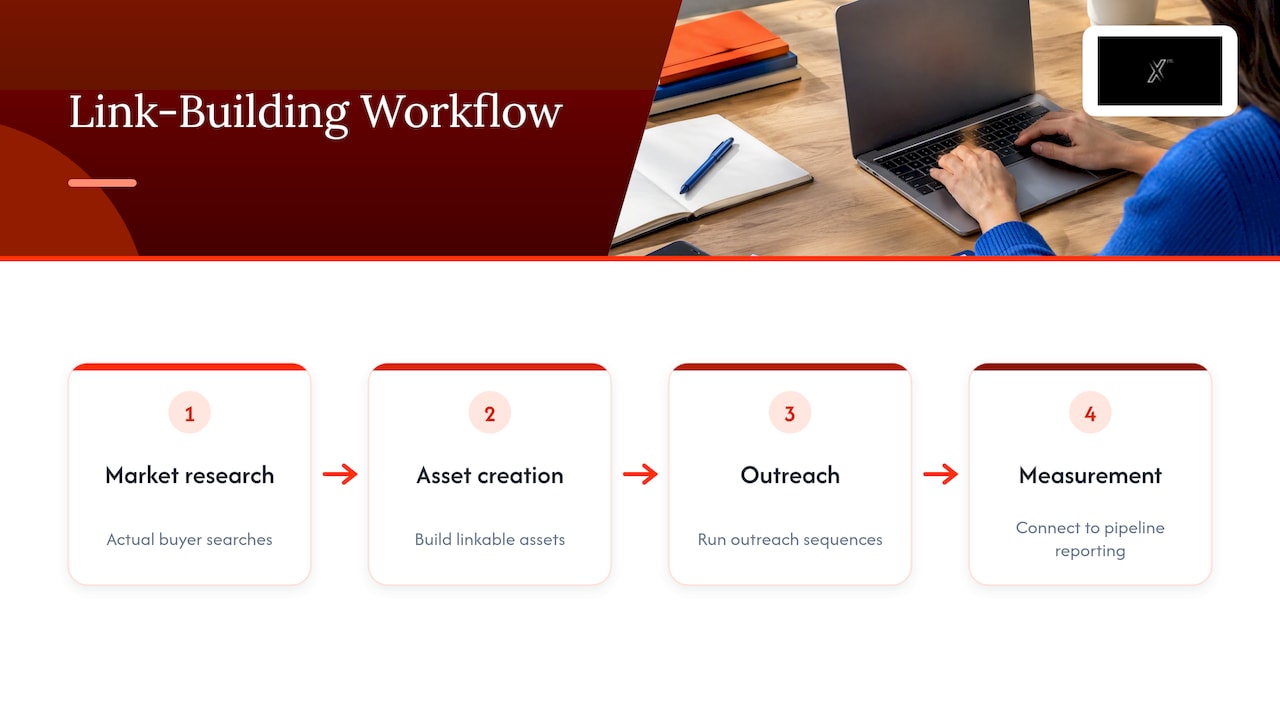
Our team integrates market research, asset creation, outreach, and measurement into one coordinated workflow rather than treating link building as an isolated task. For Gjergji H Tekstil, our SEO work paired technical site improvements with content built around the brand’s actual buyer searches, the same relevance-first principle that applies to link acquisition. We build linkable assets as part of broader digital marketing engagements, then run outreach sequences and measurement setups that connect directly to a client’s pipeline reporting.
What Scaling a B2B Link Program Actually Teaches You
Most programs start with a narrow pilot, one or two assets and a short outreach list, then expand once a pattern of working links emerges. The clearest lesson across campaigns: buyer fit beats volume every time, and a program that skips measurement setup from day one loses the ability to prove its own value later.
Consiglio: Share early referral traffic numbers with sales leadership before the first ranking gains appear, since a concrete early signal builds internal buy-in faster than a promise of future rankings.
— Xpert
Let Our Team Build Your B2B Link Program
If building relevance-first assets and running structured outreach sounds like more than your internal team has bandwidth for, we handle the full process: research, asset creation, outreach sequencing, and reporting tied to pipeline. A typical first deliverable includes a priority asset list matched to your buyer personas and a ranked outreach plan for the first thirty days.
Our services page outlines the full range of strategy, content, and digital marketing work we offer, and a short consultation is the fastest way to see where a link program fits into your broader growth plan.
FAQ
Is link building illegal?
Link building itself is not illegal and is a standard part of SEO practice. Search engines do penalize manipulative tactics like paid link schemes that violate Google’s guidance on crawlable, properly attributed links, so the practical question is whether a given tactic follows those guidelines rather than whether link building as a category is allowed.
How much should I pay for link building?
Costs vary widely depending on whether you build assets in-house, hire freelancers, or work with an agency, and no single published rate applies across the industry. Our pricing for a full program, including research, asset creation, and outreach, is available on request through a strategy consultation.
What is B2B link building?
B2B link building is the process of earning backlinks from relevant business and trade websites to strengthen search authority and reach professional buyers during vendor research. It differs from consumer link building by prioritizing audience relevance over sheer volume or domain metrics.
How long does it take to see results from a B2B link program?
Most programs need three to six months before ranking movement and referral traffic become clearly visible, since third-party citations build trust with buyers gradually rather than instantly. Reporting on referring domains monthly and pipeline impact quarterly gives a realistic picture of progress.
What is the biggest mistake companies make in B2B link building?
The most common mistake is applying B2C volume tactics, like mass directory submissions, to a B2B audience that responds better to fewer, highly relevant placements. Prioritizing quality signals like referral traffic and audience overlap over raw link counts produces stronger commercial results.
Fonti
- SEO Link Best Practices for Google | Google Search Central
- B2B buying journey coverage — Gartner
- Capterra
- G2
- TechCrunch example article


