

Brand Voice Guidelines: Templates and Rollout for Marketing Teams
Brand voice guidelines are a documented set of rules that define how a company sounds in writing, covering personality traits, vocabulary, grammar, and tone shifts by channel. When a team adopts them, communications across email, social, and support become faster to produce and more recognizably on brand. The rest of this guide walks through the exact templates and rollout steps that make this stick.
TL;DR:
- Keep voice constant across channels, but map tone changes to situations such as complaints, launches, and compliance notices; adjectives alone cannot guide writers.
- Define three to five traits through observable behaviors, then add preferred and banned vocabulary, grammar rules, and channel specific examples writers can copy.
- Audit current content, interview stakeholders and customers, and test the draft with one or two writers for two to four weeks before companywide rollout.
- Start with two or three priority channels, assign one reviewer, audit five to ten pieces monthly, and revisit the guideline every six to twelve months.
- Only a minority of customers trust businesses to use AI ethically, so AI generated copy needs human review before publication.
Indice
- Voice vs Tone: Why Teams Must Treat Them Separately
- Core Elements Every Brand Voice Guideline Must Include
- Step-by-Step Workflow to Create Your Brand Voice Guidelines
- Implementation and Rollout: Training, Governance, and Measuring Consistency
- Examples, Templates, and Quick-Reference Tools Teams Can Copy
- Xpert Marketing Perspective: Why an Agency Speeds Consistent Adoption
- Agency-Authored Note on Common Mistakes and One Immediate Fix
- How Xpert Marketing Helps You Build and Roll Out a Voice That Sticks
- FAQ
- Fonti
Voice vs Tone: Why Teams Must Treat Them Separately
Voice is the stable personality behind every piece of content: the same core identity whether you’re writing a product page or a tweet. Tone is how that personality adjusts to a situation, since a support reply to a frustrated customer needs more warmth than a product launch email, even though both come from the same brand.
Confusing the two causes most inconsistency problems. A team that writes “friendly and bold” as its only guidance has no answer for how friendly to be when a customer is angry.
Mailchimp’s content style guide separates these explicitly: voice stays constant while tone flexes by context, and the guide builds specific examples for each scenario rather than relying on adjectives alone.
- Voice: who we are, fixed across every channel and situation.
- Tone: how that identity sounds in a specific moment, like an apology or a celebration.
- Example: a bank might be “direct and reassuring” as its voice, but sound more formal in a compliance notice and warmer in a welcome email.

Core Elements Every Brand Voice Guideline Must Include
A usable guideline is a working tool, not a mood board. It needs enough specificity that two different writers produce nearly identical results.
- Three to five personality traits, each with a behavioral description (not “friendly,” but “we explain things the way a knowledgeable coworker would, without jargon”).
- A preferred vocabulary list and a banned phrase list, plus a clear policy on when industry jargon is acceptable.
- Grammar and style rules: active voice by default, a target sentence length range, and punctuation preferences like Oxford commas or em dash avoidance.
- An archetype or positioning sentence that ties the voice back to the broader brand strategy, so writers understand why the rules exist.
Microsoft’s style guide frames this well: get to the point fast, talk like a person, and favor simpler sentences, three rules that are concrete enough to apply without guesswork.
Consiglio: Write each trait as a “sounds like / doesn’t sound like” pair so writers can self-check their drafts against a real example instead of a vague adjective.
Step-by-Step Workflow to Create Your Brand Voice Guidelines
Building a guideline from scratch follows a predictable sequence. Skipping steps is the most common reason documents end up too abstract to use.
- Audit existing content. Pull samples from your website, emails, social posts, and support replies to see how your brand actually sounds today, inconsistencies included.
- Interview stakeholders and customers. Talk to sales, support, and a handful of customers to surface which language resonates and which falls flat.
- Draft core traits and tone rules. Write three to five traits with behavioral definitions, then map how each flexes across common scenarios like complaints, launches, and FAQs.
- Build sample snippets for primary channels. Write real examples for headlines, email openers, support replies, and social captions so the rules have proof, not just description.
- Pilot with a small team. Hand the draft to one or two writers for two to four weeks, collect feedback on where it’s unclear, and revise before a company-wide rollout.
Google’s developer documentation style guide reinforces this practical approach by favoring conversational, accessible language over jargon, which is a useful filter to apply during the drafting step. The goal at each stage is a deliverable, not just a discussion: an audit produces a spreadsheet of examples, interviews produce a short list of preferred phrases, and the pilot produces a revised draft with specific edits logged. Teams that treat this as a one-meeting exercise usually end up with a document nobody opens twice.
Implementation and Rollout: Training, Governance, and Measuring Consistency
A guideline that lives in a shared drive without a rollout plan rarely changes how people write. Implementation needs an owner, a review process, and a simple way to check if it’s working.
- Choose two or three priority channels first (often email and social), build a small example library for each, then expand.
- Assign a single reviewer or small committee responsible for approving new templates and granting exemptions for one-off campaigns.
- Run light QA with periodic spot audits: sample five to ten pieces of content per month against a pass or fail checklist tied to the guideline’s rules.
- Set a review cadence, typically every six to twelve months, to update traits, vocabulary, and examples as the brand evolves.
This governance structure matters more as teams add AI-assisted writing tools. Salesforce research notes that only a minority of customers trust businesses to use AI ethically, and this trust has declined compared to the previous year, which makes human review of AI-drafted copy a governance requirement rather than a nicety.
Examples, Templates, and Quick-Reference Tools Teams Can Copy
The fastest way to make a guideline usable is to give writers artifacts they can copy directly instead of principles they have to interpret.
- Voice chart: one row per trait, with columns for “what it sounds like” and “do versus avoid” examples side by side.
- Tone matrix: a grid mapping channels and scenarios (support, launch, apology) against tonal adjustments, each with a sample line.
- Snippet library: three to five pre-approved examples each for headlines, email openers, support replies, and social posts.
- New-content checklist: a short pass or fail list reviewers use before anything publishes, covering trait alignment, banned phrases, and grammar rules.
BSpec’s tone-of-voice specification offers a structured template format for exactly this kind of document, with fields for voice strategy, traits, language frameworks, and implementation steps. Starting from a structured template rather than a blank page cuts the time it takes a new writer to get up to speed, since the examples do the explaining that long paragraphs of description otherwise have to do.
Xpert Marketing Perspective: Why an Agency Speeds Consistent Adoption
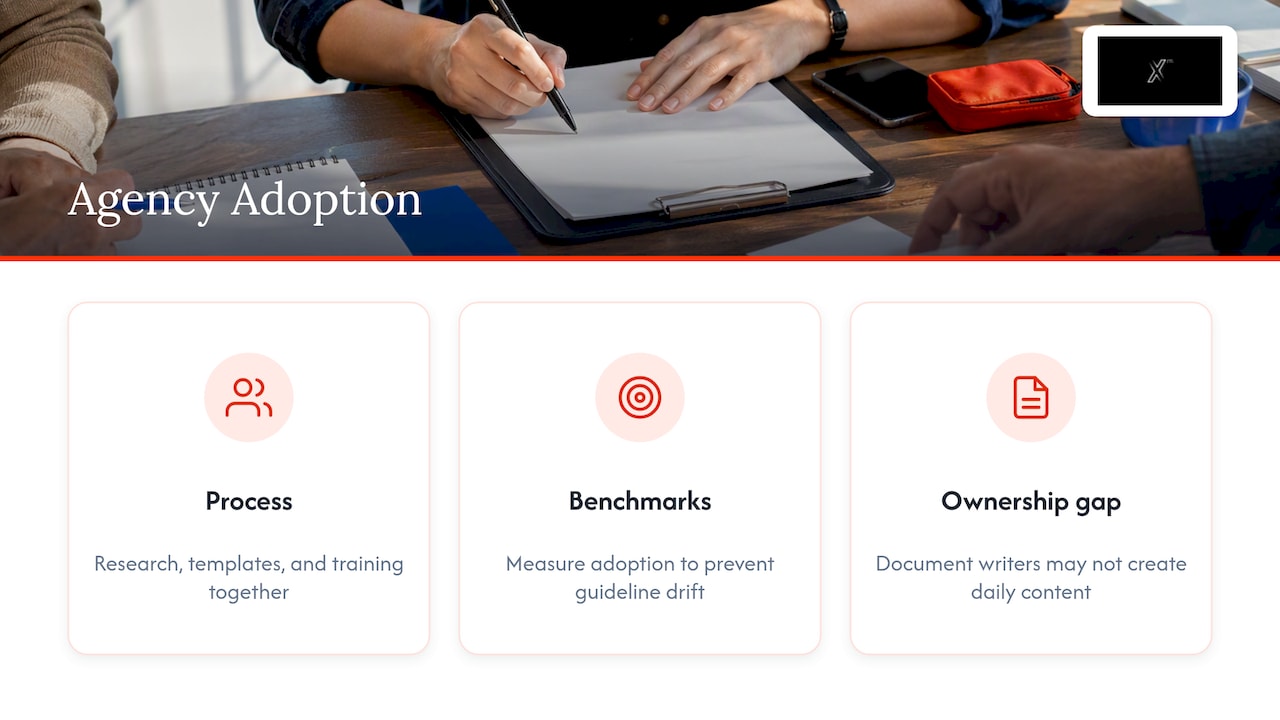
Operationalizing a voice guideline across strategy, content, and execution is where most internal teams lose momentum, since the people who write the document often aren’t the ones producing daily content. An agency brings research, templates, and training together under one process, which closes that gap faster than a document alone.
Governance and measurable adoption benchmarks matter as much as the initial draft, since a guideline nobody checks against tends to drift within a quarter.
Agency-Authored Note on Common Mistakes and One Immediate Fix
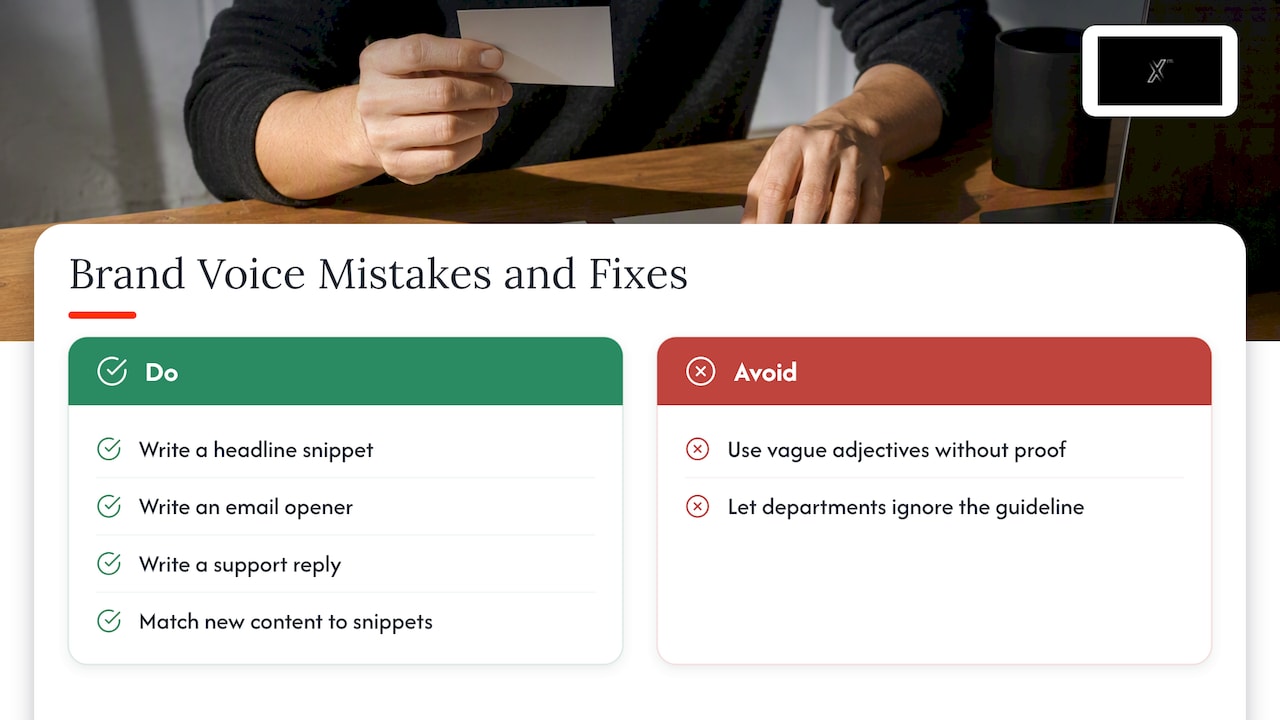
The most common brand voice mistake we see is vague adjectives with no behavioral proof: “innovative and bold” tells a writer nothing about word choice or sentence length. The second is uneven enforcement, where one department follows the guideline and another ignores it entirely because no one owns review.
The fastest fix: write three canonical snippets today, one for a headline, one for an email opener, and one for a support reply, and require every new piece of content to match their structure until a fuller guideline exists. This single step gives writers a concrete standard immediately, instead of waiting months for a complete document. Teams that need help building this out faster can lean on outside guidance for building brands that scale.
— Xpert
How Xpert Marketing Helps You Build and Roll Out a Voice That Sticks
We handle brand voice work as part of a connected process: strategy first, then the creative templates and training that make the guideline usable day one. A typical engagement starts with discovery and a content audit, moves into a documented voice guideline with the templates covered above, and closes with team training so adoption doesn’t stall after launch.

- Branding and visual identity work that defines or refreshes the voice behind your guideline.
- Ready-to-use templates and snippet libraries built for your specific channels.
- Training sessions that get your whole content team applying the rules consistently.
If you want a guideline built and rolled out rather than drafted and shelved, explore our branding and visual identity services or see the full range of strategy, branding, and content services we offer.
FAQ
What is the difference between brand voice and tone?
Voice is the stable personality a brand uses in every piece of writing, while tone is how that personality shifts for a specific situation, such as a complaint response versus a product launch. Mailchimp’s style guide treats voice as constant and tone as the variable layer on top of it.
How long should a brand voice guideline be?
There’s no fixed page count; what matters is whether it includes behavioral trait descriptions, a vocabulary list, grammar rules, and real sample snippets for your main channels. A short document with concrete examples outperforms a long one filled with abstract adjectives.
Who should own brand voice guidelines inside a company?
Ownership usually sits with a marketing or content lead who reviews new materials and approves exceptions, though input should come from sales, support, and leadership during the drafting process. A single owner keeps enforcement consistent instead of letting it drift by department.
How often should we update our brand voice guidelines?
A review every six to twelve months is a reasonable default, with updates triggered sooner if the brand repositions or expands into new channels. Treat the document as a living reference rather than something finalized once and left alone.
Can AI tools be used to write in our brand voice?
Build a review step into your governance plan rather than treating AI output as publish-ready.
Fonti
- Voice and Tone | Mailchimp Content Style Guide
- Microsoft: Brand voice — above all, simple and human
- Voice and tone | Google developer documentation style guide
- TON: Tone of Voice | BSpec


