An omnichannel marketing strategy unifies customer identity and context across every channel so a buyer’s history, preferences, and in-progress conversations carry from one touchpoint to the next. The first move is practical: map the buying journey and connect your CRM and CDP data to it, with journey analytics and executive sponsorship behind the effort from day one.
TL;DR:
- Unify CRM, CDP, and sales records before mapping research, evaluation, and decision stages; validate identity matching before trusting attribution results.
- IDC reports that 74% of B2B technology buyers prefer digital channels first, so prioritize based on buyer behavior rather than existing sales capacity.
- A 2026 study found data fusion with privacy guarantees produced 1.46% lift versus 1.66% without, while nearly 7% of users were reidentified.
- Pilot a few channels with incrementality tests before expanding budgets; add conversational or visual search only when buyer value and measurement justify the cost.
Omnichannel marketing connects customer-facing channels around one journey, so data, messaging, and context carry across website, social, email, mobile, physical locations, sales, and service rather than resetting at each stop, a definition grounded in both peer-reviewed marketing science and industry practice. Multichannel, by contrast, runs those same channels in parallel without that shared memory, which is why a customer can get a discount email the day after buying the item in a store.
The distinction shows up in outcomes, not just architecture:
Every omnichannel program rests on the same four operating principles, identified consistently across marketing science research: visibility, personalization, timing, and optimization. Before writing a single piece of content, assess where your organization stands on each.
Conseil : Audit your current channels against these four pillars before adding a new one. A fifth channel on top of weak visibility just multiplies the problem.
Building an omnichannel marketing framework works best as a sequence, not a simultaneous launch across every channel. Shopify’s practical guidance follows a similar order: start with data, map the journey, clarify messaging, build the stack, then test and optimize.
This order matters because McKinsey’s B2B research found buyers move across multiple channels within a single buying stage, not in the tidy linear path most plans assume, so sales teams increasingly act as journey orchestrators rather than channel owners.
Last-click attribution breaks down the moment a buyer touches more than one channel, which is the entire premise of omnichannel marketing. Journey-level KPIs replace it: reach, engagement, conversion, retention, customer lifetime value, and assisted influence, all tracked across the full path rather than at the final step, as recent omnichannel measurement research recommends.
A 2026 study in Marketing Science found privacy-preserving data fusion produced a 1.46% campaign lift versus 1.66% without privacy guarantees, while nearly 7% of users were reidentified in the non-private model. The gap is small enough that most teams can choose privacy-preserving methods without meaningfully sacrificing measurement quality.
A platform purchase does not make a strategy omnichannel. KPMG’s research points to the same pattern repeatedly: executive sponsorship has to integrate people, process, and technology together, because front-office silos and outdated workflows create duplicated effort even when the tools are in place.
Fragmented technology and sales-marketing misalignment are named directly in academic research on omnichannel barriers as a primary reason programs stall, right alongside data integration and privacy.
The practical stack looks consistent across most organizations: CRM as the system of record, a CDP for unified profiles, an engagement or orchestration layer, and analytics underneath to close the loop.
Privacy-preserving data fusion is a workable default rather than a compromise, given the 1.46% versus 1.66% lift difference cited above. Identity resolution, consent management, and data retention rules belong in the architecture from the start, not bolted on after a compliance review. Our Data & Analytics services cover exactly this kind of stack design if you want a second set of eyes on yours. For a deeper technical reference on building the data layer itself, a unified customer data playbook walks through audit and implementation steps in more detail.
Conseil : Validate your identity resolution match rate before you trust any attribution number that comes out of the stack. A weak match rate quietly understates every channel’s real contribution.
Omnichannel planning in 2026 has to account for AI-mediated discovery and service alongside the channels most teams already manage. The 2026 Omnichannel Index expanded its framework from 70 to 74 touchpoints, adding conversational shopping, semantic and visual search, and AI-assisted guided selling as standalone disciplines rather than features bolted onto existing channels.
Our AI search optimization guidance breaks down how to turn this shift into team-level KPIs rather than a vague mandate to “be present everywhere.”
Generic demographic segments do not hold up well in an omnichannel program, because the whole point of the strategy is to respond to what a buyer actually does across channels, not just who they are on paper. Effective segmentation for omnichannel work starts from behavioral and transactional data already inside the CRM and CDP: purchase history, channel preference, response to past campaigns, and stage in the buying journey.
For B2B specifically, IDC recommends building personas around ideal customer profiles and buying committees rather than individual titles alone, since most B2B purchases involve several people with different concerns at different stages. A procurement lead and a technical evaluator on the same deal need different content sequences even though they are buying the same thing.
Personas built this way should update as new data arrives rather than staying fixed. If a prospect who fit the “researcher” persona suddenly requests a demo, the system should recognize the shift in intent and adjust the next touchpoint instead of continuing to send top-of-funnel content. That responsiveness is what Salesforce’s omnichannel guidance points to when it describes personalization built on browsing, app usage, and purchase data working together rather than in isolation.
The practical test for any segmentation model is whether it changes what the next message says. If two segments would receive the same content anyway, the distinction is not earning its complexity.
Most omnichannel programs fail from organizational friction long before they fail from bad technology. Teams that have run channels independently for years are being asked to share data, agree on shared KPIs, and hand off customers mid-journey, which is a bigger behavioral change than most rollout plans account for.
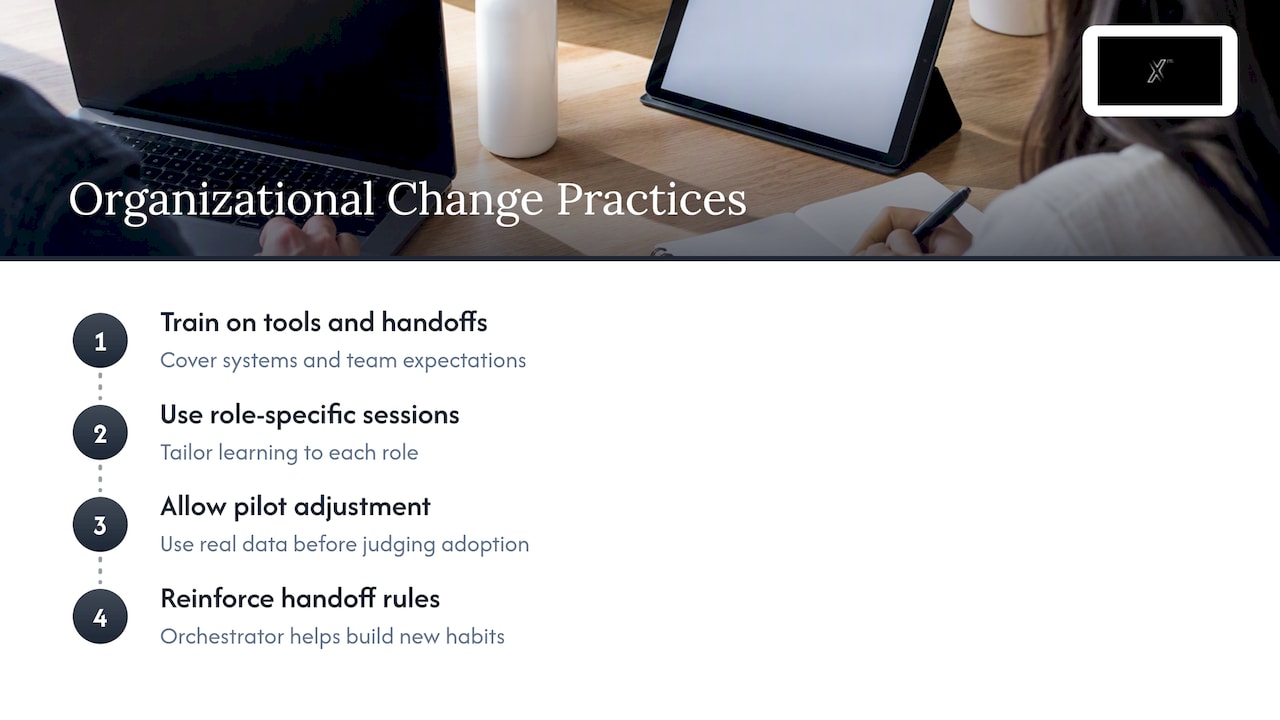
Training needs to cover two different things: the tools themselves and the new handoff expectations between teams. A sales rep who does not know that marketing already answered a prospect’s pricing question will ask it again, undoing the exact continuity the strategy is built to deliver. Short, role-specific training sessions tend to work better than one long all-hands walkthrough, because a content strategist and a sales operations manager need to learn different parts of the same system.
KPMG’s research frames the underlying issue clearly: customer experience is the sum of individual moments, and front-office silos create duplicated effort and impersonal interactions even when every team is working hard. Change management has to address that structural reality directly, not just introduce new software and hope habits follow.
Give teams a short adjustment period with real pilot data before judging adoption. A journey-orchestrator role, usually sitting between marketing operations and sales, helps enforce the new handoff rules until they become habit rather than policy.
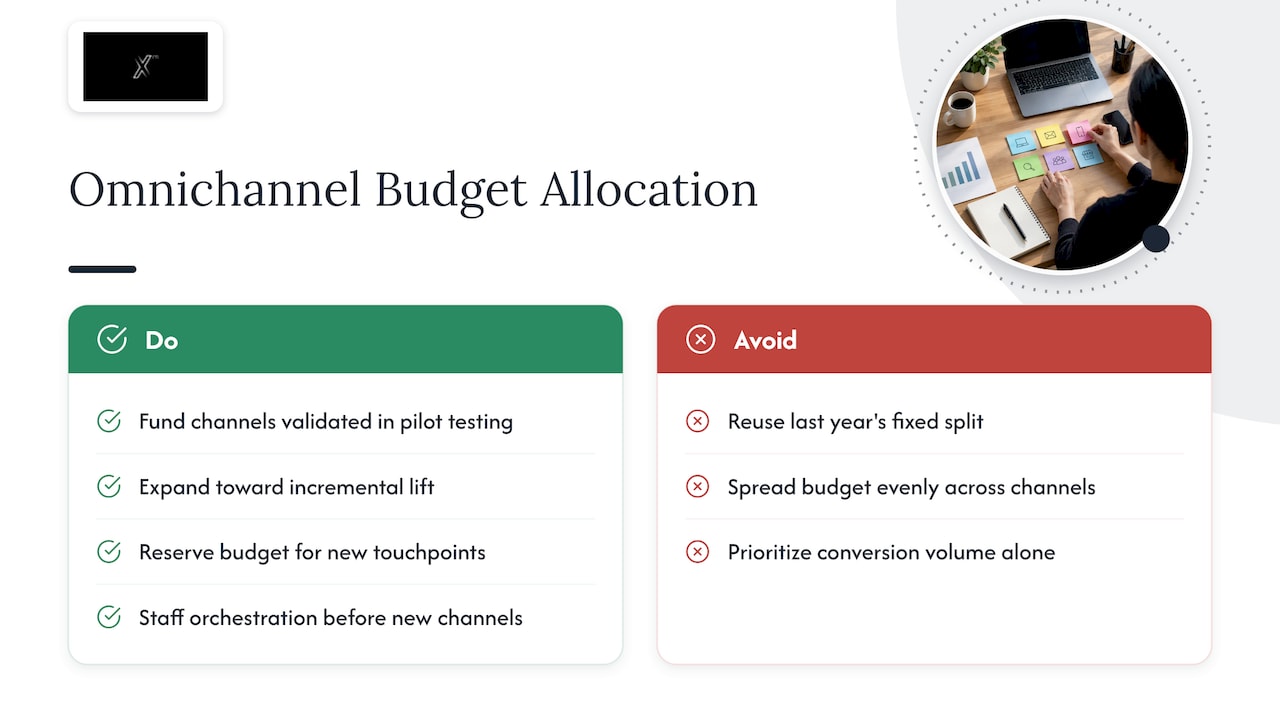
Budget decisions in an omnichannel strategy should follow the journey map, not a fixed split carried over from last year’s channel mix. A channel that drove awareness well under a multichannel model might be the wrong place to add budget once journey analytics show where buyers actually convert.
NIQ’s guidance warns specifically against blanket activation, recommending regional and market-specific data to choose which messages and channels get funded rather than spreading budget evenly across everything available. That applies to resourcing as much as media spend: a team that tries to staff every channel equally usually ends up running all of them at a mediocre level.
A practical allocation approach starts with the pilot phase. Fund the channels and touchpoints identified in your incrementality testing first, then expand budget toward whatever the experiments show is actually driving incremental lift rather than just touching the most conversions. Reserve a portion, often the hardest line item to defend internally, for testing new touchpoints like AI-mediated search before committing a full budget line to them.
Resource planning follows the same logic as budget: the journey-orchestrator role, the shared dashboard, and the cross-functional cadence all need staffing before a new channel does. An underfunded orchestration layer makes every channel’s budget less effective, since the handoffs between them are where omnichannel either works or quietly reverts to multichannel.
The organizations that get omnichannel right tend to share a pattern: they start narrow, prove incremental lift on a small set of channels, and only then expand the model. McKinsey’s B2B research found that organizations were increasingly adopting hybrid sellers, who move fluidly between digital and in-person engagement, with hybrid selling expected to become one of the most prominent B2B sales roles in the years following.
That shift illustrates the broader principle better than any single company name could: the win was not a new channel, it was the orchestration between existing ones. A buyer researching online, getting a personalized follow-up from a hybrid seller, and closing through a mix of digital and human touchpoints experienced one continuous journey instead of three disconnected processes.
The common thread across programs that work is restraint early and expansion later. Teams that try to connect every channel at once typically end up with a visibility layer too thin to support real personalization, which is why the pillars discussed earlier function better as a sequence than a checklist tackled simultaneously.
Omnichannel strategy often gets treated as a digital-only discipline, but physical touchpoints, in-store visits, trade show booths, experiential activations, carry some of the strongest context signals available if they are connected to the same CRM and CDP as everything else.
Salesforce’s guidance explicitly includes in-store purchase data alongside browsing and app usage as a core input to personalization, which only works if the point-of-sale system or event check-in feeds back into the unified profile in something close to real time. An experiential activation that captures a lead but never syncs that data to the CRM is a missed touchpoint, not a bonus one.
The practical fix is the same identity resolution work covered in the tech stack section, extended to offline capture points: badge scans, loyalty card swipes, in-store Wi-Fi sign-ins. Each one is a chance to confirm or update the same customer profile that digital channels already feed, and treating them as separate systems recreates the exact fragmentation an omnichannel strategy is meant to solve.
Most organizations building an omnichannel program benefit from a partner who can move across strategy, pilot execution, measurement, and team enablement without handing off between specialists at each stage. A first engagement usually starts with an audit of current data and channels, a roadmap built from that audit, and a pilot with clearly defined KPIs before any broader rollout. Whether to bring that work in-house or hire outside help often comes down to how fast the team needs results and how much orchestration capacity already exists internally.
— Xpert
We built our services around exactly the sequence described above: audit, roadmap, pilot, measurement, and the team training to sustain it. Our Strategy & Consulting and broader service lineup cover data unification, channel activation, and analytics.
If you want a second opinion on where your current channels stand against the four pillars, reach out through our services page to start with an audit.
An omnichannel strategy connects every customer-facing channel, website, email, social, mobile, physical locations, sales, and service, around a single customer journey, so data and context carry from one touchpoint to the next. It differs from multichannel marketing, which runs the same channels without that shared visibility.
Omnichannel frameworks are more commonly described through four pillars rather than four C’s: visibility, personalization, timing, and optimization, as identified in marketing science research. Definitions vary across sources, so treat any “4 C’s” framing as a variant of this same underlying structure rather than a separate standard.
The four pillars are visibility, personalization, timing, and optimization, identified consistently in peer-reviewed and industry research. Visibility means a unified customer profile, personalization means messaging driven by real-time signals, timing covers channel handoffs, and optimization closes the loop through measurement.
Replace last-click attribution with journey-level KPIs such as reach, engagement, conversion, retention, and assisted influence, combined with experiments and incrementality testing. Document identity resolution and consent requirements as part of the measurement plan itself, since both affect how much certainty any attribution number can claim.
Yes, our Strategy & Consulting and Digital Marketing services cover the research, journey mapping, channel selection, and measurement work an omnichannel program requires. Current prices are on our services page.