

Startup Marketing Strategy: A Practical Plan for Founders
A startup marketing strategy is a short, written set of decisions: who you sell to, what makes you worth choosing, which two or three channels you will use first, and how you will know it is working. The strongest versions are built in that order and tested in small steps, not launched all at once. If you would rather have one team own strategy, brand, content, web and media as a single connected system, Xpert Marketing works as an external marketing department for startups and growing companies.
TL;DR
- Define the audience first. Messaging, channels and budget all depend on it.
- Treat your go-to-market plan as a set of hypotheses you test, then refine after launch.
- Document a small brand foundation early: purpose, audiences, differentiators, personality and positioning.
- Pick few channels, measure brand and performance work on different timelines, and move effort toward what works.
- Strategy, creative, web and media decisions work best when one team keeps them consistent.
Indice
- Why startup marketing needs its own plan
- Step 1: Define the audience before anything else
- Step 2: Set goals you can measure
- Step 3: Build a small brand foundation
- Step 4: Write the go-to-market plan
- Step 5: Decide when to start marketing
- Step 6: Choose a few channels, not all of them
- Step 7: Set a budget and measure it the right way
- Where startups lose money
- Doing it in-house or with an agency
- How Xpert Marketing can help
- Our perspective
- FAQ
- Fonti
Why startup marketing needs its own plan
An established company markets to people who already know it. A startup markets to people who have never heard of it, with a small budget and a product that is still changing. That changes the job. You are not optimizing a machine; you are looking for the combination of audience, message and channel that works at all.
That is why the plans that rank for this topic share a skeleton. DigitalOcean’s startup guide says a basic plan should cover goals and KPIs, target audience, product-market fit and available budget. Everything below follows that skeleton and adds the decisions that usually go wrong.
Step 1: Define the audience before anything else
Most weak startup marketing starts with a channel (“we need TikTok”) instead of a person. Reverse it.
Write an ideal customer profile. Shopify’s startup guide suggests a data-driven profile that can include location, lifestyle, interests and what the customer can afford. For a B2B startup, translate that into company size, industry, the job title of the buyer, the trigger event that makes them look for a solution, and the budget they control.
Two cautions:
- Ground it in observation. Product Marketing Alliance’s go-to-market framework argues that audience definition must come before messaging and that personas should rest on observed research, not founder assumptions.
- Do not confuse market research with a handful of user interviews. Interviews show how current users think. Market research tells you how big the group is, what it will pay and who else is serving it.
For the research itself, Shopify lists social media interaction, focus groups, a third-party researcher and competitor analysis as workable routes. Our own market research guide for business owners walks through turning those findings into decisions.
A worked example
Imagine a startup selling scheduling software to dental clinics. “Small businesses” is not an audience. “Independent dental clinics with two to five dentists in the United States, where the practice manager chooses software” is. Now the message (fewer no-shows), the channels (dental association events, practice-management communities, search for specific pain points) and the budget all have something to attach to.
Step 2: Set goals you can measure
Pick one primary goal for the first quarter. DigitalOcean’s guide lists the options: awareness, sales, subscriptions, lead generation, traffic, signups, free trials, reviews and customer lifetime value. A startup that chases all of them measures none of them.
Good goals are concrete, have a timeline and a benchmark. Asana’s go-to-market guide describes SMART goals, KPIs and OKRs as ways to do this. Whichever format you choose, write the number and the date. “Book 25 qualified demos by the end of the quarter” is a goal. “Grow awareness” is a wish.
If your goals involve a sales cycle, it also helps to decide how marketing hands a lead to sales and what the buyer sees at each stage. A mutual action plan is one way to keep both sides aligned on next steps once a prospect is engaged.
Step 3: Build a small brand foundation
Founders often hear “startup brand strategy” and picture a logo. A logo is the last and least important part. Brand strategy is the set of decisions that make every message sound like it came from the same company.
High Alpha’s guidance for startups recommends documenting eight items early:
- Purpose
- Up to three stack-ranked target audiences
- Differentiators
- The benefits those differentiators create
- A personality described in no more than ten adjectives
- The category or market you sit in
- An internal positioning statement
- An informal elevator pitch
Keep it to a page or two. The point is that a new freelancer, a new hire or an agency can read it and produce work you recognize as yours.
Only after that does visual identity make sense: color, typography, imagery and the rules for using them across your website, social profiles, pitch deck and product. If you are rebranding an existing company, the same order applies. Our guide to visual identity design covers the elements and guidelines, and how a marketing agency builds brands that scale shows how strategy and identity connect.
Step 4: Write the go-to-market plan
Go-to-market (GTM) is the plan for getting a specific product in front of a specific customer and turning interest into revenue. It sits inside your marketing strategy and is the part most affected by launch timing.
Harvard Business School Online describes the go-to-market process as deciding on the customer value proposition and target audience, then considering distribution channels, product messaging and tactics, and estimated customer acquisition cost. You test hypotheses about each, combine what you learn into a strategy, and keep refining it after launch.
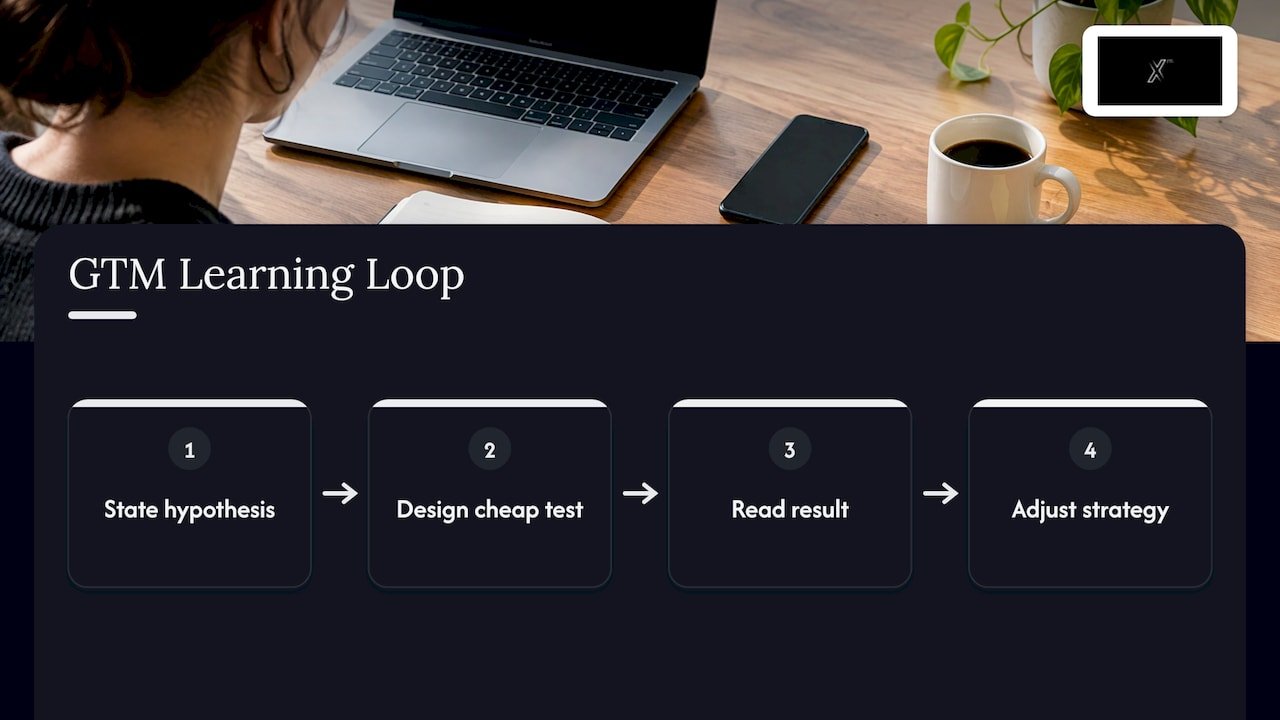
That last point matters. A GTM plan is not a document you finish; it is a learning loop. State a hypothesis (“practice managers respond to no-show cost, not features”), design a cheap test, read the result, and adjust.
The sequence to follow
Shopify’s go-to-market guide gives a nine-step order that works well as a checklist:
- Establish product-market fit
- Understand customers
- Research competition and demand
- Define the value proposition
- Set pricing
- Plan promotion
- Select channels
- Set targets
- Monitor feedback
The same guide separates sales channels (where the customer buys) from distribution channels (how the product reaches them). Startups often blur the two and then wonder why a good campaign does not convert.
Before you commit, pressure-test the story you will tell investors and buyers. If your plan leans on a market-size claim, a tool for answering investor questions about market size can help you see where that claim is weakest before someone else does.
For a deeper B2B treatment, see our go-to-market plan for startups and the product launch strategy guide.
Step 5: Decide when to start marketing
Earlier than most founders think. AltexSoft’s launch guide advises planning the launch from the start of development and starting marketing sooner when success depends on it, engaging potential customers and collecting feedback along the way.
It also helps to separate two moments. Norwest’s launch guide describes a soft launch and a hard launch: the soft launch might be a seed-funding announcement before the product is ready, while the hard launch is when the product moves from beta to general availability and acquiring customers becomes the main objective. The same discussion recommends planning a launch inside a 90-day window where possible, leaving time for messaging, a website and customer or partner quotes.
A practical reading: use the months before launch to build the audience definition, brand foundation, website and a waiting list. Use the launch window to concentrate effort, not to start from zero.

Step 6: Choose a few channels, not all of them
The ranking pages list a long menu: SEO, content, social, email, paid search, paid social, influencers, partnerships, events, PR. All of them work for someone. None of them works for everyone.
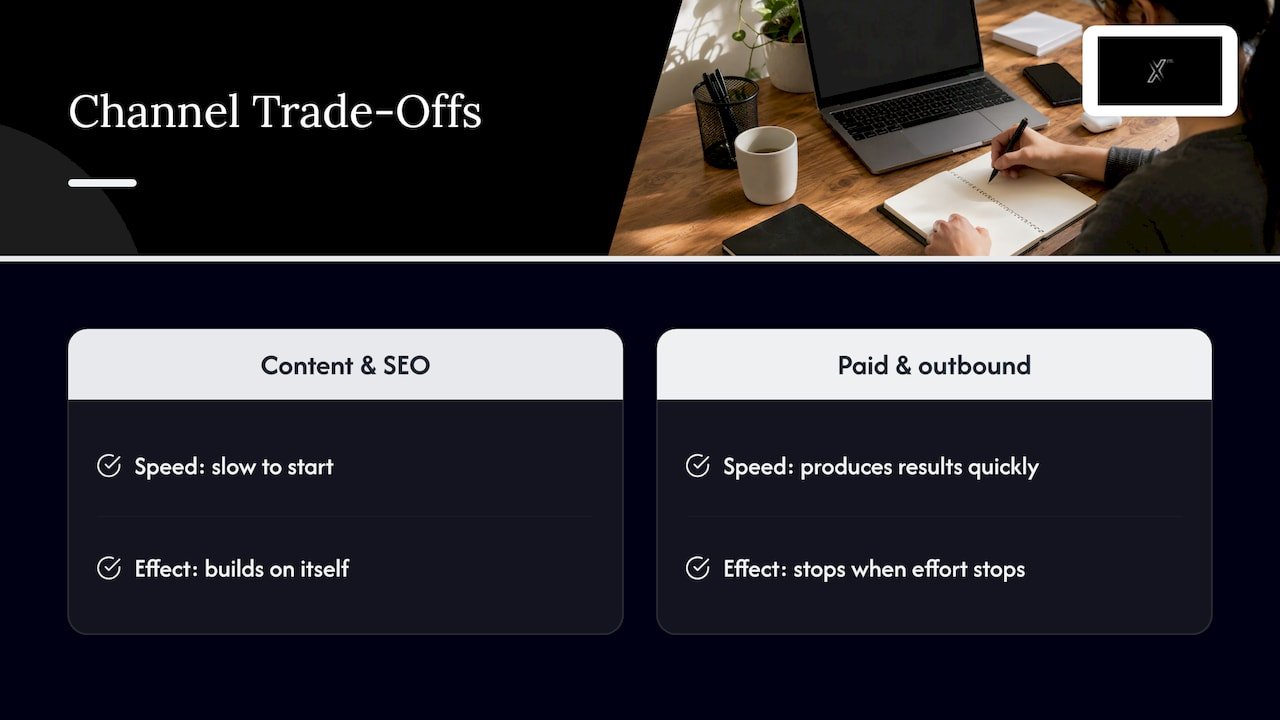
A useful way to choose is speed versus compounding. Content and SEO are slow to start but build on themselves. Paid acquisition and founder-led outbound produce results quickly but stop when you stop spending or sending. The right mix depends on your product and how your buyer buys. A startup with a short sales cycle and a clear search term can lean on search; a startup selling to enterprise buyers may start with outbound and LinkedIn and build content behind it.
HubSpot’s startup growth playbook suggests an inbound approach for teams with limited budgets: attract with SEO, blogging and social content, engage with offers and calls to action, and delight customers with helpful service. Its advice on analytics applies to any channel mix: find which channels work and shift effort toward them.
A simple channel filter
| Question | What it tells you |
|---|---|
| Does your buyer actively search for this problem? | Whether SEO and paid search are worth starting now |
| Is your buyer reachable by job title or industry? | Whether LinkedIn or targeted outbound fits |
| Does your product need explaining visually? | Whether video and demos should lead |
| Is the sales cycle long? | Whether email nurturing and content should support sales |
We cover specific channels in more depth in our guides to LinkedIn ads for B2B and video marketing.
What about the 3-3-3 rule?
People searching this topic often ask about the 3-3-3 rule. There is no single official version. One common version limits you to three core messages, three audience segments and three channels, which is a useful discipline for an early-stage team: constraint forces choices.
Step 7: Set a budget and measure it the right way
The most common measurement mistake is judging brand work and performance work with the same yardstick. First Round Review’s framework for performance versus brand marketing makes the point that they have different objectives and so need different windows and metrics.
- Brand work: measure over a longer period using organic traffic, conversion-rate lift and pipeline acceleration, alongside brand trackers, branded search impressions and video views.
- Performance ads: assess with conversions, payback window and LTV:CAC (customer lifetime value compared with the cost of acquiring the customer), and check pipeline conversion and activation.
In practice, start with a budget you can afford to lose across two or three tests. Give each test a hypothesis, a time limit and a pass mark. Then move budget toward what passes. If you are buying media, test whether the spend actually adds sales before you scale it; our media planning strategy guide explains how to test incremental lift.
Measurement only works if tracking is set up before spend begins: conversion events, a CRM that records the source of each lead, and a dashboard someone reads weekly. Our Data & Analytics service covers this layer.
Where startups lose money
- Starting with tactics. Posting daily with no defined audience produces activity, not pipeline.
- Skipping the website. Every channel sends people to the same place. If the site does not explain the offer in a few seconds, you pay for traffic that leaves.
- Inconsistent messaging. A deck, a site and a LinkedIn page that describe three different companies make buyers hesitate.
- Too many channels at once. Each needs content, testing and review. Spread thin, none gets enough to show a result.
- No feedback loop. Launch is the start of the data, not the end of the plan.
Doing it in-house or with an agency
A founder-led team can run the early work, particularly audience interviews and the first content. The strain shows when strategy, branding, content, web, paid media and analytics all need to move together. Each is a different skill, and handing them to separate vendors leaves you as the project manager.
That is the case for a single partner that connects the pieces. Our full-service agency overview and our piece on why marketing 360 is a system, not just ads and social media explain the thinking.
How Xpert Marketing can help
Xpert Marketing is a 360° agency that integrates strategy, creativity and execution. For startups that means one team can take on strategy and consulting, branding and visual identity, content production, digital marketing, media planning and buying, web and tech, analytics and training, and can act as a dedicated external marketing department when you need one. Clients such as Market Nerd and Privè have worked with us on brand presence and operational processes.
If you are planning a launch, a rebrand or a first scalable marketing system, start with our services overview and tell us your goal.
Our perspective
We see startup marketing as one connected system, not a list of tactics. Strategy decides who you serve and why you win. Brand makes that decision recognizable. Content and web carry it to the audience, media puts it in front of them, and analytics tells you what to do next.
That is why we combine strategy, creativity and execution in one agency. When these pieces sit with separate vendors, each optimizes its own slice and the message drifts. When they sit together, the research behind the audience shapes the creative, the creative shapes the landing page, and the data from the campaign feeds the next round of decisions.
Our approach starts with market research and analytics, then moves into omnichannel plans tailored to the business. Where a team wants to build its own capability, we also offer digital marketing training, so the knowledge stays with you.
Xpert
FAQ
What is the best marketing strategy for a startup?
There is no universal winner. The best strategy starts with a clearly defined audience and a single measurable goal, then uses two or three channels that fit how your buyer finds and chooses a product. Test them, keep what works and reallocate the budget.
What is the difference between a go-to-market strategy and a marketing strategy?
A marketing strategy covers how you attract and keep customers over time. A go-to-market strategy is the plan for bringing a specific product or offer to a specific audience, including value proposition, pricing, channels and targets. In a startup the two overlap heavily, and the GTM plan is usually the first part you write.
When should a startup start marketing?
Plan from the start of development. Use the pre-launch period to define your audience, document your brand foundation, build a website and gather feedback from potential customers. Concentrate the heavier push in a defined launch window, such as 90 days.
What should a startup brand strategy include?
At minimum: your purpose, up to three prioritized audiences, differentiators and the benefits they create, a short personality description, your market category, a positioning statement and an elevator pitch. Visual identity comes after these decisions.
Fonti
- How to Build a Foolproof Startup Marketing Plan (DigitalOcean)
- How to Create a Startup Marketing Strategy (Shopify)
- Nailing your GTM strategy with the 4 A’s (Product Marketing Alliance)
- Go to market GTM strategy: definition and 9-step guide (Asana)
- Why Startups Should Document Brand Strategy and Positioning (High Alpha)
- How to Develop a Go-to-Market Strategy for Your Tech Venture (Harvard Business School Online)
- Go-To-Market Strategy: Template and 9 Steps (Shopify)
- Successful Product Launch: Timing, Roles, and Checklist (AltexSoft)
- How to Launch Your Company without Breaking the Bank (Norwest)
- The Startup Growth Playbook (HubSpot for Startups)
- A Founder’s Framework for Understanding Performance vs. Brand Marketing (First Round Review)
- What Is the 3-3-3 Rule in Marketing?


