
Customer Journey Mapping: A Step-by-Step Guide
Customer journey mapping is the process of building a visual picture of every step a customer takes with your business, from first awareness to loyalty, including what they do, feel and expect at each point. Done well, it shows you where customers get stuck, where they are delighted and what to fix first. This guide walks you through the components, the stages, a practical process, the research behind it and the mistakes that turn a good map into a poster nobody uses.
TL;DR
- A customer journey map is a visual representation of a customer’s interactions with your brand, built around one persona and one goal, and it should end in a prioritized list of improvements.
- Core components: persona, stages, touchpoints, actions, emotions, pain points and opportunities.
- Build it from research. Five to eight customer interviews plus one data source you already have is a workable starting point.
- Choose the simplest framework that fits your sales cycle: five stages for short, low-risk purchases, seven for high-consideration, multichannel journeys.
- A map only pays off when it has an owner, a metric and a review rhythm.
Sommaire
- What customer journey mapping is
- What goes into a journey map
- Customer journey vs. buyer journey
- How to map a customer journey in seven steps
- Choosing a framework
- Turning the map into measurable improvements
- Common mistakes to avoid
- Our perspective
- Where we can help
- FAQ
- Sources
What customer journey mapping is
A customer journey map is a visual representation of every step a customer takes when interacting with a brand. It can be a simple timeline of touchpoints or a detailed diagram. The point is the same either way: help your team see the business from the customer’s side, understand what happens across the buying process and design better experiences.
Two ideas separate a useful map from a decorative one.
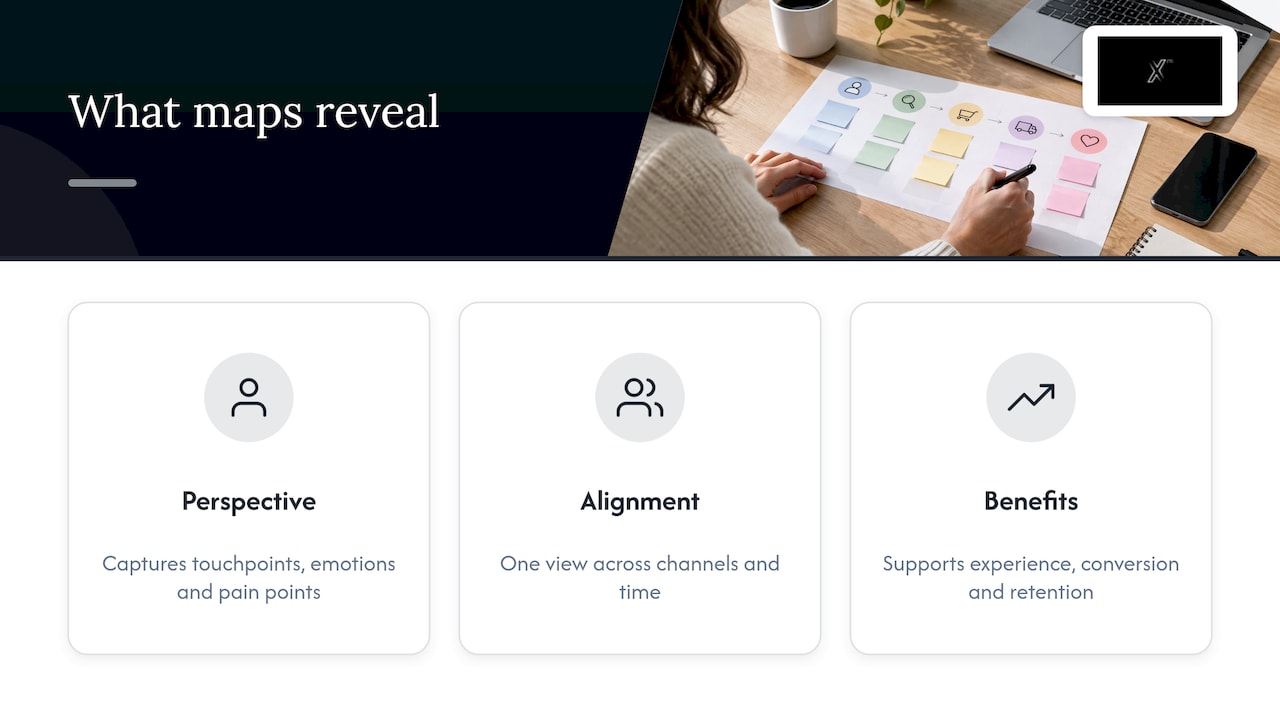
It is told from the customer’s perspective. Ideally a map captures touchpoints, emotions and potential pain points as the customer experiences them, not as your org chart sees them.
It aligns people. A map gives sales, marketing, service and product teams one holistic view of touchpoints across channels and over time. Many companies find the first workshop valuable simply because each department discovers it owns only a slice of what the customer lives through.
The benefits cited most often are better experience, higher conversion and stronger retention, because a map shows the factors that motivate or hinder a customer’s progress at each stage.
What goes into a journey map
Maps vary by industry, but the building blocks are consistent. IBM lists stages, customer personas, expectations, touchpoints, customer actions, emotions, channels and opportunities. Harvard Business School Online condenses this to four essentials: personas, journey stages, touchpoints and interactions, and emotions and pain points.
Here is how those pieces work together on a map:
| Layer | The question it answers | Example (B2B software demo request) |
|---|---|---|
| Persona | Whose journey is this? | Operations director at a 50-person company |
| Scenario | What is the person trying to achieve? | Replace a spreadsheet-based reporting process |
| Stage | Where are they in the relationship? | Consideration |
| Actions | What do they actually do? | Compare vendors, read reviews, ask a peer |
| Touchpoints and channels | Where do they meet you? | Website, search results, email, sales call |
| Emotions | How do they feel? | Uncertain about cost, worried about switching |
| Pain points | What gets in the way? | Pricing unclear, no one answers a technical question |
| Opportunities | What could we change? | Publish a clear comparison page, faster reply on forms |
Some teams add moments of truth, handoff points and ownership, and metrics. Those extras are what move a map from description to action.
Customer journey vs. buyer journey
People search both terms, and they are related but not identical. A buyer journey map covers the steps someone takes specifically as they come to a purchase decision. A customer journey map covers a broader slice of the lifecycle, including post-purchase interactions such as onboarding, support and advocacy.
The practical rule: if your challenge is winning new deals, start with the buyer journey. If your challenge is churn, repeat purchases or referrals, you need the full customer journey. Most growing businesses end up mapping both, because the experience after the sale shapes the next buyer’s research.
The usual stages
The Chartered Institute of Marketing describes five stages: awareness, consideration, purchase, retention and advocacy. Other sources use decision in place of purchase and loyalty in place of advocacy, but the logic is identical.
For longer sales cycles, some teams add stages before awareness. One seven-stage version starts with an out-of-market stage and a catalyst event that pushes a prospect to begin looking. That is useful for B2B, where a trigger such as a new leadership hire, a missed target or a failed vendor often starts the search.
How to map a customer journey in seven steps
There is no single official method. One widely used process has eight steps: scope the journey, gather research, structure it, map the layers, surface pain points and opportunities, visualize, validate and share, and maintain. The version below folds these into seven steps you can run with a small team.
1. Define the goal and scope
Pick one persona and one scenario, for example “a first-time buyer requesting a quote” or “a new customer in their first 90 days.” Write down the business outcome you want to move, such as more qualified leads or fewer cancellations. CX Dive reports that mapping goes wrong when teams do it because they feel they should, with no defined outcome behind it, and the result becomes “wall art”: documented, never acted on.
2. Gather what you already know
Collect analytics, CRM notes, support tickets, chat logs, call recordings, survey results and the knowledge of frontline staff. These are all standard inputs for a journey map.
3. Talk to customers
Interviews are the backbone of the method. In a Nielsen Norman Group survey of practitioners, 86% used interviews for external user research, while diary studies were used least, by 12%. The same research found that 62% of practitioners start with a hypothesis built from what stakeholders already know, and about 35% begin with an upfront research phase.
A workable minimum is five to eight customer interviews, one quantitative source you already have and a review of internal data, with at least three sources to triangulate findings. Ask for stories, not opinions: “Walk me through the last time you looked for a provider like us” teaches you more than “What do you think of our website?”
4. Lay out stages and touchpoints
Put the stages across the top. Under each, list what the customer does, which channels they use and which of your teams they meet. Include the steps that happen before they know you and after they pay. Skipping those is one of the most common mapping mistakes.
5. Add emotions and pain points
Plot how the customer feels at each step on a simple high-to-low line, and mark the moments of friction. Quote customers in their own words where you can. This layer is what makes a map persuasive in a leadership meeting.
6. Find the moments that matter and the opportunities
Moments of truth are the make-or-break touchpoints. Circle two or three, then list one concrete improvement for each, with an owner and a metric.
7. Validate, share and maintain
Show the draft to customers who were not interviewed and to the teams who own each touchpoint. Then schedule a review. CX Dive’s source says organizations most often fall short after the workshop ends, so effective mapping needs hypothesis testing, result measurement and updates, treating the map as a living document.
Choosing a framework
You do not need an exotic framework. Pick based on how your customers buy.
| Modèle | Best for | Watch out for |
|---|---|---|
| Five stages (awareness, consideration, decision, retention, loyalty) | Short, transactional, low-risk purchases; first-time mapping | Can hide pre-purchase research and post-purchase doubt |
| Seven stages (adds research and validation) | High-consideration, multichannel journeys | More resources, more data, longer time to impact |
This comparison follows ClearlyRated’s description of the two dominant models, including the seven-stage model’s higher complexity, data dependence and risk of over-segmentation. Forrester also publishes guidance on four distinct mapping approaches and how to select among them.
Our advice: start with five stages and one persona. Add stages only when your interviews show customers doing something the five stages cannot hold.
Turning the map into measurable improvements
A finished map is a hypothesis list. To make it pay, connect each stage to a number you already track.
- Awareness and consideration: traffic sources, conversion paths, bounce rates.
- Purchase: the share of people who start the buying process and finish it.
- Retention and advocacy: repeat purchase, response and resolution times, reviews and referrals.
Signavio notes that each phase carries its own business metrics, such as whether more customers who start a purchase complete it after journey-map improvements. For survey-based measures, NPS, CSAT and Customer Effort Score all show how the journey performs, but many teams affect each score, so avoid judging your work on one metric alone.
Interviews and analytics answer different questions. Interviews tell you why a customer is frustrated; analytics tell you how many customers share that frustration and where they drop off. Use both, and put the metrics inside the map so the numbers stay current. If you need help structuring that reporting, our guide to a working marketing analytics dashboard covers the options.
What the problems often look like
Two published cases show how maps change the question being asked.
- A telecom app review found the issue was not the interface but the service behind it: changing a tariff required four systems, two phone calls and several days, whichever channel the customer used.
- A project for a $3B North American retailer involved more than 50 internal interviews, observation of 300 customer interactions and 27 identified improvement opportunities, spanning rewards, email, online purchases, returns and in-store experience.
The lesson in both: the biggest friction frequently sits between teams or systems, which is exactly what a cross-functional map exposes.
Common mistakes to avoid
Harvard Business School Online lists the usual errors: focusing on internal processes rather than customer experience, relying on assumptions, oversimplifying, overcomplicating and treating the map as static. Practitioners add a few more:
- No persona behind the map. Without a defined customer, you are creating a process map, not a journey.
- One tidy path. Forcing different experiences into a single prescribed path hides alternative routes that could reveal new customer segments.
- Company-centric language. Stages named after your internal funnel (“MQL,” “handoff”) rarely match how customers describe their own progress.
- Mapping everything at once. One persona, one scenario, then expand.
- No owner and no cadence. Assign each improvement to a named person and review quarterly.
Our perspective
We see the same pattern with growing businesses: the journey map is rarely the hard part. The hard part is that the customer’s experience is spread across strategy, content, advertising, the website, sales follow-up and service, and each is handled separately.
That is why we treat mapping as a connected-system exercise. The map shows where messaging, channels, web experience and data need to work together, and then the same team can act on it. Our approach combines market research and analytics with creative and execution, so the findings do not stall in a slide deck.
Our advice to business owners is to start narrow. Choose the journey closest to revenue, interview real customers, and decide up front which metric should move. Then turn each pain point into a campaign, a page, an automation or a training for the team that owns that touchpoint.
Xpert
Where we can help
If you would rather not run this alone, we work as an integrated marketing partner, and can act as an external marketing department when you need one. Journey findings usually point to several workstreams at once: digital marketing, Données & analytique, web and content, or marketing automation for follow-up. For multichannel businesses, our view on B2B omnichannel strategy shows how the pieces fit together.
See everything we offer on our services page, or contact us through our site to talk through the journey you want to improve.
FAQ
What are the stages of the customer journey?
The most common five-stage version is awareness, consideration, purchase (or decision), retention and advocacy (or loyalty). Longer B2B cycles sometimes add stages before awareness, such as an out-of-market stage and a trigger event, and a validation stage after purchase. Choose the number of stages that matches how your customers actually buy.
How many customer interviews do I need?
Five to eight interviews are typically enough to surface patterns for one persona. Pair them with at least one quantitative source, such as web analytics or survey scores, so you can see how widespread each issue is. If you serve very different segments, run a separate small round for each.
What is the difference between a customer journey map and a buyer journey map?
A buyer journey map focuses on the steps leading to a purchase decision. A customer journey map is broader and includes what happens after the sale, such as onboarding, support and advocacy. Choose based on whether your problem is winning customers or keeping and growing them.
How often should I update a journey map?
Treat it as a living document rather than a one-time deliverable. Review it on a set rhythm, for example quarterly, and after any major change to your product, pricing, website or service process. Updating is easier when the map includes live metrics.
Do I need special software to build one?
No. A whiteboard or a spreadsheet with stages across the top and layers down the side is enough for a first map. Software becomes useful when several teams need to maintain the map together or you want to connect it to live data.
Sources
- What Is a Customer Journey Map? Process, Stages, and Example (Harvard Business School Online)
- What is a Customer Journey Map? (IBM)
- Customer journey mapping: A step-by-step guide (Genesys)
- What is a customer journey map? (HubSpot)
- The Fundamentals of Customer Journey Mapping (Signavio)
- Five stages of your customer buying journey (CIM)
- The Customer Journey: Stages, Mapping, and Examples (Semrush)
- The Customer Journey Mapping Process, Step by Step (Smaply)
- Customer Research Methods for Journey Mapping (Smaply)
- 10 customer journey mapping mistakes to avoid (Smaply)
- How Practitioners Create Journey Maps (Nielsen Norman Group)
- What CX leaders need to know about customer journey mapping (CX Dive)
- How to Conduct a Customer Journey Analysis (ClearlyRated)
- Mapping The Customer Journey (Forrester)
- Service Design Case Studies: 8 Real-World Examples (SI Labs)
- Customer journey mapping case study for a major retailer (COPC)
- Common Mistakes During Customer Journey Mapping (Conifer Research)
- 5 common Customer Journey Mapping mistakes (Service Design Show)


