
Integrated Marketing Campaign: How to Plan One That Works
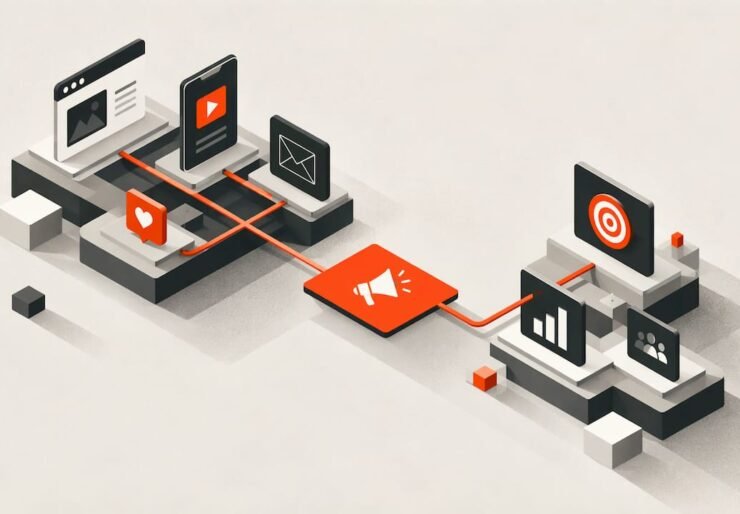
An integrated marketing campaign delivers one core message across every channel your audience uses, including email, social, paid ads, search, PR and in-person touchpoints, so each channel reinforces the others instead of competing with them. To build one, you define a single promise, assign each channel a job, sequence the launch, and measure everything against one set of goals. This guide walks through each of those steps with examples, a planning framework and the measurement approach.
TL;DR
- An integrated campaign uses a consistent message across multiple channels. The channels differ in format, but the promise stays the same.
- Start with one sentence that states the core promise. If you can’t write it, the campaign has no center yet.
- Give every channel one role, set a shared calendar, and review all headlines side by side before launch.
- Tie KPIs to the campaign’s call to action and report them in one dashboard, not channel by channel.
- Rebrands and startup launches benefit most, because the message has to land everywhere at once.
Sommaire
- What an integrated marketing campaign is
- Core components of an integrated campaign
- Examples of integrated marketing campaigns
- How to build an integrated marketing plan, step by step
- Budget and team
- How an integrated campaign supports a rebrand or a launch
- Measuring an integrated campaign
- Our perspective
- Work with an agency that covers the whole campaign
- FAQ
- Sources
What an integrated marketing campaign is
An integrated marketing campaign is a coordinated effort in which every channel and tactic carries the same core message and supports the same business objective. Salesforce describes integrated marketing as combining channels and tactics to create a unified brand message and experience so that all marketing efforts work together toward business goals.
The academic definitions say the same thing in more formal terms. OpenStax defines integrated marketing communications (IMC) as using the various forms of the promotional mix to send the same message to the target audience. Monash Business School frames it as a strategic process: you plan, develop, execute and evaluate coordinated, measurable brand communication programs to build long-term brand value.
So “integrated marketing,” “integrated marketing communications” and “integrated campaign” overlap heavily. IMC is the discipline and the philosophy. A campaign is one time-bound execution of it, with a goal, a budget, a calendar and an end date.
Why integration works
OpenStax explains the logic through clutter and noise. Any single method reaches only some customers. Using two or more raises your odds of getting through, and a consistent message across them raises effectiveness further. Fragmentation does the opposite. Northwestern’s Medill IMC program describes IMC as a top-down, data-driven, customer-centric answer to the fragmentation that siloed departments create.
A practical example: your social team posts a playful promotion, your email team sends a formal discount note, and your website still shows last quarter’s headline. Each piece may be fine alone. Together, the customer sees three brands.
The four C’s
National University offers a useful checklist for how materials should work together across channels and over time:
- Consistency: the same voice, visuals and promise everywhere.
- Coherence: the pieces connect logically.
- Complementary: each piece adds something the others don’t.
- Continuity: the message holds over the life of the campaign.
Core components of an integrated campaign
The University of West Alabama lists direct mail, paid online search, SEO, print advertising, email and social media as common components. Which ones you use depends on where your audience pays attention. A B2B software company may lean on search, email, LinkedIn and events. A local retailer may lean on print, social and in-store signage.
Beyond channels, the University of Arkansas describes an “IMC recipe” with building blocks that apply from small to massive programs:
- Target audience
- Message
- Stratégie
- Promotional mix
- Budget
- Action plan
- Measurement
If one of these is missing, the campaign tends to drift. A common version is a campaign with creative and channels but no measurement plan, so no one can say afterward what worked.
Paid, owned, earned and shared
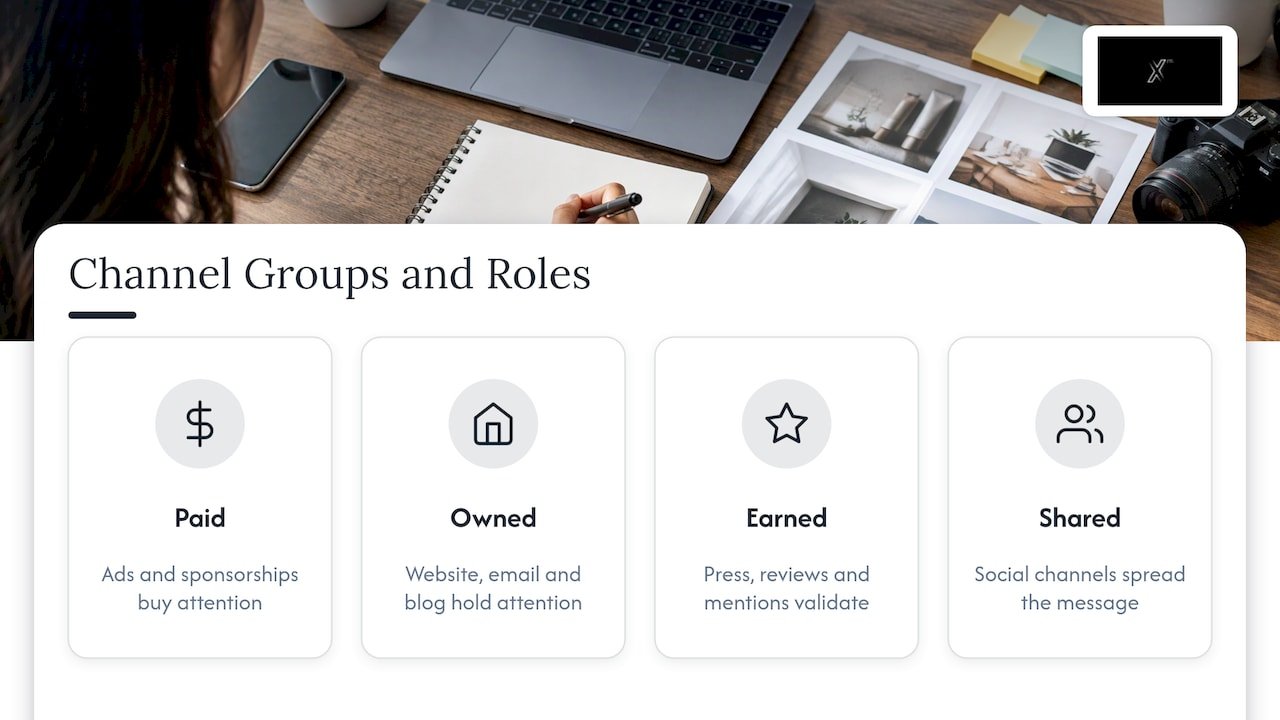
It helps to sort channels into four groups. Paid channels (ads, sponsorships) buy attention. Owned channels (your website, email list, blog) hold it. Earned channels (press, reviews, mentions) validate it. Shared channels (social) spread it. A strong campaign gives each group a specific job rather than asking every channel to do everything.
Examples of integrated marketing campaigns
Dove’s Campaign for Real Beauty
UWA cites Dove’s Campaign for Real Beauty as an IMC example. It launched in 2004 and ran for more than a decade, and the same source reports that Dove sales rose from $2.5 billion to $4 billion per year over its first 10 years. The lesson is less about any single ad and more about continuity: one idea about beauty carried through many formats for years.
Small Business Saturday
The University of Arkansas module uses Small Business Saturday as a worked example. The stated goal was to establish the day as part of the annual U.S. holiday shopping season. It reports more than 500,000 small business owners participating and a 23% increase in American Express card transactions in 2011. This is a good model for a clear goal that every tactic served.
What the examples share
Both campaigns start from a single idea that fits in a sentence. Both repeat it across formats without changing what it means. Both had a defined audience and an outcome someone could count. You can copy that structure at any budget.

How to build an integrated marketing plan, step by step
Sources differ on how many steps there are. The AMA marketing plan template uses seven, HubSpot and others use a similar sequence, and academic texts such as Larry Percy’s five-step process start with audience and positioning. The substance is consistent. Here is a version you can use.
1. Define the one true thing
Storyflow’s 2026 guide argues that an IMC plan is the layer above a channel plan, and that the single core promise must come first. If you can’t write it in one sentence, every team will invent its own. Write it, then test it on someone outside your company.
2. Set goals and know the audience
The University of West Alabama guide suggests starting from the company mission, defining the immediate response you want from the audience, and identifying KPIs tied to the call to action. Adobe recommends SMART goals and planning data capture from the beginning so you can adjust based on results.
Then define who you are talking to. Use buyer personas by channel, since the same buyer may read email at work and scroll social in the evening.
3. Fix what stays constant
Decide what does not change: voice, key phrases, visual identity and proof points. Everything else can flex by channel. This is where a clear brand system pays off. If you are mid-rebrand, see our guide to visual identity design for the elements and guidelines that keep this consistent.
4. Assign each channel one job
Map the campaign across paid, owned, earned and shared, and give each channel one role in service of the core promise. For example:
| Channel | Job | Example output |
|---|---|---|
| Website landing page | Convert interest | One clear offer matching the ad headline |
| Nurture and remind | Three-message sequence by buyer stage | |
| Paid search and social | Reach new audiences | Ads using the same promise in different hooks |
| RP | Add credibility | A story or announcement tied to the promise |
| Organic social | Spread and engage | Short clips and posts adapting the core idea |
If you are building the social side, our social media management plan article covers it in detail. For choosing where to place paid budget, see our media planning strategy guide.
5. Align channels with the customer journey
Smart Insights recommends using the same messaging at each stage of the decision process, so the experience feels seamless from first awareness to purchase. For B2B audiences with longer cycles, our overview of omnichannel marketing strategy shows how the pieces connect.
6. Build the calendar and sequence the launch
Cision recommends an integrated campaign calendar that outlines when each component rolls out, coordinating launch dates across media. For example, a TV spot airs the same day social posts go live and the website landing page is updated.
Storyflow suggests a sequence: owned assets first, paid to amplify, shared to spread, earned to follow. Assign a named owner to every channel and deadline. Our step-by-step approach pairs well with a marketing automation guide for business leaders when you are deciding which repeatable steps to automate.
7. Review for drift, then launch
Before launch, put every channel’s headline side by side. Fix any that contradict the core promise. This simple review catches most consistency problems.
Budget and team
The budget belongs in the plan before creative work starts. The AMA template recommends building a budget with expected ROI and KPIs, then organizing execution in four phases: Foundation, Launch, Optimization and Expansion. Treat the first phase as the time to settle audience, message and measurement, so spending later goes to work that fits the plan.
Team structure matters as much as budget. Name one person accountable for the whole campaign, plus a manager for each channel. The campaign owner arbitrates when two channels want different headlines. Without that person, consistency erodes quietly.
How an integrated campaign supports a rebrand or a launch
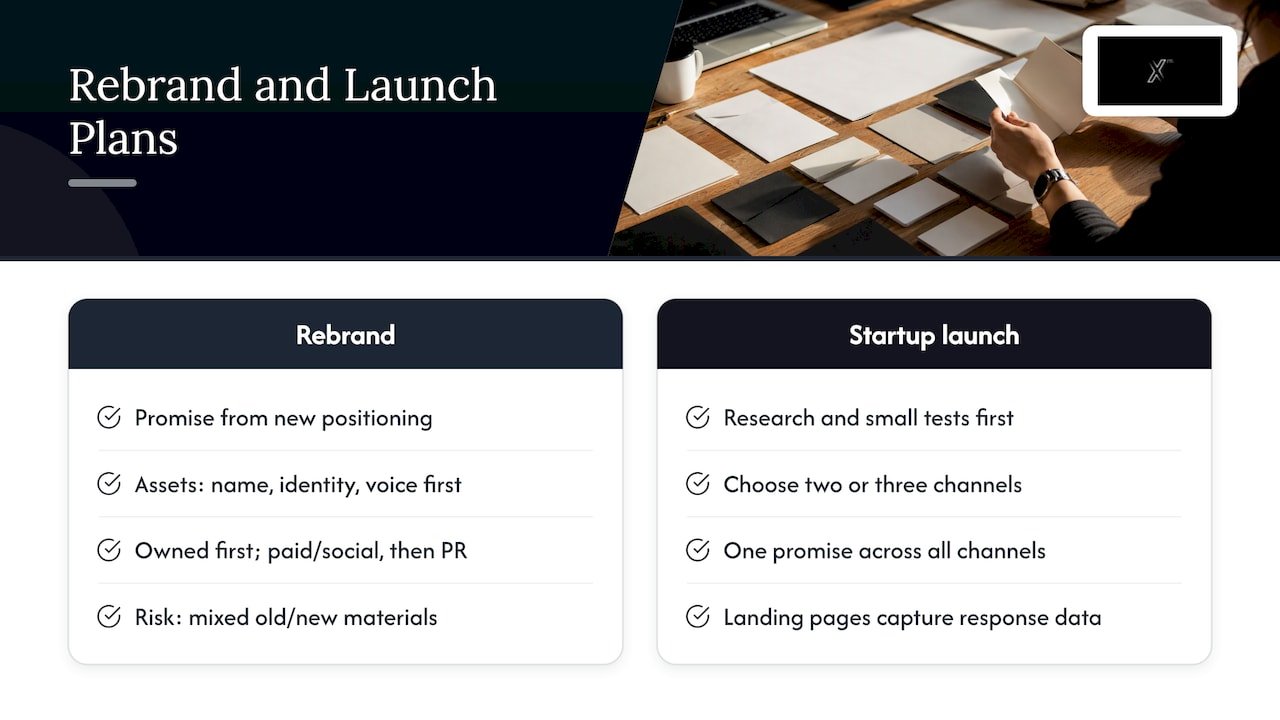
Rebrands and go-to-market launches are the situations where integration matters most, because a new identity or product has to be understood everywhere at the same moment. Here is how we would apply the steps above.
For a rebrand: the core promise comes from the new positioning. The constant elements (name, visual identity, voice) must be ready before the first public asset goes out. Owned channels such as the website and email signatures change first. Then paid and social announce the change, and PR gives it a story. Mixed old and new materials in market are the most common weakness, so build a checklist of every touchpoint.
For a startup launch: the audience is unknown, so the plan begins with research and small tests rather than full budgets. Choose two or three channels where the audience is reachable, keep the promise identical across them, and use landing pages to capture response data. Expand to more channels once you see what converts.
In both cases, the point is the same as in the rest of the plan: one promise, clear channel roles, one calendar.
Measuring an integrated campaign
Start with the call to action. UWA advises tying KPIs to it and tracking online conversions, referral traffic, social insights, cost per lead and print response rate, while also considering brand awareness and online reviews alongside ROI on individual pieces.
Two practices make measurement work across channels:
- One dashboard. Cision recommends consolidating performance data from multiple sources into a unified report so you see performance holistically, instead of five channel reports that each look good.
- Short and long horizons. The IAB and CIMM attention playbook notes that effectiveness can include immediate signals, such as attention scores, and longer-term outcomes, such as conversion rate and campaign ROI.
Medill describes a feedback loop in which response data informs the unified message shared across platforms. In practice, review results on a fixed schedule, adjust the message or the channel mix, and record what changed. For attribution, our guide to marketing attribution models explains how to choose by sales cycle rather than defaulting to last click, and our B2B marketing KPIs article covers which numbers deserve a place on the dashboard.
Our perspective
Most integrated campaigns fail in the handoffs, not in the idea. Strategy is written by one team, creative by another, media bought by a third, and the website by a fourth. By launch, each piece is competent and the whole is incoherent.
That is why we work as a connected system rather than a list of services. Strategy, creative and execution sit in one agency, so the core promise is set once and carried into content, media, web and analytics. When a business needs it, we operate as its external marketing department.
Our approach starts with market research and analytics, then builds an omnichannel plan around the audience, not around the channels we happen to like. Measurement is designed in from the first week, so the data from one channel shapes the next decision. We also offer training, so your own team can run the plan after launch.
If you want to see how that works beyond ads and social posts, read our view on marketing as a system.
Xpert
Work with an agency that covers the whole campaign
An integrated campaign needs strategy, creative, media, web and analytics to move together. We offer all of these at Xpert Marketing, from branding and content production to digital marketing, media planning and buying, and data and analytics.
If you are planning a rebrand, a launch or a campaign that needs to work across channels, look at our full list of services or see our digital marketing offer. You can also review our portfolio to see the kind of work we do.
FAQ
What is the difference between integrated marketing and integrated marketing communications?
The terms are used almost interchangeably. Integrated marketing communications focuses on aligning messages across the promotional mix, such as advertising, PR, social and direct marketing. Integrated marketing is sometimes used more broadly, to include product, pricing and distribution decisions. A campaign is one specific, time-bound application of either.
How many channels do I need?
There is no fixed number. One method reaches only some customers and two or more improve your chances, according to OpenStax. Pick the channels your audience actually uses, and give each a clear job. IAB Europe’s omnichannel guide cites a rule of thumb of about 4 to 5 touch points during the buying process to influence a purchase.
How do I keep the message consistent across teams?
Write the core promise in one sentence and fix the constants: voice, key phrases, visual identity and proof points. Share a campaign calendar and assign one owner per channel. Before launch, compare every headline side by side and correct any that contradict the promise.
How do I know if the campaign worked?
Choose KPIs linked to the campaign’s call to action before launch, such as conversions, cost per lead or referral traffic. Report them in one dashboard so you can compare channels fairly, and pair short-term signals with longer-term brand and ROI indicators.
Sources
- Salesforce: What is Integrated Marketing?
- OpenStax: Integrated Marketing Communications
- Monash Business School: Integrated Marketing Communication
- Northwestern Medill: Integrated Marketing Communications Explained
- National University: What Is Integrated Marketing Communications?
- UWA: Build, Execute, and Measure an Integrated Marketing Campaign
- UWA: Integrated marketing campaign guide (PDF)
- University of Arkansas: Integrated Marketing Communication strategy
- AMA Marketing Plan Template
- Adobe: Integrated Marketing
- Storyflow: What Is Integrated Marketing Communications?
- Smart Insights: What is Integrated Marketing?
- Cision: Integrated Marketing Campaigns
- CIMM and IAB: Attention Measurement Playbook
- IAB Europe: Omnichannel Guide
- Marketing Automation for Business Leaders: 2026 Guide


